Atlas Core is the fully managed cloud database and associated database, built on the architecture where compute and storage run on the same node. It is available across Free clusters, Flex clusters, and dedicated cluster tiers.
To learn about different database editions and how they compare, see Database Editions. For a side-by-side view, see the edition comparison diagram.
Existing Atlas cluster documentation describes Atlas Core by default. This page is the starting point for Atlas Core and helps you identify which edition existing content applies to.
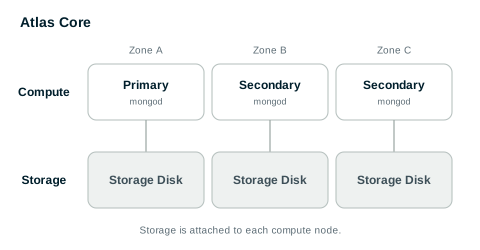
In this example layout, an Atlas Core cluster runs a primary and two secondary nodes, and each node has its own attached storage
Architecture
Atlas Core clusters provision compute and storage in a coupled fashion. Each data-bearing node runs on a virtual machine with attached storage.
Architectural Characteristics
The following characteristics describe how Atlas Core provisions and scales resources:
Compute scales by cluster tier: You change a node's compute capacity by selecting a different cluster tier. Compute capacity and storage capacity are coupled on the same node, so Atlas restarts the cluster's nodes when you change the tier. On dedicated clusters, Atlas performs a rolling restart with no expected downtime.
Atlas provisions storage per cluster: Atlas provisions storage capacity for the cluster, and your application can use that capacity at any time.
Storage limits depend on the cluster tier: You scale a node's storage capacity and IOPS independently of its compute capacity on dedicated clusters, up to the maximum storage capacity for the cluster tier. To add storage capacity beyond that maximum, you scale the cluster to a higher tier.
Node recovery requires an initial sync: When Atlas replaces a node, the new node performs an initial sync to copy your application's data from the other nodes before it serves queries.
Large workloads may require sharding: When your application's data approaches the compute or storage capacity of a single shard, you shard the cluster to scale horizontally.
Analytics, search, and AI workloads run on separate systems: Each workload type runs on its own system with its own copy of the data.
To learn more about security, elasticity, sizing, backup, performance, and metrics on Atlas Core, see:
About This Documentation
Most Atlas documentation applies to both Atlas Core and Atlas Infinite, because the Atlas interface, drivers, APIs, and most operational workflows are the same across editions. Documentation describes which editions each page or section applies to, as follows:
Applies to both editions: Unless a page says otherwise, its content applies to both Atlas Core and Atlas Infinite.
Applies to one edition only: When content applies to a single edition, the page identifies that edition in its title or text.
Not supported on Atlas Infinite: When a feature isn't available on Atlas Infinite during public preview, the page includes a note and links to the supported features.
Behaves differently on Atlas Infinite: When a workflow or option differs between editions, the page or section calls out the difference in place.