Retrieval-augmented generation (RAG) is an architecture used to augment large language models (LLMs) with additional data so that they can generate more accurate responses. You can implement RAG in your generative AI applications by combining an LLM with a retrieval system powered by MongoDB Vector Search.
开始体验
To quickly try RAG with MongoDB Vector Search, use the Chatbot Demo Builder in the MongoDB Search Playground. To learn more, see Chatbot Demo Builder in Search Playground.
To implement your own RAG system with MongoDB Vector Search, see the tutorial on this page.
为何使用 RAG?
在使用 LLM 时,您可能会遇到以下限制:
过时数据:LLM 是在特定时间点之前的静态数据集上训练的。这意味着他们的知识库有限,并且可能会使用过时的数据。
无权访问其他数据:LLM 无权访问本地、个性化或特定领域的数据。因此,他们可能缺乏有关特定领域的知识。
幻觉:当基于不完整或过时的数据时,LLM 可能会生成不准确的响应。
You can address these limitations by taking the following steps to implement RAG:
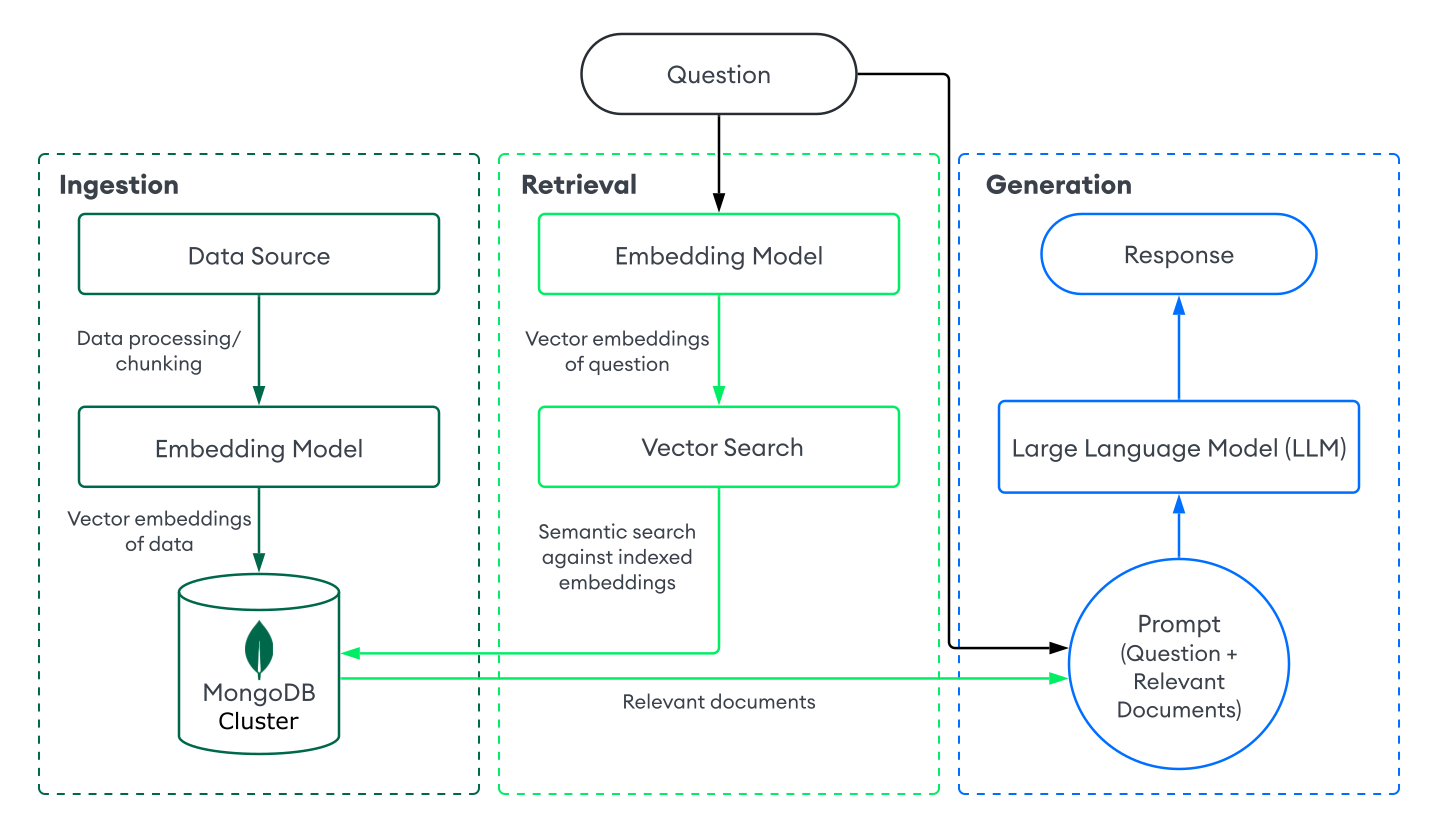
摄取:将自定义数据作为vector embeddings存储在矢量数据库(例如MongoDB)中。这样,您就可以创建最新的个性化数据知识库。
检索:使用搜索解决方案(例如MongoDB Vector Search)根据用户的问题从数据库中检索语义相似的文档。这些文档通过额外的相关数据丰富了法学硕士课程。
生成:提示 LLM。LLM 使用检索到的文档作为上下文来生成更准确和更相关的响应,从而减少幻觉。
RAG 是一种构建 AI 聊天机器人的有效架构,因为它使 AI 系统能够提供个性化、领域特定的响应。要创建可用于生产的聊天机器人,请配置服务器来路由请求并在 RAG 实现的基础上构建用户界面。
带有MongoDB Vector Search 的 RAG
To implement RAG with MongoDB Vector Search, you ingest data into MongoDB, retrieve documents with MongoDB Vector Search, and generate responses using an LLM. This section describes the components of a basic, or naive, RAG implementation with MongoDB Vector Search. For step-by-step instructions, see Tutorial.
接收
RAG 的数据摄取涉及处理自定义数据并将其存储在向量数据库中以准备检索。要使用MongoDB作为向量数据库创建基本摄取管道,请执行以下操作:
Retrieval
构建检索系统涉及从向量数据库中搜索并返回最相关的文档,以增强法学硕士学位。 要使用MongoDB Vector Search检索相关文档,您可以将用户的问题转换为向量嵌入,并对MongoDB集合中的数据运行向量搜索查询,以查找嵌入最相似的文档。
要使用MongoDB Vector Search 执行基本检索,请执行以下操作:
在包含向量嵌入的集合上定义MongoDB Vector Search索引。
根据用户的问题选择以下方法之一来检索文档:
Use an MongoDB Vector Search integration with a popular framework or service. These integrations include built-in libraries and tools that enable you to easily build retrieval systems with MongoDB Vector Search.
构建自己的检索系统。您可以定义自己的函数和管道来运行特定于您使用案例的MongoDB Vector Search 查询。
To learn how to build a basic retrieval system with MongoDB Vector Search, see Tutorial.
生成
要生成响应,请将您的检索系统与 LLM 相结合。在执行向量搜索以检索相关文档后,可以将用户的问题和相关文档作为上下文提供给 LLM,这样它就可以生成更准确的答案。
选择以下方法之一连接到 LLM:
Use an MongoDB Vector Search integration with a popular framework or service. These integrations include built-in libraries and tools to help you connect to LLMs with minimal set-up.
调用 LLM 的 API。大多数 AI 提供商为其生成模型提供 API,您可以使用这些 API 来生成响应。
加载开源 LLM。如果您没有API密钥或信用额度,您可以通过从应用程序本地加载开源 LLM 来使用。有关实施示例,请参阅使用MongoDB Vector Search 构建本地 RAG 实现教程。
Tutorial
The following example demonstrates how to implement RAG with a retrieval system powered by MongoDB Vector Search. Select your preferred embedding model, LLM, and programming language to get started:
后续步骤
有关其他 RAG 教程,请参阅以下资源:
To learn how to implement RAG with popular LLM frameworks and AI services, see MongoDB AI Integrations and Partners.
要学习;了解如何使用本地Atlas部署和本地模型实现RAG,请参阅使用MongoDB Vector Search 构建本地 RAG 实施。
For use-case based tutorials and interactive Python notebooks, see Docs Notebooks Repository and Generative AI Use Cases Repository.
要构建AI助手并实现代理 RAG,请参阅使用MongoDB构建AI助手。
Improve Your Results
要优化 RAG 应用进程,请确保使用强大的嵌入模型(如 Voyage AI)来生成高质量的矢量嵌入。
Additionally, MongoDB Vector Search supports advanced retrieval systems. You can seamlessly index vector data along with your other data in your cluster. This allows you to improve your results by pre-filtering on other fields in your collection or performing hybrid search that combine semantic search with full-text search results.
数据块策略
数据块在生成嵌入之前将大型文档分解为较小的片段。正确的分块策略可以显着提高 RAG 应用程序的检索质量。
数据块策略由以下关键部分组成:
拆分技术:确定放置数据块边界的位置,例如段落边界、特定于编程语言的分隔符、词元或语义边界。
数据块大小:每个数据块的最大字符数或词元数。
数据块重叠:相邻数据块之间重叠字符或词元的数量。重叠有助于跨数据块边界保留上下文。
常见的数据块划分策略包括:
策略 | 最适合 |
|---|---|
固定令牌 | 具有统一内容结构的简单用例。 |
修复存在重叠的词元 | 上下文跨越数据数据块边界的通用分块。 |
递归 | 要保留段落和句子边界的文本文档。 |
特定于语言的递归 | 带有编程语言片段的代码或技术文档。 |
semantic | 没有明确结构边界的文档,例如论文或叙述性内容。 |
要试验数据块策略,请使用MongoDB Search Playground 中的聊天机器人演示生成器,它允许您尝试递归数据块和具有重叠的固定词元数据块。
有关使用 Ragas框架评估不同分块策略的实践教程,请参阅 GenAI-Showcase存储库中的分块策略笔记本。
您还可以使用以下资源: