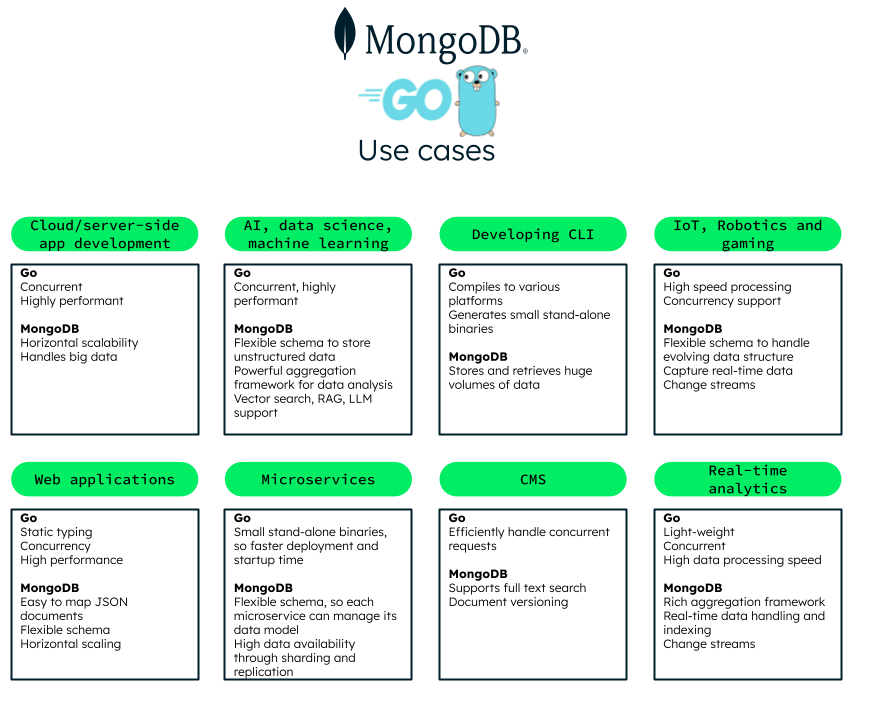
Using Go and MongoDB with other technologies
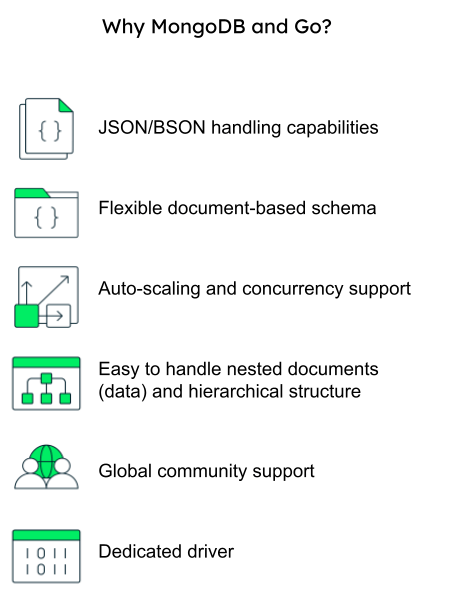
The official MongoDB Go driver allows you to integrate MongoDB into any application and tap into the impressive Go ecosystem.
Server development
For server development, there are full-featured web frameworks like Revel and Gin, as well as more lightweight tools like Web.go. There are even simpler modular approaches like the Gorilla web toolkit. These frameworks provide straightforward tools for cloud-based and server-side applications, and Go’s concurrent nature proves to be an ideal choice for high-performance server applications. You can also have very advanced implementations just using the standard library. The MongoDB database provides horizontal scalability, thus making it easier to build and maintain server applications, and handling large volumes of data.
Machine learning, artificial intelligence, and data science
For data science use cases, you can use tools like Gopher Data, Gopher Notes, and Gota or qframe. For machine learning use cases, GoLearn is a possibility.
Go’s highly performant nature is ideal for data-intensive tasks and large-scale data processing. The MongoDB database stores unstructured and semi-structured data easily due to its flexible dynamic schema. MongoDB also provides the aggregation framework which can easily handle complex scenarios through rich querying capabilities. Additionally, MongoDB offers features like vector search and supports full integration with large language model (LLM) and retrieval-augmented generation (RAG) tools.
Developing command line interface (CLI)
Go compiles to various operating systems easily and generates small, stand-alone (self-contained) binaries. The MongoDB database is the perfect back end for storage and retrieval of huge amounts of logs, configuration data, and other data required by the tool.
IoT, robotics, and gaming
IoT, robotics, and gaming systems require high-speed data processing as well as multitasking support. Both of these are supported by Go through its concurrent and highly performant nature. MongoDB’s flexible schema makes it extremely suitable to handle evolving data structures and high volumes of real-time data, like time-series data.
Microservices
Go provides fast deployment and startup time due to its small and self-contained binary size, thus making it an ideal choice for microservices. Go's ecosystem includes relevant tools such as protobuffers for faster and safer communication, loggers, identity provider clients, and other middleware to streamline development. Also, as MongoDB databases provide a flexible schema, each microservice can manage its own data model and easily store complex data structures in a collection instance.
Content management systems (CMS)
Content management applications require high speed concurrent request processing, which is one of the main selling points of Go. MongoDB complements this by providing a host of features like full-text search, content document versioning, and flexible data format, amongst others.
Real-time analytics
Go’s high performance and concurrency support along with MongoDB’s rich aggregation framework, real-time data handling, and indexing capabilities prove to be highly useful for data ingestion, processing, analysis, and transformation.