AnnouncementSome features mentioned below are deprecated as of Sep. 30, 2025. Learn more.

Implementing an Operational Data Layer

Modernization without disruption

An Operational Data Layer (ODL)—also known as an operational data store—is a smart architectural approach that brings together data from multiple sources into a single, consistent view. It helps eliminate the mess of disparate data sources and legacy systems, making real-time operational data more accessible across your operational systems. With everything connected through a centralized repository, teams can avoid data silos and easily support both day-to-day operations and analytical reporting without slowing things down. By separating backend systems from what users actually interact with, an ODL simplifies integration, speeds up development, and helps ensure strong data governance.

What makes it even more powerful is the foundation it runs on. MongoDB’s flexible document model makes it easy to handle structured, semi-structured, and unstructured data all in one place. Whether you’re managing customer data, transactional data, or incoming raw data, MongoDB scales to support everything from inventory management systems to online transaction processing. It also helps you analyze data in real time, catch suspicious transactions, track sales trends, and tailor customer interactions—all while keeping your operational workloads running smoothly. With an ODL in place, it’s easier to modernize your systems, unlock valuable insights, and stay ahead of the curve, without having to overhaul everything at once.

Read more about the Operational Data Layer >

Why Implement an ODL?

Implementing an Operational Data Layer (ODL) is essential to overcome data fragmentation from disparate data sources that hinder access to real-time operational data. By serving as a centralized repository, an operational data store makes it possible to collect data from multiple systems, including transactional databases, inventory management systems, and other operational systems, ensuring data consistency, high-quality data, and data accuracy.

This unified layer enables organizations to combine customer data, transactional data, and historical data, supporting both operational workloads and analytical reporting. With improved access to the data in consistent data formats, businesses gain real-time visibility, actionable insights, and in-depth analysis that fuel operational decision making, tactical execution, and business intelligence. By integrating with operational databases, data warehouses, and data lakes, and aligning with a resilient data architecture and data governance framework, the ODL helps streamline operations, optimize supply chain management, detect suspicious transactions, track sales, and enhance customer interactions. This ultimately drives personalized interactions, refined pricing strategies, an enhanced customer experience, and a lasting competitive edge.

Next-Gen AI Applications

AI applications and models depend on real-time, clean, and context-rich operational data often scattered across systems. An ODL unifies real-time, contextual data with native vector search to power accurate RAG, smart apps, and low-latency AI agents.

Customer 360 and Single View

Achieving a holistic view and real-time personalization is challenging due to data silos, disparate data sources, and incomplete records. An operational data store is a real-time canonical source, consolidating identities with high consistency across systems.

Data-as-a-Service (DaaS)

Data tightly bound to apps causes slow, non-reusable access. An ODL centralizes and harmonizes data, exposing it via robust APIs and event streams, transforming data into a discoverable, versioned, on-demand service with real-time freshness, trust, and compliance.

Data Governance and Sovereignty

Fragmented data across silos and inconsistent governance and sovereignty controls expose organizations to increased risk, regulatory pressure, and barriers to secure collaboration. An ODL centralizes policy enforcement—delivering secure, auditable, and regulation-aligned data access without slowing innovation.

Real-Time Data APIs

Backend systems are not designed to expose real-time, reliable, and composable APIs over operational data. An ODL provides a decoupled API layer with stable, scalable access to operational data for apps and partners.

Why MongoDB for an Operational Data Layer?


general_features_flexibility

Flexible data model

Adapts to evolving schemas, enabling agile development. Maps data directly to code objects for intuitive modeling.

general_features_scale_bigger

Scalability and performance

Effortlessly scales to handle high transaction volumes and growing data, ensuring unmatched speed and responsiveness.

industry_ai

AI-ready capabilities

Natively supports vector search and embeddings for powering next-gen AI, RAG, and agentic AI applications with accurate context.

mdb_workload_isolation

Workload Isolation

Separates analytical and transactional workloads within the same infrastructure to prevent interference and optimize performance.

atlas_stream_processing

Real-time data ingestion

Enables immediate data access and event-driven architectures by capturing real-time changes for responsive applications.

general_security_default

Data governance and security

Offers robust controls, encryption, and policy enforcement to secure data, ensure compliance, and build trust in the ODL.

atlas_deployment_flexibility

Deployment flexibility

Deploy MongoDB across any cloud, multi-cloud, on-premises, or at the edge for unmatched flexibility and no lock-in.

cloud_global

Multi-region data control

Supports region-aware routing and geo-sharding for global applications, ensuring data residency and optimal performance worldwide.

atlas_integration

Integrations and partner ecosystem

Seamlessly integrates with 100+ technologies, connecting ERP, IoT, and mobile apps. Powers real-time data flow for unified enterprise solutions.

How to Implement an ODL

Explore our Architecture Center for an in-depth analysis of the Operational Data Layer (ODL) where you will learn:

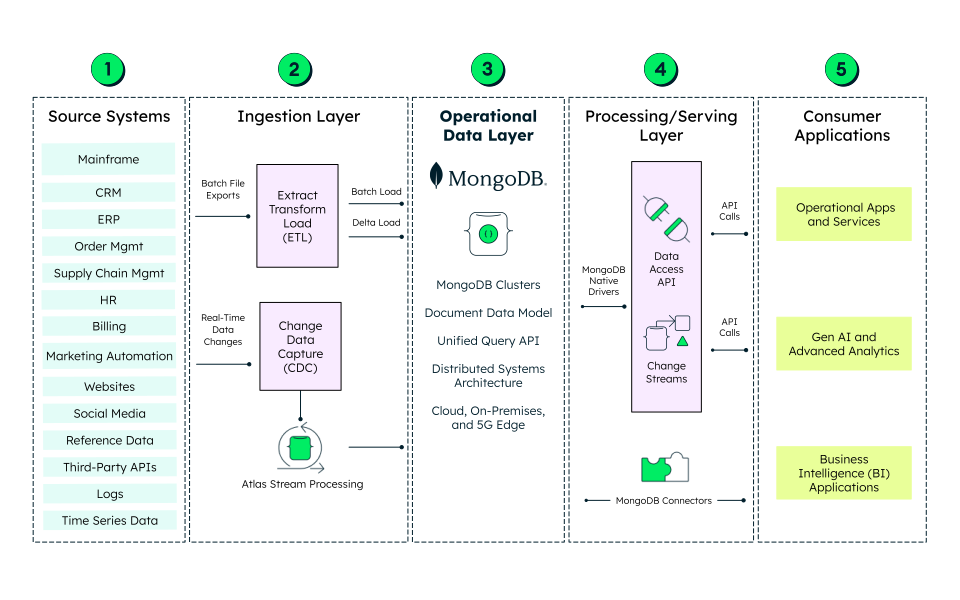
  • Core concepts: Understand how the ODL, with MongoDB as its core foundation, consolidates siloed enterprise data into a unified, real-time data store.
  • Architectural patterns: Learn about different levels of ODL implementation—from read-only to enriched and read-write—and how they address diverse needs. Discover essential patterns like event-driven and microservices architectures, workload isolation for OLTP and OLAP, and how MongoDB unifies fragmented systems.
  • Data ingestion and modeling: Master methods for ingesting real-time data and historical data from disparate data sources, including batch ingestion, real-time streaming, and change data capture (CDC), along with optimal schema design patterns for high-quality data.
  • Access layer design: Understand how to build a secure, high-performance access layer for operational and analytical reporting, ensuring real-time data availability with strict data governance.
  • Industry-specific solutions: See how the ODL drives innovation across diverse business domains, such as financial services (e.g., payments modernization, fraud detection), retail (e.g., unified commerce, pricing strategies, inventory management systems), telco, manufacturing (e.g., unified namespace), and healthcare (e.g., real-time patient 360 view).


Learn more >

Architecture Center for an in-depth analysis of the Operational Data Layer (ODL)

TRUSTED BY
Forbes logo
Nationwide Building Society logo

ODL Across Industries

Financial Services

Agentic AI-Powered Investment Portfolio Management

Discover how MongoDB powers AI agents with Vector Search, Time Series collections, the Aggregation Pipeline, and Charts for portfolio management, risk assessment, and real-time insights.

View solution

Open Finance Data Store With MongoDB

Learn how MongoDB powers open finance with flexible data integration, built-in security, and scalability.

View solution

Manufacturing and Motion

Unified Namespace Data Integrity

Discover how MongoDB helps manufacturers unify production data, streamline operations, and gain real-time insights with a unified namespace.

View solution

Healthcare

AI-Powered Healthcare With MongoDB and Microsoft

Learn how AI is transforming breast cancer diagnosis and care, making it more personalized and data-driven.

View solution
BANKING
“MongoDB handles more than 20 terabytes of data per day and supports over 80 microservices. We’re currently using the ODS to run our rewards and loyalty programs.”
Nadeem Kayani
EVP/CIO of Consumer Lending, Wells Fargo
Read customer story
BANKING
“MongoDB handles more than 20 terabytes of data per day and supports over 80 microservices. We’re currently using the ODS to run our rewards and loyalty programs.”
Nadeem Kayani
EVP/CIO of Consumer Lending, Wells Fargo
Read customer story
INSURANCE
“We found that MongoDB Atlas had a great way of structuring data that was so simple and easy to use for our developers. It has taken a great deal of the complexity out of managing data.”
Rob Jackson
Head of Application Architecture, Nationwide
Read customer story
TECHNOLOGY
“AI is going to be integrated into pretty much everything. It’s not a matter of what product will have AI, it is what product will not have AI in the future.”
Omar Santos
Distinguished Engineer, Cisco
Read customer story
MANUFACTURING
"The use cases of big data are limitless, and MongoDB makes every single one of those possible."
Steffen Gürtler
Senior Expert of IoT Data Management, Bosch Digital
Read customer story
HEALTHCARE
"MongoDB Atlas is a game-changer. This technology stack is helping us streamline commercialization and bring market-ready solutions to deliver advanced healthcare. Some of the recent tests resulted in an *83% decrease in retrieval time for critical data elements."
Emir Biser
Senior Data Architect, GE HealthCare
Read customer story

Get Started with MongoDB Atlas

Try Free