Unify EV charging data and operations with MongoDB to build scalable, responsive charging experiences and adapt quickly as your infrastructure grows.
Use cases: Internet of Things
Industries: Manufacturing & Mobility
Products and tools: MongoDB Atlas, MongoDB Search, MongoDB Time Series
Partners: Vercel, Apollo GraphQL
Solution Overview
Whether you are an automotive OEM, an energy or utility provider, or a mobility tech startup, connected electric vehicle (EV) charging requires bringing together data that changes at different speeds and powers different parts of the charging experience.
This data includes:
Station locations and connector capabilities.
Station availability and active sessions.
Pricing.
Operational events.
As charging networks grow, keeping this data consistent and accessible across driver-facing and operational experiences becomes increasingly important for delivering reliable services and making informed decisions.
This solution demonstrates how a unified operational data layer can bring these workloads together in MongoDB. A shared data foundation supports real-time charging experiences and provides operators with a consistent view of station and session activity.
Within a single application architecture, the solution manages:
Station discovery and availability.
Charging reservations and active sessions.
Operational events and telemetry.
The approach uses the MongoDB document model to organize data around application access patterns, while geospatial queries support location-aware discovery, conditional updates help maintain accurate availability, and change streams connect operational state changes with downstream processing. Consolidating operational data into one flexible platform allows your team to build connected charging applications that adapt as networks, data requirements, and operational needs grow.
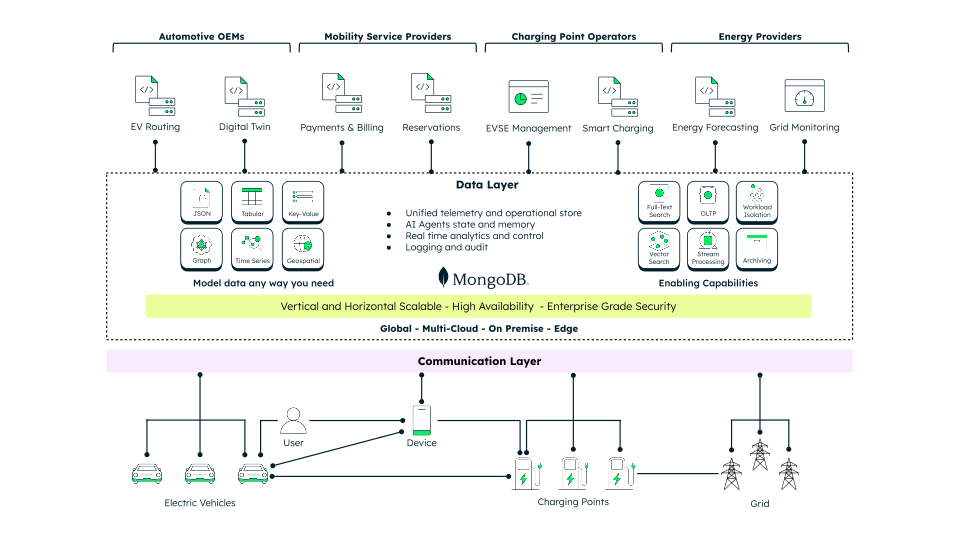
Figure 1. Overview of the data platform serving the EV charging ecosystem
Reference Architectures
The solution brings driver experiences, charging operations, station simulation, and operational data together through a unified app architecture.
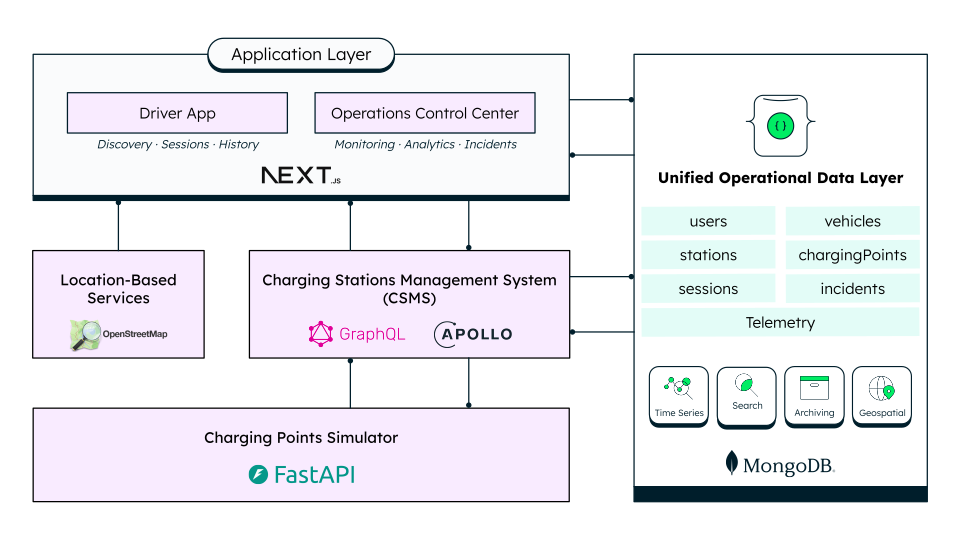
Figure 2. EV charging demo architecture
The Next.js app provides two primary experiences:
Driver App: Used for station discovery and charging-session management.
Operations Control Center: Used to monitor real-time charging activity and operational data.
The app communicates bidirectionally with the Charging Station Management System (CSMS), built with Apollo GraphQL. The CSMS provides the app contract for charging workflows and connects app actions with charging-station operations. The app also integrates with location-based services through OpenStreetMap to support station discovery and location-aware experiences.
A Python FastAPI simulator represents charging-station activity and generates session telemetry. MongoDB change streams capture state changes in the charging session for the CSMS-to-simulator workflow. The simulator uses these events to:
Start or stop processing a charging session.
Calculate the simulated charging state.
Generate session telemetry.
MongoDB provides the unified operational data platform across the architecture. It integrates all data required for the end-to-end charging experience—from driver and vehicle context to charging infrastructure, session activity, operational events, and high-volume telemetry.
As your solution evolves, MongoDB capabilities such as geospatial queries, time series collections, Atlas Search, and Online Archive support varied data and access patterns.
Data Model Approach
The data model follows the way EV charging applications actually work: drivers need a complete view of a charging session, station searches need location and availability together, while telemetry needs to be handled as a high-volume stream. The MongoDB document model lets you shape each collection around those specific access patterns.
The solution uses the following core collections:
usersandvehicles: Store driver and vehicle information.chargingStationsandchargingPoints: Track station discovery and Electric Vehicle Supply Equipment (EVSE) state.chargingSessions: Manage bookings, active sessions, and charging history.incidents: Track operational issues.telemetry: Store high-volume charging data.
The document model makes the solution intuitive and easier to implement.
For example, the chargingSessions collection uses the Extended Reference Pattern to keep session history data together. Alongside references to the underlying vehicle and station, the session stores small snapshots of the relevant details.
{ "status": "COMPLETED", "stationSnapshot": { "name": "Downtown Mall Charging", "addressShort": "Main St 10, Zurich", "chargingPointLabel": "Bay 1" }, "vehicleSnapshot": { "make": "BMW", "model": "i3" }, "charging": { "energyDeliveredKwh": 52.4 }, "pricingSnapshot": { "currency": "EUR", "priceCentsPerKwh": 55 }, "cost": { "totalCents": 2882 } }
When drivers view their session history, the app retrieves this information from a single document without joining multiple collections. The snapshots also preserve historical session context even if the underlying station or vehicle data changes later.
The same principle simplifies station discovery. The chargingStations collection stores its location as GeoJSON, enabling MongoDB geospatial queries to find stations near a driver's location. It also maintains computed availability counts and a bounded projection of charging-point capabilities, so common map and search queries can be answered directly from the station document.
{ "name": "Downtown Mall Charging", "location": { "type": "Point", "coordinates": [8.5417, 47.3769] }, "availability": { "availableNowPoints": 7 }, "chargingPoints": [ { "connectors": [ { "type": "CCS", "power": 150 }, { "type": "TYPE2", "power": 22 } ] } ] }
Frequently changing operational state stays in the separate chargingPoints collection to avoid updating station documents whenever a charging point's status changes. This separation also keeps the model efficient as telemetry volume grows.
Telemetry has a different access pattern: it is high-volume, time-based, and continuously growing. The solution keeps telemetry separate and uses a MongoDB time series collection with a TTL index to automatically enforce retention policies. For longer-lived data, MongoDB Online Archive moves older data to lower-cost storage, providing a native way to manage the data lifecycle without building separate archival workflows.
{ "timestamp": "2026-02-12T08:11:58Z", "meta": { "stationId": "65c8f2e2d2f4c3a9b3b9b001", "chargingPointId": "65c8f2e2d2f4c3a9b3b9b101", "stationCode": "station-001", "chargingPointCode": "cp_station-001_01" }, "messageType": "SESSION_SAMPLE", "ok": true, "powerKw": 120, "energyKwhDelta": 0.4, "voltageV": 400, "currentA": 300, "temperatureC": 31.2 }
These patterns keep the implementation focused on the application's actual workflows while enabling each data type to scale and evolve independently. The result is a practical document model that reduces app complexity without sacrificing flexibility.
Build the Solution
To run the solution locally, complete the following steps:
For the complete setup instructions, local development options, environment variables, and additional commands, see the GitHub repository.
Key Learnings
Unify EV charging data and operations: Consolidate driver experiences, charging infrastructure, operational data, and telemetry onto a single operational data platform to improve visibility and simplify architecture.
Simplify development and evolution: Use the MongoDB flexible document model and schema patterns to build and adapt charging workflows as requirements change.
Build for availability and scale: Combine real-time data, event-driven processing, and native MongoDB capabilities to support responsive charging experiences as infrastructure and data volumes grow.
Extend operations with AI: Use connected station, session, incident, and telemetry context as a foundation for AI-assisted support and operational decision workflows.
Authors
Rami Pinto, MongoDB
Humza Akhtar, MongoDB
Daniel Jamir, MongoDB