Underwriting, claims, and service decisions in insurance depend on context that is usually scattered across many different systems including policy admin systems, claims platforms, telematics, and third-party risk data, among others. Assembling that context by hand every time is slow, inconsistent, and hard to audit.
This architecture describes a context layer on MongoDB Atlas, which is a real-time operational data tier that assembles business object context into a single live object that agents and applications can read, write, and act on.
The context layer sits between existing systems of record and AI-driven underwriting, claims, and service workflows, so carriers do not need to replace those systems to make them usable by agents. It combines a flexible document model, AI-native retrieval, real-time change propagation, and field-level governance to meet the low-latency and auditability requirements that regulated, agent-augmented decision loops demand.
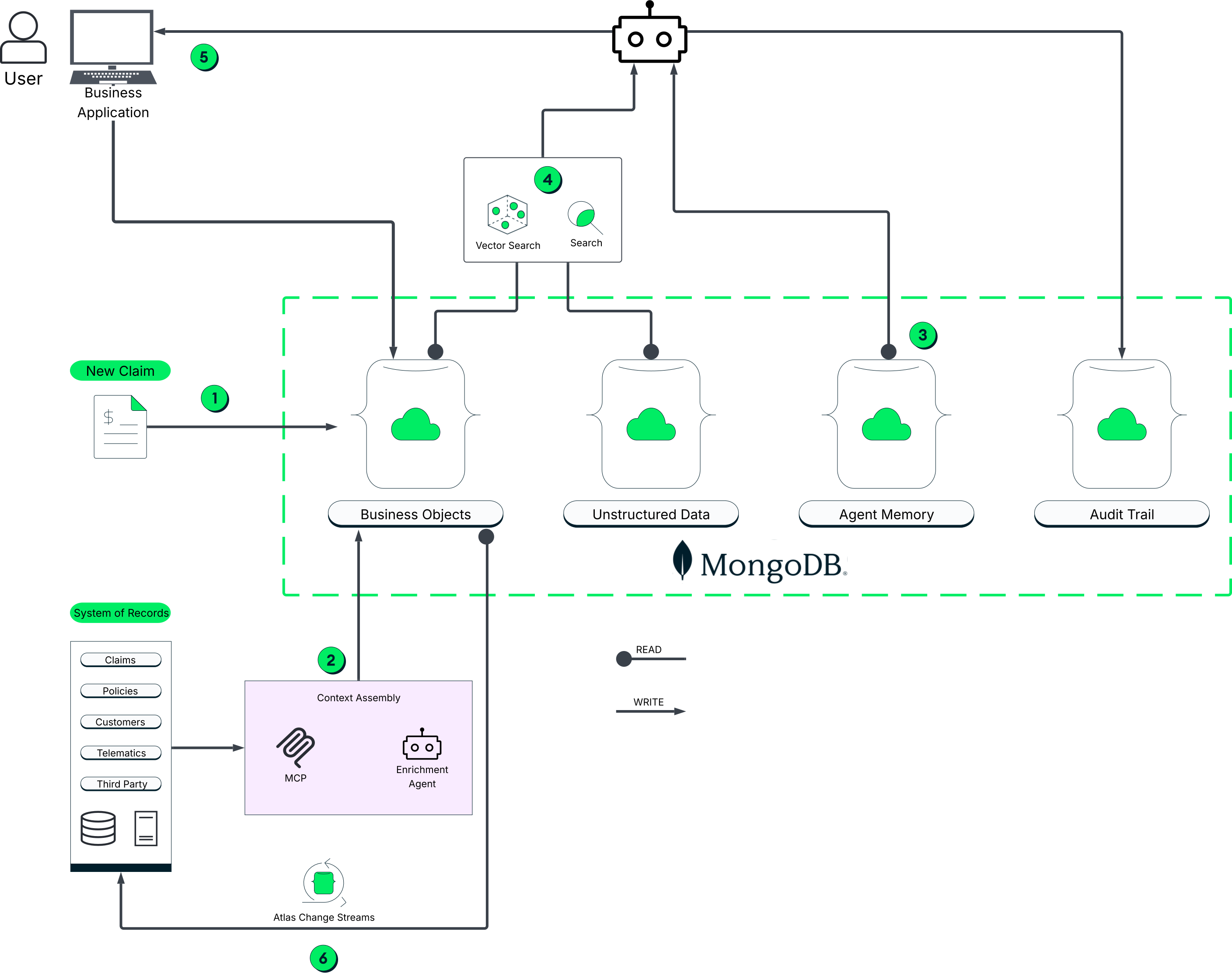
Figure 1. Context Layer Architecture & AI Agent Data Flow
Data Flow
The following steps trace a single submission or claim as it moves through the context layer, from intake to a written-back, auditable decision.
Submission or claim intake
A new submission or claim arrives and the intake service captures core identifiers and initial structured fields. After that information is identified, the intake service writes them into a
business_objectscollection in MongoDB Atlas as a single document.Context enrichment and assembly
A specialized enrichment agent gathers the remaining context that the underwriter or claims handler needs, such as coverage limits, endorsements, loss descriptions, adjuster notes, and more. The agent assembles data from the system of records to create a single, live record. Now, a single MongoDB document holds everything an underwriter or claims agent needs to gather knowledge, make a decision, and take action.
Agent memory and state retrieval
At the same time as the context enrichment, the service also retrieves prior memory for this submission or claim, as the agentic memory holds conversation history, decision traces, audit history, and sentiment for this specific case. This lets an underwriting or claims agent resume work with full memory of prior turns, recommendations, and human overrides.
AI-native retrieval over structured and unstructured content
The service issues hybrid
$vectorSearchand$searchqueries against the business object and linked unstructured artifacts such as adjuster notes, loss narratives or imagery metadata. To do this, domain-tuned embeddings and reranking can be used, so the agent sees the most relevant history and precedent first rather than a raw list of matches.Agent decision, the Human-In-The-Loop and write-back
The agent reviews the assembled context and takes an action, such as issuing a quote or requesting more information. In many situations, this action will need to be reviewed by the human, keeping the final revision always under human control. Finally, the decision, along with its full reasoning trace, is written back by the agent into its own collection of decision traces in MongoDB as an immutable audit entry to ensure full compliance and traceability and transparency over agentic actions.
Real-time propagation with Change Streams
MongoDB Change Streams broadcasts the update to every agent, dashboard, and downstream system watching the submission or claim. Additionally, new signals may be introduced by the human user at any point, so that they can be used to trigger agents directly, such as a new fraud indicator on a claim firing the claims agent immediately, without a batch cycle.
Components
Systems of record
A system of record (SoR), also known as a single system of record (SSoR), is a single computer system that serves as the authoritative data source for a critical data element or data object. The SoR holds the "true state" of the data, meaning it’s the most up-to-date, accurate, and compliant version available for that particular data source.
In this architecture, systems of record remain the source of business transactions. They continue to own their original responsibilities while the context layer assembles a usable decision context across them.
Business objects and agent memory
Business objects hold the operational entity, either a submission, claim, or customer record, as a single, continuously enriched document. This ensures that every consumer works from the same up-to-date view, rather than having to gather the information from scattered sources. MongoDB stores agent memory alongside this record so agents retain context and audit history across a multi-step decision.
AI-native retrieval
MongoDB Vector Search combined with full-text search and reranking lets agents retrieve the most relevant loss history, precedent, or guidelines from both structured fields and unstructured artifacts in a single query, rather than orchestrating across a separate vector store.
Real-time propagation
MongoDB Change Streams and native stream processing keep every agent and downstream system synchronized with the current state of a submission or claim, and allow new signals or events to trigger an agent directly instead of waiting on a polling or batch cycle.
Audit trail
The context layer keeps an immutable audit trail for every read and write, so that all AI-assisted decisions remain transparent and traceable at all times. One collection gathers the full information about each decision from the identity of the user/agent that made the decision to the steps to arrive at the conclusion, context, AI metadata, decision outcome, and much more.
Limitations
This pattern introduces complexity and should be adopted intentionally.
Operational Layer is not always best for analytical purposes: This architecture is not a good fit for analytics-only workloads, archival repositories, or use cases where decisions do not require real-time context assembly, writes, or auditability. If the primary need is reporting or batch-oriented analysis, analytical platforms may be sufficient without adding an operational context layer.
Schema flexibility requires its own discipline: This approach also requires discipline in data modeling, identity resolution, governance, and lifecycle management. A context layer can accumulate large, complex objects and evolving schemas, so teams must define object boundaries, expectations, and update patterns early.
Upstream system complexity will not be eliminated: It reduces decision-time fragmentation, but it still depends on reliable upstream data access and data quality. Poor source quality or weak event design will surface inside the context layer rather than disappear.
The architecture works best when tailored to a specific use case with a predefined data model and then expanded from a proven reference workflow.
Learn More
Explore the other reference architectures: