MONGODB
Vector Search
Build intelligent applications with vector search, hybrid search, and generative AI on the live operational data already in MongoDB.
.jpg)
What is vector search?
Generative AI uses vectors to enable intelligent semantic search over unstructured data (text, images, and audio). Vectors are critical in building recommendation engines, anomaly detection, and conversational AI. The wide range of use cases, made possible with native capabilities in MongoDB, deliver transformative user experiences.
The combined power of vectors and MongoDB
Semantic search, as easy as keyword search
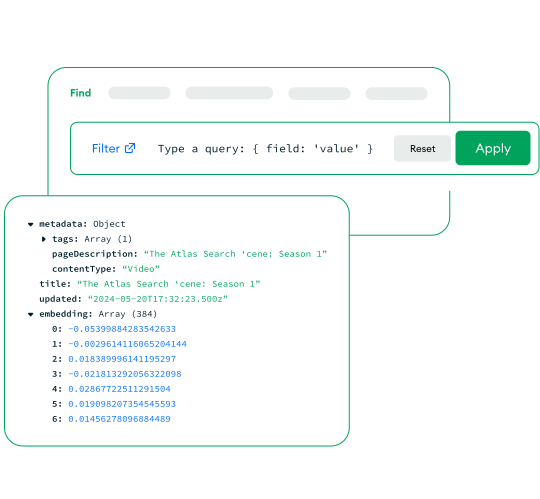
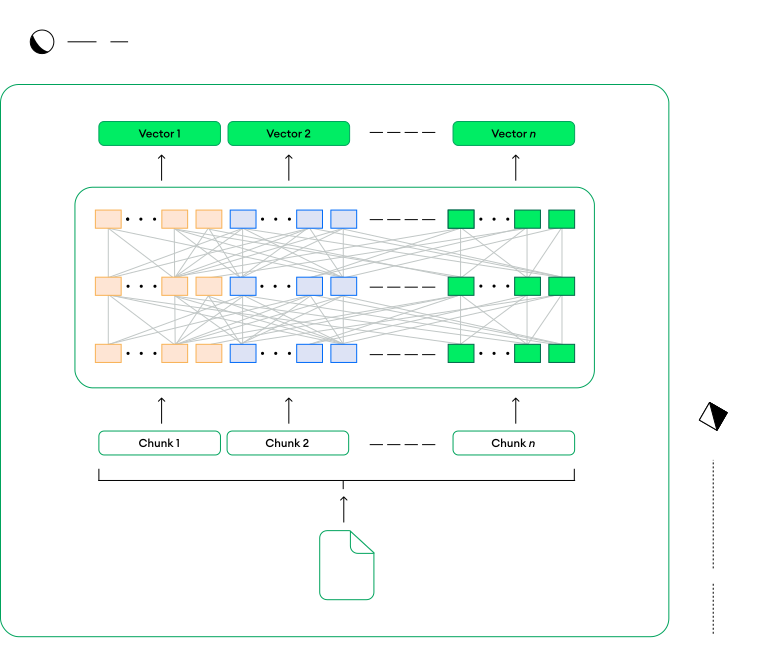
With Automated Embedding, just define an index on your live operational data and MongoDB automatically generates and syncs vector embeddings as the data changes. Search in natural language. Pick the embedding model from Voyage AI that fits your workload’s quality-cost-latency requirements. MongoDB Atlas manages model inference, scaling, and syncing behind the scenes.
Native reranking in Atlas
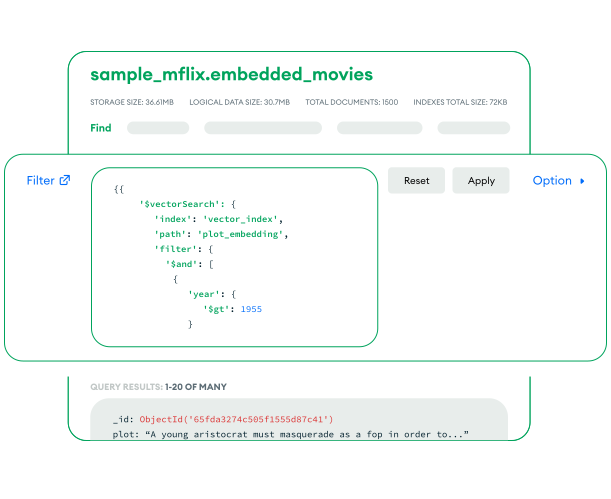
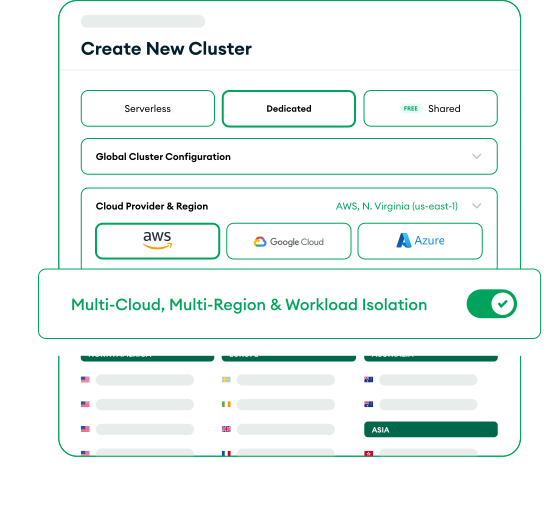
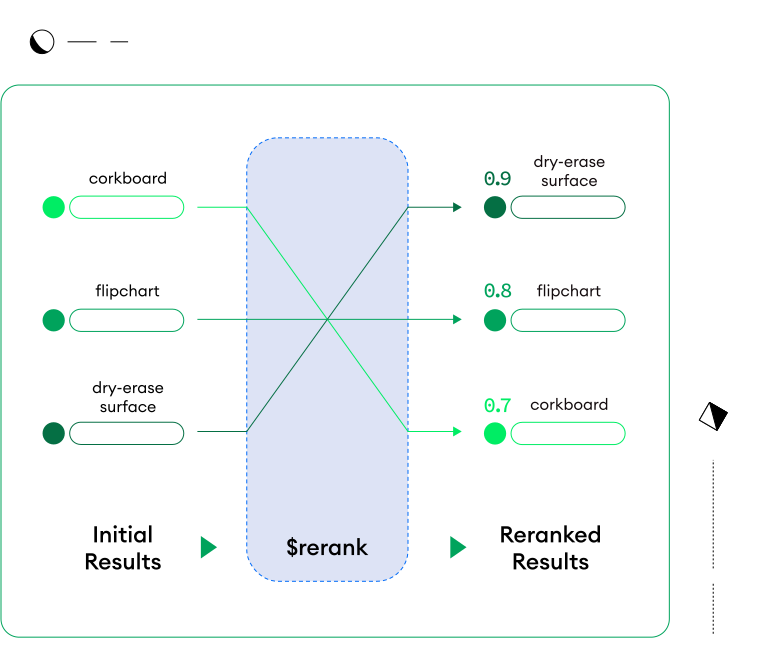
Instantly improve retrieval accuracy using Voyage AI's best-in-class reranker models without leaving the MongoDB query engine. With MongoDB native reranking, only the most relevant results reach your LLM, reducing token costs and latency for agentic and multi-step retrieval pipelines.

Technical Director for FT Core Platforms, Financial Times
Technical Director for FT Core Platforms, Financial Times
Head of Content Digitalisation, Novo Nordisk

Director of Engineering, Okta

Senior Data Scientist, Delivery Hero

CEO, Kovai






_Thumbnail_(1).svg)
Learning hub


FAQ
Vectors are mathematical representations of data, expressed as arrays of numbers that capture specific features or properties. In machine learning and artificial intelligence, vector embeddings refer to these numeric representations, often used to encode complex data such as text, images, or audio into a format computers can understand and process. Embeddings are designed to retain relationships and patterns within the data, such as similarities or contextual meaning. For example, in natural language processing, words with similar meanings are represented by embeddings close to each other in vector space. This approach enables efficient search, recommendation systems, and other machine learning tasks.
Automated Embedding is a feature that generates vector embeddings for your data directly inside MongoDB. When you define an autoEmbed field in a vector search index, MongoDB automatically creates embeddings with a Voyage AI model at ingest, update, and query time—keeping vectors in sync with your documents without an external pipeline.
MongoDB Vector Search allows searching through data based on semantic meaning captured in vectors, whereas MongoDB Search allows for keyword search (i.e., based on the actual text and any defined synonym mappings).
Yes, MongoDB is a vector database. Atlas is a fully managed, AI-ready, intelligent data platform with a rich array of capabilities that includes text or lexical and vector search. Rather than use a standalone or bolt-on vector database, the versatility of our platform empowers users to store their operational data, metadata, and vector embeddings and seamlessly use vector search for indexing, retrieval, and building performant generative AI applications. MongoDB Vector Search is also available for MongoDB Enterprise Advanced, the most flexible way to run MongoDB in production on-premises and in private clouds. It is also available in MongoDB Community Edition.
MongoDB Vector Search supports embeddings from any provider that is under the 4096-dimension limit on the service.
Automated Embedding supports the Voyage AI model family, all hosted within Atlas security perimeter, with configuration for output dimensions and quantized outputs.
We support the ingestion, indexing, and querying of scalar and binary quantized vectors from embedding providers. We also provide the option to implement automatic scalar and binary quantization of full-fidelity vectors in MongoDB.
You can bring your own embeddings from any provider and MongoDB Vector Search will always work with that.
When using Automated Embedding, inference, authentication, scaling, retries, and synchronization are managed by MongoDB. There is no external embedding service to provision, no keys to rotate, and no sync infrastructure to operate. The embedding models are billed as per your actual token usage.
When using Bring your own embeddings, you are responsible for ingesting the generated vector embedding from the provider of your choice. All the related operations—billing, rate limits, api key management—need to be handled by you.
KNN stands for "K-Nearest Neighbors," which is the algorithm frequently used to find vectors near one another.
ANN stands for "Approximate Nearest Neighbors" and it is an approach to finding similar vectors that trades accuracy in favor of performance. This is one of the core algorithms used to power Atlas Vector Search. Our algorithm for Approximate Nearest Neighbor search uses the Hierarchical Navigable Small World (HNSW) graph for efficient indexing and querying of millions of vectors.
ENN stands for “Exact Nearest Neighbors” and it is an approach to finding similar vectors that might trade some performance in favor of accuracy. This method returns the exact closest vectors to a query vector, with the number of vectors specified by the variable limit. Exact vector search (ENN) query execution can maintain sub-second latency for unfiltered queries up to 10,000 documents. It can also provide low-latency responses for highly selective filters that restrict a broad set of documents into 10,000 documents or fewer, ordered by vector relevance.
Yes, vector quantization is supported.
With Automated Embedding you can choose between scalar, float, binary (with rescoring using float vectors) and binary without any rescoring.
With bring your own embeddings, we support the ingestion, indexing, and querying of scalar and binary quantized vectors from embedding providers. We also provide the option to implement automatic scalar and binary quantization of full-fidelity vectors in MongoDB.
Yes, MongoDB Vector Search can query any kind of data that can be turned into a vector embedding. One of the benefits of the document model is that you can store your embeddings right alongside your rich data in your documents.
Native reranking ($rerank) elevates retrieval precision instantly by integrating Voyage AI’s premier reranker models directly within the MongoDB query engine. MongoDB native reranking allows users to ensure only highly pertinent data is delivered to your LLM, optimizing token expenditure and enhancing accuracy.
Hybrid search in MongoDB combines lexical search and vector search in a single query so applications can benefit from both keyword precision and semantic relevance. In MongoDB, hybrid search runs directly on live operational data, which helps teams improve retrieval without adding a separate search system to sync and maintain. MongoDB supports native fusion stages for hybrid retrieval, giving teams a simpler way to combine lexical and vector results in one query. MongoDB supports native fusion stages for hybrid retrieval, giving teams a simpler way to combine lexical and vector results in one query.
Get started with MongoDB Vector Search
- Simplified deployment
- Unified developer experience
- Horizontal, vertical, independent scale
- Integrated AI ecosystem
- 125+ regions worldwide