Note
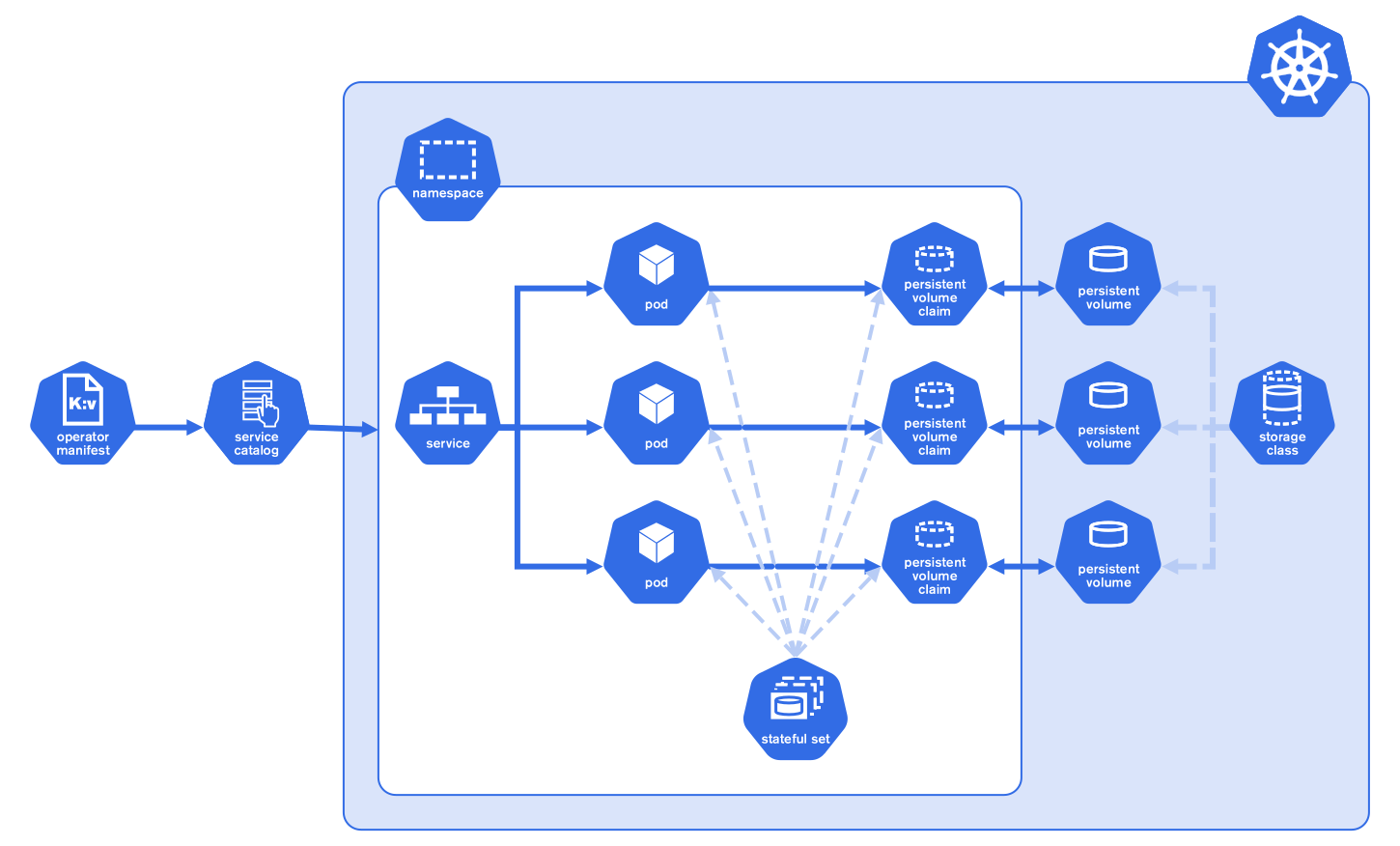
This tutorial presumes some knowledge of Kubernetes. If you are unfamiliar with Kubernetes, review the Kubernetes documentation on Kubernetes objects and custom resources before you begin. The Kubernetes Operator represents Ops Manager and MongoDB deployments as custom resources. You create and manage them with kubectl in the same way that you manage any other Kubernetes object. To learn how these custom resources relate to each other, see MongoDB Controllers for Kubernetes Operator Architecture Overview.
Prerequisites
Complete the following prerequisites before you install the Kubernetes Operator:
Have a Kubernetes solution available to use, and verify hardware architecture support.
If you need a Kubernetes solution, see the Kubernetes documentation on picking the right solution. Review supported hardware architectures.
Clone the MongoDB Controllers for Kubernetes Operator repository.
git clone https://github.com/mongodb/mongodb-kubernetes.git
Note
You can use Helm to install the Kubernetes Operator. To learn how to install Helm, see its documentation on GitHub.
Create a namespace for your Kubernetes deployment.
By default, The Kubernetes Operator uses the mongodb namespace. To simplify your installation, consider creating a namespace labeled mongodb using the following kubectl command:
kubectl create namespace mongodb
If you do not want to use the mongodb namespace, you can label your namespace anything you like:
kubectl create namespace <namespaceName>
Optional: Have a running Ops Manager.
If you don't deploy an Ops Manager resource with the Kubernetes Operator, you must have an Ops Manager running outside of your Kubernetes cluster. If you will deploy an Ops Manager resource in Kubernetes with the Kubernetes Operator, skip this prerequisite.
Important
Your Ops Manager installation must run an active NTP service. If the Ops Manager host's clock falls out of sync, that host can't communicate with the Kubernetes Operator.
To learn how to check your NTP service for your Ops Manager host, see the documentation for RHEL.
Considerations
Review the following planning topics. To learn more, see Plan your MongoDB Controllers for Kubernetes Operator Installation.
Decide whether to install on a single Kubernetes cluster or on multiple Kubernetes clusters. See Choose Kubernetes Operator Installation Mode: Single- or Multi-Kubernetes Clusters.
Confirm that your versions of Kubernetes, OpenShift, MongoDB, and Ops Manager are compatible. See MongoDB Controllers for Kubernetes Operator Compatibility.
Set the scope of the Kubernetes Operator deployment, which determines the namespaces that the Kubernetes Operator watches. See Set Scope for MongoDB Controllers for Kubernetes Operator Deployment.
Apply the production recommendations for storage, persistence, and CPU and memory bounds. See Best Practices.
Install with Kubernetes
The installation procedure varies based on how you want to configure your environment:
Note
Use the same namespace throughout
By default, the Kubernetes Operator deploys all resources in your Kubernetes cluster to the namespace mongodb. You can deploy Kubernetes Operator resources to a different namespace by editing all values for metadata.namespace in mongodb-kubernetes.yaml:
apiVersion: v1 kind: ServiceAccount metadata: name: mongodb-kubernetes-operator namespace: production apiVersion: apps/v1 kind: Deployment metadata: name: mongodb-kubernetes-operator namespace: production # Example truncated ...
Optional: Customize the Kubernetes Operator YAML before installing it.
To learn about optional Kubernetes Operator installation settings, see Operator kubectl and oc Installation Settings.
Note
To enable the Public Preview of static containers, which improve and simplify security, see Static Containers (Public Preview). We don't recommend using this feature in production while it's in Public Preview. To learn more, see Preview Features.
Use the MongoDB Helm Charts for Kubernetes.
Add the MongoDB Helm Charts for Kubernetes.
You can add the Kubernetes Operator Helm Chart locally by running:
helm repo add mongodb https://mongodb.github.io/helm-charts
Customize your Helm Chart before deploying it.
To learn about optional Kubernetes Operator installation settings, see Operator Helm Installation Settings.
Deploy the Kubernetes Operator.
Run the following helm command to deploy the Kubernetes Operator to the default namespace in your Kubernetes cluster:
helm upgrade --install mongodb-kubernetes-operator mongodb/mongodb-kubernetes
You can pass the --namespace and --create-namespace flags to deploy the Kubernetes Operator to a non-default namespace, like so:
helm upgrade --install mongodb-kubernetes-operator mongodb/mongodb-kubernetes \ --namespace mongodb \ --create-namespace
Install a Specific Daily Build with Helm
MongoDB rebuilds Kubernetes Operator images every day to integrate the latest security and OS updates.
By default, helm installs the latest build for the version of the Kubernetes Operator you specify.
To install an earlier build, specify the build ID as a parameter with --set build=<build-id>. Build IDs are always in the format -b<YYYYMMDD>T000000Z, where <YYYYMMDD> is the date that the build you want to use was created.
Example
This example shows how to install the Kubernetes Operator with the latest image:
helm install mongodb-kubernetes-operator mongodb/mongodb-kubernetes
This example shows how to install the Kubernetes Operator with the image created at midnight on February 5th, 2021:
helm install mongodb-kubernetes-operator mongodb/mongodb-kubernetes \ --set build=-b20210205T000000Z
Note
MongoDB recommends using the default (latest) build.
Install with OpenShift
Before you begin, ensure that the MANAGED_SECURITY_CONTEXT flag is set to true when you deploy the Kubernetes Operator to OpenShift. This value is pre-defined in the values-openshift.yaml file.
The installation procedure varies based on how you want to configure your environment:
Note
Use the same namespace throughout
By default, the Kubernetes Operator deploys all resources in your Kubernetes cluster to the namespace mongodb. You can deploy Kubernetes Operator resources to a different namespace by editing all values for metadata.namespace in mongodb-kubernetes-openshift.yaml:
apiVersion: v1 kind: ServiceAccount metadata: name: mongodb-kubernetes-operator namespace: production apiVersion: apps/v1 kind: Deployment metadata: name: mongodb-kubernetes-operator namespace: production # Example truncated ...
Clone the MongoDB Controllers for Kubernetes Operator repository.
Invoke the following git command:
git clone https://github.com/mongodb/mongodb-kubernetes.git
Navigate to the directory in which you cloned the MongoDB Controllers for Kubernetes Operator repository.
For example, if you cloned the repository in your home directory, run:
cd ~/mongodb-kubernetes
Install the CustomResourceDefinitions for MongoDB deployments.
Invoke the following oc command:
oc apply -f crds.yaml
Optional: Customize the Kubernetes Operator YAML before installing it.
To learn about optional Kubernetes Operator installation settings, see Operator kubectl and oc Installation Settings.
Note
To enable the Public Preview of static containers, which improve and simplify security, see Static Containers (Public Preview). We don't recommend using this feature in production while it's in Public Preview. To learn more, see Preview Features.
Add your <openshift-pull-secret> to the ServiceAccount definitions in the Kubernetes Operator YAML before installing it.
apiVersion: v1 kind: ServiceAccount metadata: name: enterprise-operator namespace: mongodb imagePullSecrets: - name: <openshift-pull-secret> apiVersion: v1 kind: ServiceAccount metadata: name: mongodb-kubernetes-appdb namespace: mongodb imagePullSecrets: - name: <openshift-pull-secret> apiVersion: v1 kind: ServiceAccount metadata: name: mongodb-kubernetes-database-pods namespace: mongodb imagePullSecrets: - name: <openshift-pull-secret>
To learn more, see the registry.imagePullSecrets setting in the Helm installation settings.
Use the MongoDB Helm Charts for Kubernetes.
You can install the Kubernetes Operator with Helm 3.
Add the MongoDB Helm Charts for Kubernetes repository to Helm.
helm repo add mongodb https://mongodb.github.io/helm-charts
Install the Kubernetes Operator using helm.
Install MongoDB Helm Charts for Kubernetes:
helm install mongodb-kubernetes-operator mongodb/mongodb-kubernetes \ --values https://raw.githubusercontent.com/mongodb/helm-charts/main/charts/mongodb-kubernetes/values-openshift.yaml
Use the values-openshift.yaml settings. To learn about optional Kubernetes Operator installation settings, see Operator Helm Installation Settings.
Note
To enable the Public Preview of static containers, which improve and simplify security, see Static Containers (Public Preview). We don't recommend using this feature in production while it's in Public Preview. To learn more, see Preview Features.
Install a Specific Daily Build with Helm
MongoDB rebuilds Kubernetes Operator images every day to integrate the latest security and OS updates.
By default, helm installs the latest build for the version of the Kubernetes Operator you specify.
To install an earlier build, specify the build ID as a parameter with --set build=<build-id>. Build IDs are always in the format -b<YYYYMMDD>T000000Z, where <YYYYMMDD> is the date that the build you want to use was created.
Example
This example shows how to install the Kubernetes Operator with the latest image:
helm install mongodb-kubernetes-operator mongodb/mongodb-kubernetes
This example shows how to install the Kubernetes Operator with the image created at midnight on February 5th, 2021:
helm install mongodb-kubernetes-operator mongodb/mongodb-kubernetes \ --set build=-b20210205T000000Z
Note
MongoDB recommends using the default (latest) build.
Verify the Installation
To verify that the Kubernetes Operator installed correctly, run the following command and verify the output:
kubectl describe deployments mongodb-kubernetes-operator -n <metadata.namespace>
oc describe deployments mongodb-kubernetes-operator -n <metadata.namespace>
By default, deployments exist in the mongodb namespace. If the following error message appears, ensure you use the correct namespace:
Error from server (NotFound): deployments.apps "mongodb-kubernetes-operator" not found
To troubleshoot your Kubernetes Operator, see Review Logs from the Kubernetes Operator and other troubleshooting topics.
Important
If you need to remove the Kubernetes Operator or the namespace, you first must remove MongoDB resources.
Next Steps
After installing the MongoDB Controllers for Kubernetes Operator, you can: