Piramal Finance Limited is a retail-led upper-layer NBFC with a pan-India presence. It offers a diverse portfolio of retail lending products spanning affordable housing loans, loan against property, microfinance, personal loans, insurance solutions, and more, as well as wholesale lending, which provides asset-backed, data-driven financing solutions across real estate and select non-real estate sectors.
As of June 30, 2026, the company has over ₹ 1,00,000 Cr of assets under management; it operates 780 branches and serves over 6 million customers across 26 states.
The company operates a distinctive phygital model combining high-touch engagement with high-tech capabilities, including machine learning models, agentic AI tools, and real-time dashboards. Underpinning this breadth of services is Piramal Finance’s "high-tech, high-touch" strategy. Unlike other financial institutions that rely on off-the-shelf software, Piramal Finance’s team built the company’s entire tech stack in-house.
MongoDB has been core to Piramal Finance’s tech stack since the company’s early days. Today, MongoDB Atlas’ flexible document model—combined with built-in capabilities like MongoDB Search and MongoDB Vector Search—powers over 80% of Piramal Finance’s services, including its loan management system, which was migrated from PostgreSQL.
Building on this solid data foundation, Piramal Finance recently set out to solve its next big challenge: empowering its workforce with generative AI.
Building an internal agentic AI assistant for 18,000+ employees
In 2024, Piramal Finance decided to invest in agentic AI to help improve productivity and job satisfaction for its more than 18,000 employees. The company aimed to empower employees across the company—including those from engineering, operations, HR, and customer service—with AI tools.
Piramal Finance’s team wanted to build an intuitive, enterprise-wide agentic AI assistant that would serve as a one-stop shop for employees, from querying policies and tracking performance metrics to resolving customer issues and interacting with internal systems. The idea was to democratize access to AI and allow even non-technical staff to leverage state-of-the-art AI, without complex prompts or technical training.
Initially, Piramal Finance's team started building an architecture that stitched together several specialized third-party tools:
Neo4j, a graph database that stores data as nodes and the relationships between them, managed the dynamic permissions model. Because permissions depended on a user's position in the organizational hierarchy and their associations with other entities—and because those relationships changed in real time—access had to be evaluated at runtime rather than precomputed.
pgVector, an open-source extension that adds vector storage and similarity search to PostgreSQL, handled the vector workloads powering AI features.
PostgreSQL, an open-source relational database, handled operational data and analytical queries.
However, this setup introduced significant complexity and inefficiencies, and it didn't lend itself to running complex AI workloads at scale.
Piramal Finance’s team saw MongoDB Atlas as the best solution to move away from PostgreSQL’s credential management. Using MongoDB’s built-in authentication and authorization features, Piramal Finance was able to map MongoDB Atlas’s access control directly to its enterprise single sign-on and Active Directory, so employees could log in securely with their standard corporate credentials. Meanwhile,MongoDB Atlas’s built-in role-based access control (RBAC) capabilities automatically restricted sensitive data based on Piramal Finance employees’ job roles.
Piramal Finance soon realized that the power of the MongoDB Atlas platform could solve many of the other challenges that its fragmented database stack presented.
From a fragmented to a unified AI data layer: The power of MongoDB Atlas
As Piramal Finance’s internal agentic AI Assistant's enterprise knowledge base grew, the data architecture became increasingly complex. Although this separation allowed each database to specialize in its workload, it introduced significant operational overhead and complexity, as Piramal Finance explained in a recent conversation at MongoDB .local Mumbai.
Data had to be synchronized across multiple systems through ETL pipelines, resulting in update latencies of over 30 minutes before newly ingested content became searchable.
Figure 1. Piramal Finance’s data architecture before migrating to MongoDB Atlas.
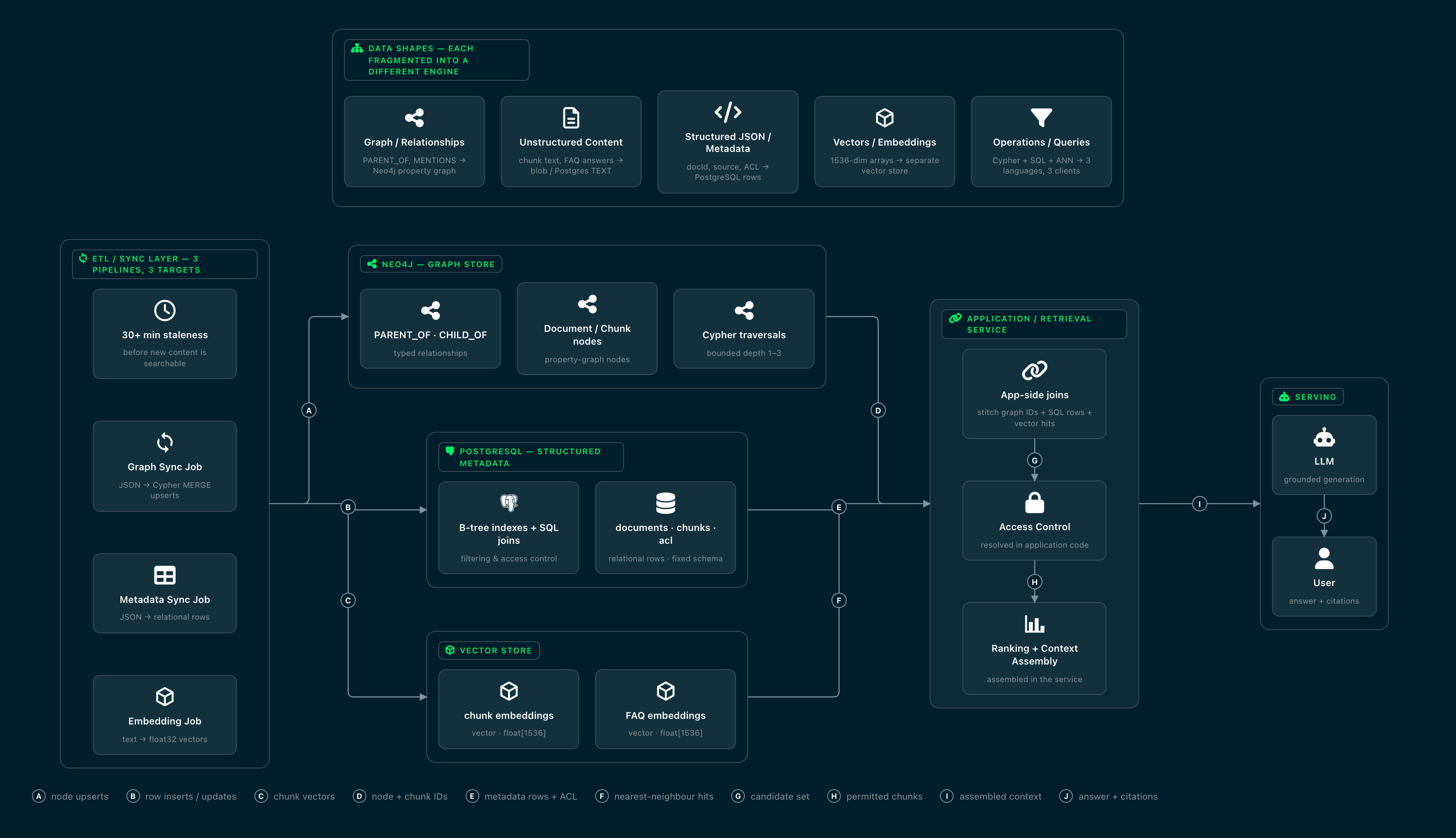
As Piramal Finance explored options to unify its data foundation, it realized that MongoDB Atlas was both inherently built for AI workloads (thanks to its flexible document model), and that it had all the capabilities needed to scale an agentic AI solution on a single platform.
Kaushik Deb, Head of AI engineering, Piramal Finance, said: “An AI agent is only as good as the data behind it. MongoDB gives us one platform for all our data, which makes our AI simpler to build, easier to maintain, and more reliable in production.”
Figure 2. Piramal Finance’s data architecture after migrating to MongoDB Atlas.
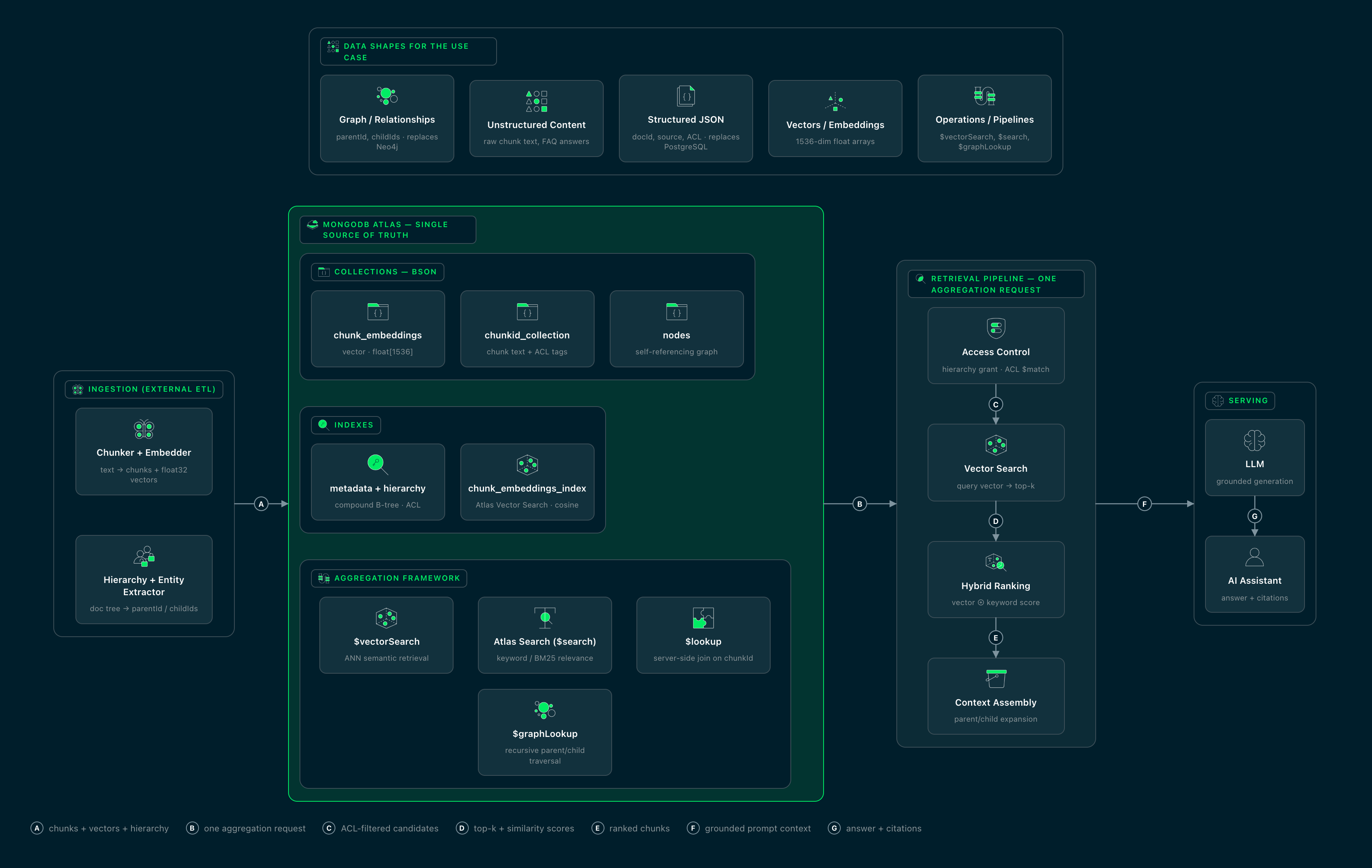
During the architecture review, Piramal Finance’s team realized that most of the graph queries involved bounded traversals such as reconstructing document hierarchies, identifying parent-child relationships, and retrieving connected metadata—operations that did not require a dedicated graph database. The data model was redesigned to represent these relationships within MongoDB itself, using the flexibility of MongoDB Atlas’ document model and MongoDB’s aggregation framework capabilities.
The $graphLookup aggregation stage became central to the implementation, enabling recursive traversal of document relationships directly within MongoDB collections. Combined with operators such as $lookup, $facet, $unwind, and $project, Piramal Finance was able to replace Neo4j traversals with efficient aggregation pipelines, all while expressing complex relationship queries entirely within MongoDB.
MongoDB Atlas also allowed the team to consolidate structured metadata, document storage, relationship traversal, and search into a single platform. MongoDB Search handled keyword retrieval, while the aggregation framework combined metadata filtering, graph traversal, and ranking into unified retrieval pipelines, reducing application-side joins and simplifying backend services.
Today, there are 25+ MongoDB MCP servers live, powering Piramal Finance’s agentic AI assistant, which, combined with MongoDB Vector Search, allows for unstructured documents (e.g., 500-page policy PDFs) to be processed through Piramal Finance’s in-house pipeline (.score), chunked, embedded using in-house embedding models, and stored directly in MongoDB Atlas. MongoDB Vector Search delivers 3x faster retrieval performance compared to Piramal Finance’s former Postgres setup.
An incredibly efficient, smart agentic assistant
Since the launch of Piramal Finance’s internal agentic AI assistant, employee performance and productivity across all functions have improved, which has in turn improved customer experience and satisfaction.
Today, over 80% of Piramal Finance's 18,000 employees use the internal agentic AI assistant on a weekly basis, with an average of 15,000 daily queries handled by the platform.
Teams from all across the organization are benefiting from using the agentic AI assistant. HR teams experience a significant reduction in routine internal support tickets regarding benefits, travel policies, and payroll, as new hires and staff turn to the agentic solution for instant answers, supporting agents. Support agents who previously spent extensive time manually combing lengthy and complex policy manuals during live calls are now able to ingest real-time customer data and policy docs into the agentic assistant. This has drastically reduced handle times, improving first-contact resolution and customer satisfaction. Furthermore, sales representatives using the internal agentic AI assistant have seen a 2x improvement in performance compared to non-users during contest periods.
Piramal Finance’s tech team, including developers, are also greatly benefiting from using MongoDB Atlas. Knowledge graph and document updates that previously took up to 30 minutes in legacy setups now execute in just 15 seconds, eliminating operational downtime. Working with MongoDB and being able to use MongoDB Atlas’ built-in capabilities such as MongoDB Search and MongoDB Vector Search has also made developers’ jobs much easier.
With MongoDB, Piramal Finance has been able to turn what was initially a pretty simple AI assistant into a full agentic solution that orchestrates workflows across the entire organization. MongoDB Atlas has become the single source of truth for the internal agentic AI assistant, providing a simpler architecture and a scalable foundation for semantic retrieval, richer metadata, and future AI-powered knowledge discovery.
Looking to the future, Piramal Finance plans to use MongoDB’s capabilities to further expand its internal agentic AI assistant into a personalized, proactive coach for every employee in the company.
Next Steps
Visit our product pages to learn more about MongoDB Atlas and MongoDB for AI.