Most agentic demos look impressive in a notebook. A prompt comes in, an agent reasons, tools fire, and a result comes back that feels almost magical.
But the moment a team tries to turn that demo into a real application, the questions change. Can the system scale across users and workflows? Can it enforce security boundaries? Can it keep costs under control? Can teams understand why an agent made a decision, what context it used, and how to improve it over time?
This is where context engineering becomes the real production challenge.
This is the core idea behind context engineering: the quality of an agentic system depends not just on the model, but on how well the system assembles the right working context for each request. When context is explicit and bounded, ambiguity drops, and useful action becomes much more reliable. Context engineering is the discipline of assembling that working set of identity, task state, memory, retrieved knowledge, tool outputs, and governance controls so that an agent can operate reliably in an enterprise environment.
That is why moving from POC to production is not just about proving that agents work. It is about proving that the system can assemble the right context for every request while remaining scalable, governable, cost-efficient, and observable. As multi-agent systems grow from a few workflows to dozens or hundreds of specialist agents, the challenge shifts from prompt design alone to controlled context assembly across the full request lifecycle.
The real problem is unmanaged context
A lot of AI conversations still center on model choice. That matters, but in production, it is rarely the only blocker. The harder problem is everything that shapes the model call.
In real agentic systems, failures tend to happen for predictable reasons. The wrong agent receives the task because routing is brittle. Retrieval brings in too much, too little, or the wrong information. Memory and state are assembled in ad hoc ways instead of being managed as durable recall systems. Full chat history is repeatedly pushed into prompts, driving up token cost and latency while reducing consistency. Security, governance, and observability arrive too late, after context pathways have already been built without enough control.
In other words, the production challenge is not simply reasoning. It is deciding how context flows through the system.
That is what makes this architecture interesting. It approaches routing, memory, retrieval, tool access, and observability as first-class design concerns rather than treating them as cleanup work after a successful demo.
A context engineering architecture for agentic apps
At a high level, the platform combines Amazon Bedrock AgentCore, MongoDB Atlas, and a modular set of deployment and configuration patterns into a reusable foundation for agentic applications. But the more useful way to understand it is as a context engineering system.
Instead of treating prompts, memory, retrieval, and tools as loosely connected features, the architecture organizes them into a repeatable context assembly pipeline. That pipeline can be extended by adding new specialist agents, skill packages, and domain data without forcing teams to rewrite the underlying platform every time a new use case appears.
Figure 1. Technical architecture of the solution.
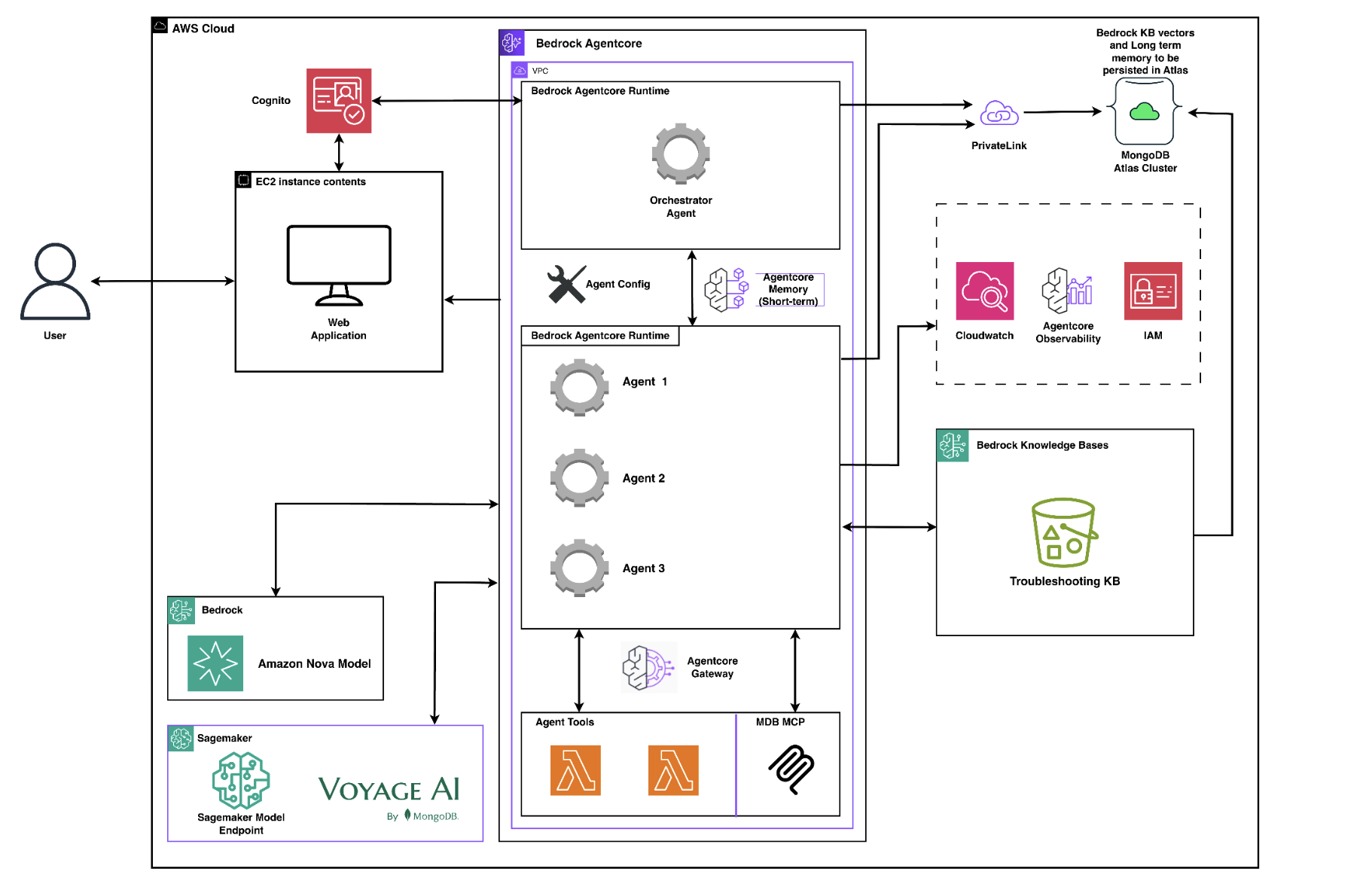
Viewed through that lens, each request moves through a series of context decisions.
First, the user sends a prompt through the application interface.
Next, Amazon Cognito-backed authentication validates identity and contributes user-specific context through JWT claims. Identity is not just an access check here. It becomes part of the working context that can shape what data the agent is allowed to access, what tools it may use, and what actions it is permitted to take.
The API layer then receives the request and applies routing logic to determine which specialist agent should handle the task. This is more than orchestration. Routing is the first major context selection step. It determines which expertise, toolset, memory scope, and domain boundary the request is allowed to enter.
Once the correct specialist is selected, the system loads the minimum viable working context for that turn. That may include recent conversational state, relevant long-term memory, task-specific instructions, and any operational context required to complete the request. The goal is not to give the model everything. The goal is to give it enough of the right context to act well.
If the task requires enterprise data or knowledge retrieval, the agent accesses tools through AgentCore Gateway. MongoDB operations are mediated by a dedicated MongoDB MCP server running on AgentCore Runtime, which connects privately to Atlas through patterns such as Private Endpoint, VPC peering, or whitelisting IPs, depending on deployment choices. This design matters because it creates a controlled path between the agent and enterprise state, rather than letting every agent connect directly to every backend system.
Retrieved knowledge, prior memory, and tool outputs are then combined into the reasoning path for that specific turn. The result is streamed back to the user, while traces, token usage, latency, and session telemetry are recorded in a MongoDB Atlas cluster for later inspection.
Seen this way, the platform is not just an agent runtime stack. It is a system for deciding how context is assembled, constrained, persisted, and audited across the lifecycle of every request. Explore the GitHub repository to fork the codebase and start experimenting with this architecture.
Why this architecture works from a context engineering perspective
What makes the platform compelling is not simply the list of components. Its real value is that it converts recurring context engineering problems into reusable architectural patterns.
Smarter routing and lower context overhead
The platform avoids using a large model for every routing decision. Instead, it uses a lightweight in-API classifier first and only falls back to model-based routing when needed.
That improves latency and cost, but the deeper benefit is contextual. Routing is not just a dispatch problem. It is a scope-control problem. It determines which agent, tools, memory domain, and retrieval boundary a request is allowed to enter. Better routing, therefore, reduces both unnecessary computation and unnecessary context expansion.
Governed access to enterprise data
Rather than allowing every agent to connect directly to data sources, the architecture routes MongoDB operations through a dedicated MongoDB MCP server behind AgentCore Gateway. That creates a more governed and auditable access path.
From a context engineering perspective, this matters because tool access is part of context control. The architecture can regulate not only whether an agent may call a tool, but also how tool outputs are introduced into the reasoning loop and how tightly those outputs remain bounded to the task at hand.
Selective memory instead of oversized prompts
The system combines short-term memory in AgentCore with long-term memory in MongoDB Atlas so agents can retain useful context across conversations without overloading each prompt with full history.
That distinction is critical. Good memory is not about storing everything forever. It is about deciding what should be written, what should be recalled, when it should expire, and how it should be summarized before re-entering the model context window. The more selectively an agent can remember, the less expensively it has to reconstruct context on every turn.
Isolation, reliability, and cleaner context boundaries
Because specialist agents run in separate AgentCore runtimes, the platform is easier to scale and operate than a single-process design. Teams can isolate failures, tune runtime behavior by agent, and avoid letting one overloaded workflow affect the whole system.
That operational isolation also improves context isolation. User sessions, agent responsibilities, tool pathways, and memory boundaries can be kept cleaner, reducing the risk that one workflow’s noisy or irrelevant state contaminates another.
Observability for context debugging
The platform includes structured traces, dashboards, token and cost visibility, and a trace viewer backed by MongoDB Atlas. That means teams can inspect more than the final outputs. They can inspect routing decisions, tool calls, memory reads, latency, model usage, and overall session behavior.
This is especially important for agentic systems because debugging is rarely just about whether the answer was wrong. It is often about whether the wrong context was assembled in the first place. Observability turns context engineering from guesswork into an inspectable operational discipline.
The context lifecycle in an agentic application
One of the most useful ways to evaluate a system like this is to follow the lifecycle of context through a single request.
A user begins with an intent. The system authenticates that user and captures identity context. It selects the specialist agent that should own the request. It loads relevant short-term and long-term memory, retrieves the knowledge needed for that moment from MongoDB Atlas, and composes a bounded working context for the model. The agent reasons over that context, executes tools when necessary, and returns a response. After the turn completes, the system records traces and writes back only the memory worth preserving in the MongoDB Atlas cluster.
This lifecycle is what separates an agentic prototype from an operational application. Without it, teams tend to fall back on bloated prompts, inconsistent recall, and opaque behavior. With this framework, they can build agents that feel more stateful, more relevant, and more reliable over time.
Scaling from one agent to many
One of the strongest ideas in this architecture is that adding a new use case should feel like extending a platform, not starting a new project.
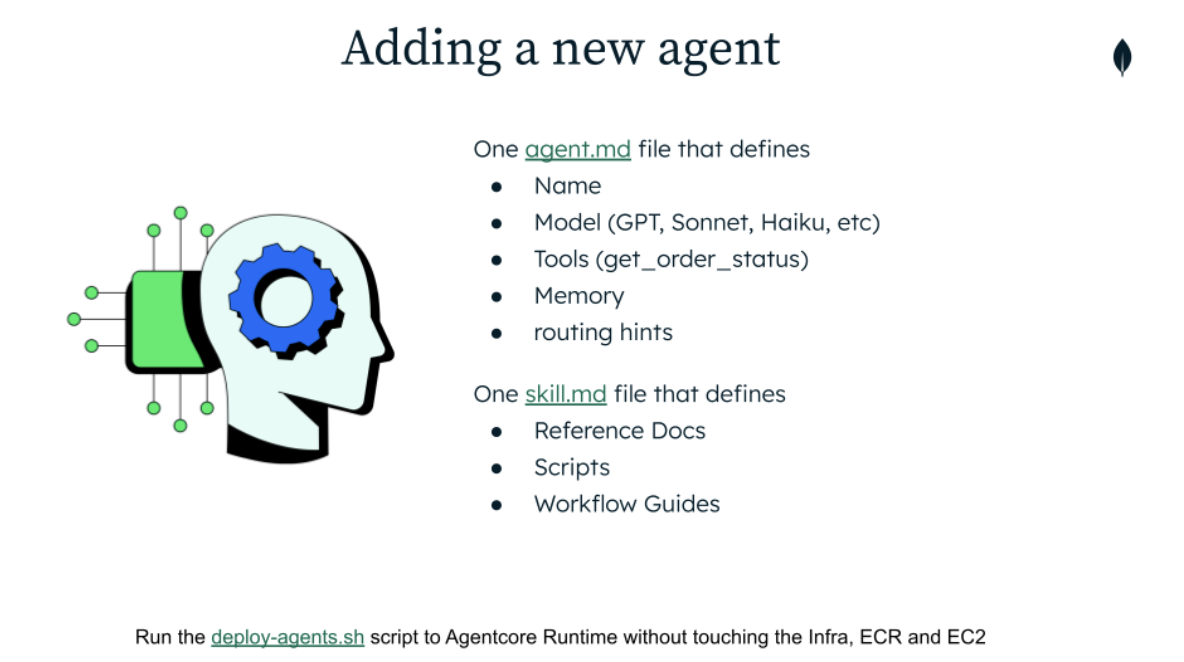
Figure 2. Process for adding a new agent to the system.
The lifecycle for adding a new agent is intentionally clean. Teams define a specialist in markdown, package the relevant expertise and logic into a skill, provision the required data and indexes, and add routing hints that determine when that agent should be selected. The platform then integrates the new specialist into the broader system without forcing a redesign of the core infrastructure.
That matters because most organizations do not need one generic agent. They need a growing portfolio of domain-specific assistants for support, operations, partner workflows, recommendations, internal knowledge, troubleshooting, advisory scenarios, and more.
At that point, scaling is no longer just an infrastructure problem. It becomes a context policy problem. Each new specialist needs clear context boundaries, memory patterns, retrieval scope, tool access, and observability. If every new use case rebuilds those decisions from scratch, the delivery motion will not scale even if the model does.
This architecture argues for a different approach: keep the foundation stable, and let domain-specific behavior emerge through configuration, skills, and data.
MongoDB Atlas as the durable context layer
MongoDB Atlas is not just another database in this design. It is the durable context layer that helps agents become more useful over time.
In this architecture, Atlas supports long-term memory, operational state, vector search, hybrid search, and trace storage, while working alongside AgentCore’s session-oriented capabilities to give agents both immediate context and durable recall across interactions.
That matters because effective agent memory is more than transcript retention. In production agentic systems, value comes from remembering the right facts, retrieving prior decisions when they are relevant, linking operational state to the current task, and keeping low-value context out of the prompt.
By keeping operational data, semantic retrieval, persistent memory, and observability on one platform, MongoDB simplifies the stack while reducing how much context must be repacked into every request. That can lower cost, improve latency, and increase response consistency, but more importantly, it strengthens the system’s ability to preserve useful context across time without overwhelming the model.
In agentic systems, memory is not a side feature. It is one part of a broader context engineering discipline.
Driving enterprise ROI through reusable context patterns
The business argument for this architecture becomes stronger when framed through context engineering.
Reusable architecture improves speed not only because teams reuse infrastructure, but because they reuse patterns for routing, memory, retrieval, tool mediation, and observability. Architects start from a reference model for identity, context boundaries, and policy enforcement instead of a blank page. Developers spend more time on domain logic and less time rebuilding orchestration and state handling. Decision-makers get better visibility into cost, controls, and delivery risk because the flow of context through the system is inspectable.
If an organization expects to build more than one agentic solution, standardizing on deployable context patterns has a compounding value. It reduces duplicated effort, shortens time to proof of value, and makes it easier to govern how AI applications are built across the enterprise.
From demo to durable platform
The most useful way to think about this solution is not as a single demo application or even just as a multi-agent framework. It is a reusable context engineering foundation for production-ready agentic systems on AWS Bedrock AgentCore and MongoDB Atlas.
Its core promise is practical: build the hard parts of context assembly, memory, retrieval, governance, and observability once; keep them modular; and let new use cases emerge through configuration, skills, and data instead of repeated platform rewrites.
That is what helps close the gap between a Proof of Concept (POC) and a production system. In the current AI landscape, the differentiator is rarely the existence of an agent. It is whether teams can trust how that agent receives context, acts on it, and improves over time.
And from that perspective, context engineering is not a secondary concern. It is the architecture.
Next Steps
Don't let context be the bottleneck in your agentic apps. Explore our GitHub repository to see how you can standardize your context assembly and build more reliable, scalable agentic applications.