I've spent more than 25 years in technology, which means I'm rarely surprised by new tech—I usually see it up close before the public does. As an IT leader, I never evaluate a new capability in isolation; it's always weighed against real enterprise use cases, and against the risks that come with them. These days, I tell people that being a CIO in the age of AI means holding two jobs at once: the engineer reinforcing the dam, and the operator who has to open the floodgates anyway.
This week, MongoDB announced the public preview of Atlas Agent Engine, and I couldn’t be more excited about what it promises for customers. Atlas Agent Engine offers a secure way of building, deploying, and governing AI agents in production. Because it has built-in memory and retrieval, Atlas Agent Engine indexes enterprise data where it lives and delivers precise context in real time improving accuracy while cutting token costs. It’s also open and flexible by design, which means teams can build with the LLM and framework of their choice (and soon in any environment of their choice).
Customers are already excited about the promise Atlas Agent Engine holds for their businesses. For example, Paysafe uses MongoDB Atlas to power an agentic system for natural-language-to-SQL queries over transactional data—the first in a series of reusable workflow pipelines Paysafe plans to build as templates for future use cases.
Today, the company’s Snowflake MCP setup gives API clients only a limited understanding of the underlying data schema. MongoDB Atlas's flexible document architecture and reliable scale support an agent designed to replace that setup with a more capable, reusable pipeline that API clients can query directly in natural language.
“Investigating unusual activity in our payment network today means our analysts stitching together data from multiple systems by hand, often under time pressure,” said Jana Janarthanan, SVP of Payment Engineering, Paysafe. “We're excited about the potential for an intelligent agent, built on MongoDB's Atlas Agent Engine, to shrink the time between a problem emerging and our team acting on it, giving our analysts more time to focus on the judgment calls that matter most.”
When the MongoDB team first showed me Atlas Agent Engine, the phrase “secure and governed by design” got my immediate attention. Because if anything keeps me up at night, it’s the thought of agents running amok in MongoDB’s (or our customers’) systems.
Agent governance isn't just my concern. It's in the news, and it's something CIOs across the industry are wrestling with. Every conversation I have with my peers reinforces the same thing: demand for agents across the enterprise keeps growing, but IT leaders need a way to deploy them safely and securely—not just quickly.
At its core, this is a centralization-versus-decentralization story. Developers want the autonomy to ship agents fast with minimal friction; IT leaders want centralized control, visibility, and cost optimization levers over how agents behave at scale. The organizations that get this right will build an architecture that delivers both.
Software is becoming increasingly headless and agent-driven, and CIOs need options now. Put another way, the future is here, and our job is to shape it responsibly.
Customer zero: Our internal AI strategy in action
One of the ways we do that at MongoDB is by acting as “customer zero” for our products. The industry has many different names for this practice—“dogfooding” and “drinking your own champagne” are two—but the meaning is the same. Before releasing a product, we act as our own customer to test software in production, using real-world use cases and situations.
For example, when the company released MongoDB 8.0 in 2024, my colleague Jim Scharf wrote a blog post about how much 8.0 improved team performance.
With Atlas Agent Engine, our dogfooding took the form of Holly: a unified agentic workspace that gives MongoDB's sellers one stop for everything they need, instead of seven. Before Holly, prepping a single account meant hopping between seven disconnected tools, none of them sharing context with each other—4 to 6 hours per account, per deal cycle, burned on pure tool tax. Holly ends that. Seven tools become one agentic experience, and reps get that time back to spend where it counts: with customers.
Holly: Cutting hours of work down to minutes
MongoDB's GTM teams follow a standardized, step-by-step methodology for understanding a customer's current state, their goals, and what it'll take to get them there. Reps call it a "spoke," and it isn't quick; MongoDB Strategic Account Executive Jack Bunkenburg says spokes eat up a day or two of his week, every week.
The problem was tooling, not process. Reps needed one tool that understands the full corpus of data they draw from, and one that carries memory across systems that had never talked to each other before.
Without that, working an account across seven different tools is a bit like seeing seven specialists for one condition—and having none of them able to see what the others found. Every visit starts over: you re-explain your symptoms, your history, and what the last doctor already learned. Each specialist might be excellent. But the system still fails you, because the context never travels. Only you do.
Before building anything, the team watched how the work actually happened—and the reality on the ground was, in Bunkenburg's words, "quite a bit messier" than the process on paper. Account research alone meant juggling multiple AI tools (ChatGPT, Claude, Gemini) that don't share context with each other or with MongoDB's systems, and that hand back generic, one-size-fits-all answers. Finding proof points was just as manual. So was filtering the results down to what actually mattered.
Holly is the fix—the shared context the other tools never had. One interface, zero tool-switching, that brings together everything a seller needs to research, prepare, and execute. Underneath it, Atlas Agent Engine does the heavy lifting—runtime, security, identity, orchestration, state, observability, and lifecycle management—so Holly's agents run in production, not just in a demo.
Figure 1. Holly’s agent architecture.
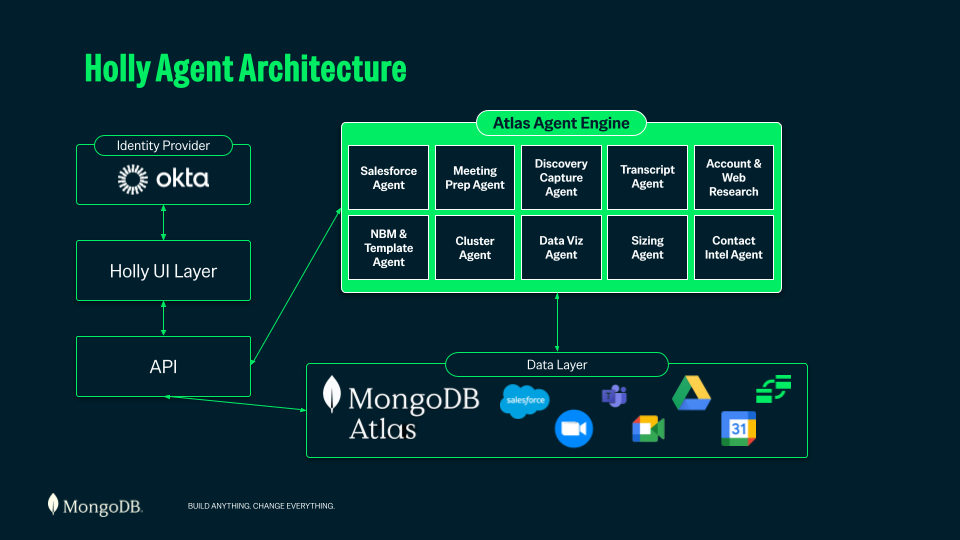
In practice, that means Holly curates and summarizes meeting transcripts, drafts briefs, surfaces questions a rep hasn't answered yet, and helps write outreach. The result: reps using Holly have cut the time it takes to research and build an outbound prospecting list by roughly 95%, and prep that used to take hours now takes minutes. This means that reps walk into every conversation better prepared, not just faster.
“Prior to Holly, I was using a dozen different tools to perform research and outreach, so having everything in a single interface has been a real value add,” said Bunkenburg. “Many tools don’t understand MongoDB’s business or exactly what we’re trying to accomplish with those tools, but Holly does.”
The intelligent data platform for the AI era
Going forward, the vision is for Holly to become a fully integrated intelligence layer that deeply understands MongoDB, our customers, and individual accounts—helping the entire GTM org execute end-to-end workflows more effectively.
The part that excites me most is what’s underneath Holly itself. Holly runs on roughly 30 agents today, all built on the same Atlas Agent Engine architecture. That architecture doesn't get shakier as you add agents to it; it was designed to hold whether you're running 30 or 3,000. We didn't just build a tool for our GTM team. We proved out a blueprint—one that scales safely with every new agent an organization adds, instead of accumulating risk with each one.
That's the shift Atlas Agent Engine represents: moving beyond one-off agents toward a governed, reusable platform that isn't tied to a single cloud, model, or framework. It's the difference between hoping your agents behave and knowing they will, no matter how many you're running.
The launch of Atlas Agent Engine is one of three major announcements MongoDB made this week, alongside MongoDB 9.0 and Atlas Infinite. The launches build on each other: MongoDB 9.0 strengthens the foundation every MongoDB customer already runs on, Atlas Infinite removes the limits on how that foundation can scale, and Atlas Agent Engine puts AI agents to work on top of both, governed and grounded in real-time data.
Builders have always chosen MongoDB because its document model fits the natural shape of application data and how AI systems represent and exchange information. That makes applications faster to build and easier to adapt. Companies increasingly choose MongoDB because it combines that native fit with live operational data, elastic scale, the freedom to run anywhere—and now, a platform purpose-built for the agentic era.
One platform. Any number of agents. Build, deploy, and run them where your data already lives—with MongoDB's intelligent data platform.
Next Steps
To learn more about how Atlas Agent Engine can help you build, deploy, and govern agents in production, check out our official announcement or the Atlas Agent Engine page.
Get started with these new capabilities today at mongodb.com/atlas. And to build the skills to move AI agents from prototype to production, explore MongoDB's new Skill Badges in governance, observability, and agentic platform evaluation.