


INTRODUCTION
Taiwan’s gaming innovator goes global
Founded in 2018, Yile Technology Co. Ltd., is a Taiwanese mobile game developer dedicated to developing a variety of games with a sense of entertainment that bring the atmosphere of leisure and entertainment to players.
In just four years, Yile Technology scaled rapidly releasing its first three games and has emerged as one of Taiwan’s leaders in social casino gaming now employing 200 people. The company's Online808 and GBAO Online games are mainly designed for the Chinese market. By August 2021, Online808 had more than 1 million members.
Yile Technology is constantly optimizing the quality of its games and they have global aspirations for their newly launched Pocket Casino game as a starting point towards becoming the world's leading internationally renowned online game company.
Mezi Wu, Research and Development Manager at Yile Technology, said: “In the face of the fiercely competitive casino games market, we have to focus on product optimization and user experience improvement. MongoDB Atlas frees us from the burden of basic operational maintenance and maximizes the use of our most valuable resources: our people.”
THE CHALLENGE
Game’s slow response impacts user experience
From the very beginning, Yile Technology had identified the potential of mobile gaming with more and more people turning to their smartphones for fun and excitement.
The company evaluated the preferences and mobile phone usage habits of Taiwanese users and decided to target the rapidly growing online casino games market. In an effort to provide the best experience for gamers, Yile Technology decided to deploy their first game on Google Cloud, eliminating the need to purchase and maintain hardware equipment, thereby strengthening the stability of game services and reducing the response time of the application service.
Yile Technology produced its first prototype game Online808 within a few months underpinned by a relational database (RDBMS). However, during the internal stress test stage, the team encountered performance issues. Even when there were as few as 50 players connected to the game at the same time, the game response time could be as long as 3 seconds, far exceeding the 0.5 seconds minimum they had set themselves.
With only three months left until the launch date, the R&D team needed to solve the problem quickly. After a careful and in-depth investigation into the cause, they worked out that the root cause was the way player data was being stored in the relational database they were using.
Mezi Wu explained that the relational database worked relatively well for some aspects of the application which didn't require complex data or fast response times. However, when they needed to access player profiles in large numbers at the same time, their database couldn't cope.
“Our team sought alternatives to find a database with much stronger horizontal scalability. After assessing the pros and cons of a variety of solutions on the market, we decided to build with MongoDB's document database,” Mezi Wu said.
THE SOLUTION
MongoDB Atlas delivers scale, great user experience, and reduces maintenance cost
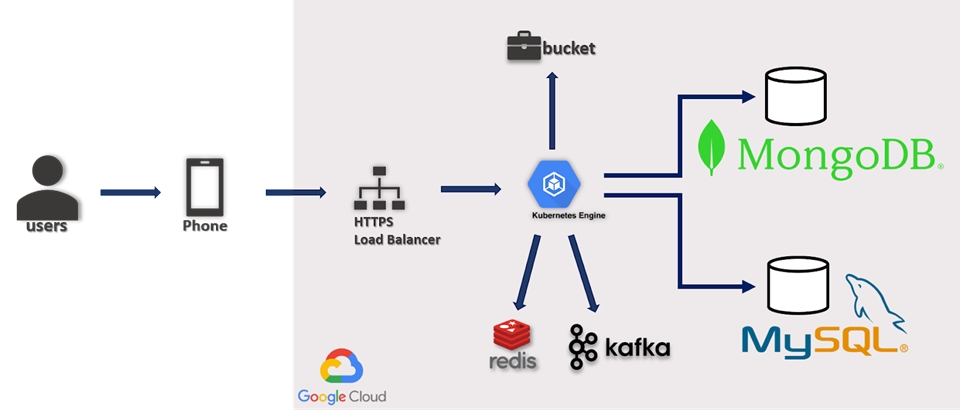
Although Yile Technology’s R&D team had not used MongoDB previously, they were impressed by the database's simple and easy-to-use features. Mezi Wu explained MongoDB’s extensive online resources and discussion forums also made it easier to become familiar with the technology and get started in a very short time. “Within a month, we had completely replaced the RDBMS and all customer profile data was stored on MongoDB, this included player status and previous behavior as well as some of the game’s operational data,” he said.
On the second round of the internal pressure test, the game’s responsive time improved significantly to well below the required 0.5 seconds, a more than 6x improvement. Powered by MongoDB, this responsiveness helped Online808 become the second best performing social casino game in Taiwan.
Their first game achieved a dazzling performance after launch and MongoDB enabled Yile Technology to scale well. However, the team was using the MongoDB community version and so they had to spend a lot of time manually working on system parameter adaptation, management, and performance alignment, which was creating a heavy burden for the R&D developers who wanted to focus on new features. They knew that as the company continued to grow, they needed more support.


_1.svg)