How do search APIs work?
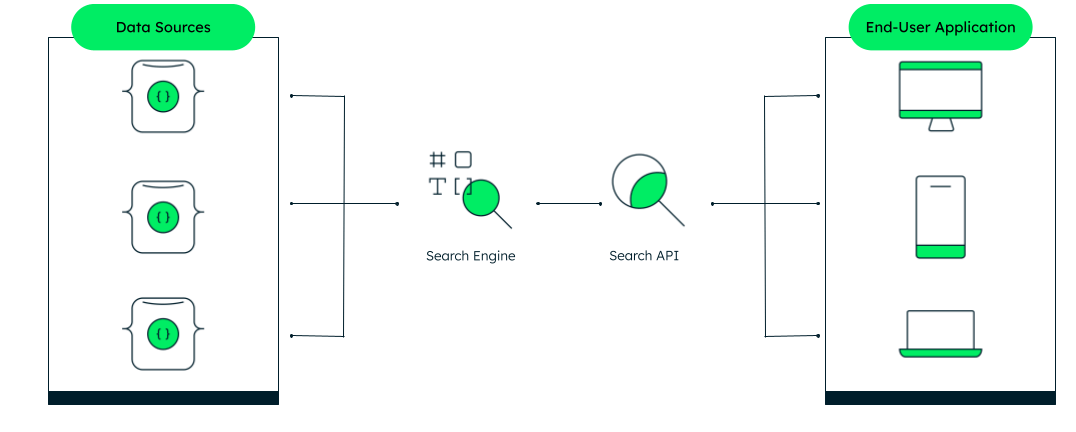
A search API streamlines the process of submitting a user query, retrieving relevant content, and formatting those search results for end-users.
There are several steps in this communication process.
What is a search API? What is the search engine communication process?
Query submission
Client applications send their search queries to the search API, providing their search criteria (e.g., keywords, filters) as well as results preferences such as sorting and format. This is accomplished by the API sending a request to a specific endpoint using HTTP (e.g., GET, POST). Each request sent from the client to the API server is considered a single API call, making it easy for developers to integrate search capabilities without maintaining complex back-end systems.
Query processing
Once the search API receives the search query from the client application, it parses the query to identify relevant keywords and filters. Some preprocessing may also take place at this time, including text normalization, spell checks, and stemming (e.g., reducing a word to its root) to improve search accuracy.
Query translation
The search API then translates the client application's web search query into a format that the underlying search engine can understand. This process includes converting queries into a specific programming language or adjusting the format of the queries into a format supported by the search engine (e.g., SQL, MongoDB query language, Lucene Query Syntax, JSON).
Query execution
Once translated, the search API then sends the web search query to the search engine for execution. The query is then processed against the search engine's index, where relevant search results are retrieved and ranked based on content relevance, website popularity, posting date, etc.
Results aggregation
After execution, the search results are returned to the search API in such formats as JSON or XML, allowing developers to refine web search outcomes into relevant information for their applications.
Response communication
The formatted, filtered, sorted search results are then sent back to the client application that created the query by the search API. The API also manages any exceptions that may happen during this process, including system errors.
Customization
Search APIs allow developers to tailor queries using custom scoring, sorting, and indexing.
Authentication and authorization
The search API may enforce authentication to protect sensitive data using various authorization tools such as an API key, authentication token, or other credentials to authenticate and authorize their API requests.