Build a retail advisor that uses MongoDB Atlas for product discovery, customer context, and memory across cooperating agents.
Use cases: Artificial Intelligence, Personalization
Industries: Retail
Products and tools: MongoDB Search, Vector Search, Voyage AI
Partners: Anthropic, Google Cloud
Solution Overview
Building AI agents appears straightforward with modern large language models (LLMs) and orchestration frameworks, but production agent systems often fail because of complex data management. Teams frequently stitch together separate databases for vector search, session history, memory, and audit logging. This fragmented database architecture increases latency, operational costs, and maintenance complexity.
In the retail industry, customers demand continuous, personalized interactions with distinct requirements:
Carol searches for road-marathon shoes in a size 8 with maximum cushioning.
John searches for trail-running shoes in a size 11 with waterproof material and minimal cushioning.
To support these scenarios, your system must retain short-term session history, customer preferences, and long-term memory across all channels. Siloed backend data systems prevent retailers from building a unified architecture that stores and shares the context needed to power production ready AI assistants.
MongoDB Atlas replaces fragmented datastores with a single, unified database platform that serves as your agentic data plane.
Deploy MongoDB Atlas to handle all five data needs of agentic AI natively:
Knowledge: Store product catalogs and vector embeddings together.
User Context: Maintain flexible customer profiles.
Session History: Retain conversation context across turns.
Long-Term Memory: Learn and update customer preferences over time.
Observability: Record tool execution paths and latencies.
The Multi Agent Retail Advisor (MARA) is a solution that demonstrates this unified data plane. MARA helps customers find the products that best fit their specific needs.
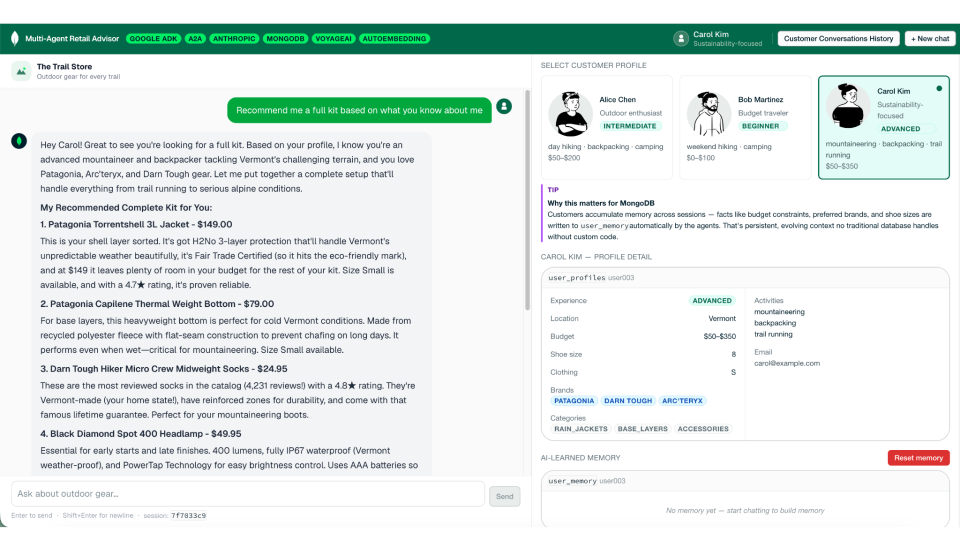
Figure 1. Overview of MARA system user interface
The solution combines three key architectural pillars:
Google Agent Development Kit (ADK): Orchestrates multi-agent workflows and manages agent interactions.
Agent-to-Agent (A2A) protocol: Standardizes network-based communication and dynamic discovery across agent boundaries.
MongoDB Atlas agentic data plane: Consolidates knowledge, user context, session history, memory, and observability into a single platform.
Reference Architectures
MARA’s agents communicate over the A2A protocol and use MongoDB Atlas as a shared data layer for product discovery, customer memory, and traceability.
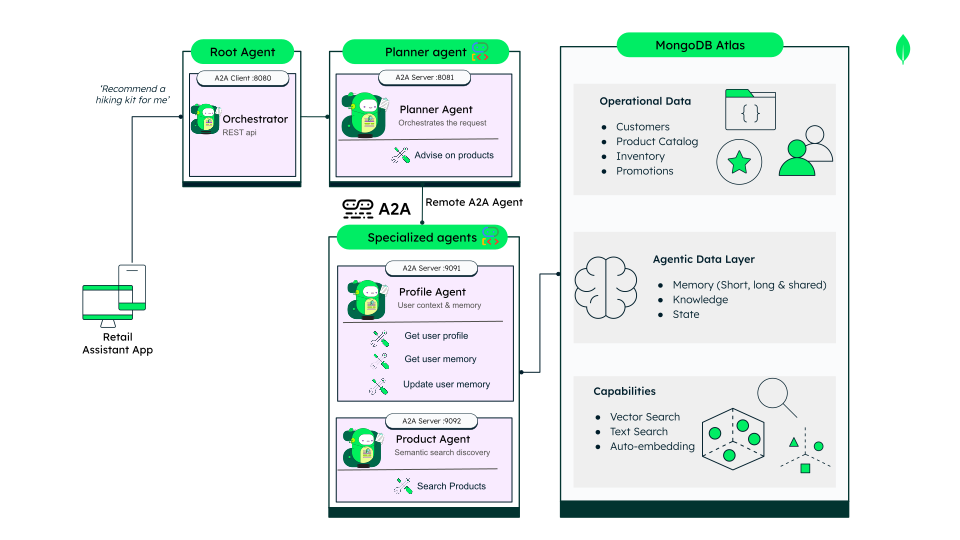
Figure 2. MARA reference architecture
Product Knowledge and Asymmetric Retrieval
MongoDB Atlas holds MARA’s product catalog and powers product discovery. Each product document contains a search_text field with searchable catalog details. Atlas automatically generates vector embeddings for this text using voyage-4-large. When a customer submits a query, the application embeds the request with the lighter voyage-4-lite model. Because Voyage 4 models share an embedding space, queries embedded by the lightweight model can directly search representations generated by the larger index model. This asymmetric retrieval approach combines high-quality indexed data with lower query-embedding cost and latency, balancing accuracy and compute efficiency.
The Product agent searches products with vector search and structured catalog filters. When native reranking is enabled, it reorders candidates before returning matches. Otherwise, the agent returns the vector search results directly.
Agent Collaboration and Memory
The Planner agent coordinates product recommendations. Through Agent-to-Agent (A2A) connections, it queries the Profile agent for customer context and the Product agent for matching catalog items. The Profile agent reads attributes from users and retrieves saved preferences from user_memory. When the interaction reveals a durable preference, the Profile agent can save it to user_memory. The Planner agent brings the specialists’ results together in its recommendation. ADK supports the agent workflow; MongoDB Atlas supplies the data beneath it.
The memory labels describe different roles for that data.
sessions: Records conversation messages.agent_state: Records workflow status, the interaction’s short-term record.user_memory: Holds learned facts that persist beyond one conversation."Shared memory": Refers to the common Atlas context layer accessed by agents based on their roles, rather than a separate database collection.
Traceability
A session identifier tracks all agent calls. Specialist tools record their agent names, tool names, inputs, outputs, and execution times to tool_invocations under that identifier. Combined with the session and workflow records, these traces make the observable sequence of an interaction reconstructible and comparable across runs. They support investigations of recommendations or failures, but they do not capture every internal model decision or guarantee identical wording across repeated requests.
Data Model Approach
Stitching together separate databases for vector search, session state, and logging increases cost. MongoDB Atlas consolidates all agent data into six dedicated collections.
Collection | Purpose |
|---|---|
products | Stores catalog items with automated vector embeddings. |
users | Maintains static customer preferences, favorite brands, and sizes. |
user_memory | Keeps persistent, learned preferences that accumulate across conversations. |
sessions | Holds chronological chat interaction history per customer conversation. |
agent_state | Tracks the active execution phase of each agent workflow. |
tool_invocations | Logs inputs, outputs, and execution latencies for debugging. |
Why AI Thrives with the Document Model
Modern AI requires managing the entire lifecycle of evolving context, such as data, memory, embeddings, retrieval, and real-time application state, in one flexible model.
The flexible document model handles evolving schemas without redesigning tables or coordinating disruptive migrations. Embedding related data, such as a customer profile, interaction history, preferences, and permissions, keeps frequently accessed context in one document. This reduces joins, simplifies queries, and improves response latency.
AI data is naturally document-shaped. Conversation history, agent memory, tool calls, metadata, and retrieved context are naturally represented as nested JSON-like structures. MongoDB documents map closely to application objects, reducing translation and Object-Relational Mapping (ORM) overhead.
Evolving Memories for Personalized Context
The users collection stores static customer attributes, such as shoe sizes and brand preferences. Because customer attributes are stored together in one document, the Profile agent retrieves a complete preference profile with a single, high-speed read query. This avoids the latency overhead of multi-table joins.
{ "name": "Carol Kim", "email": "carol@example.com", "preferences": { "brands": [ "Patagonia", "Darn Tough", "Arc'teryx" ], "price_range": { "min": 50, "max": 350 }, "categories": [ "rain_jackets", "base_layers", "accessories" ], "sizes": { "shoes": "8", "clothing": "S" } }, "profile": { "experience": "advanced", "activities": [ "mountaineering", "backpacking", "trail running" ], "location": "Vermont" }}The user_memory collection stores dynamic, learned facts that agents extract during conversations.
{ "user_id": "user003", "facts": [ "Prefers polyester base layers because they dry faster than cotton or other materials" ], "updated_at": "2026-08-12T23:08:44.886000"}The user.preferences.shoe_size field filters product catalog searches directly. The fact text field captures evolving insights, such as material preferences.
Static schemas and unstructured dynamic memories are stored in flexible JSON. The Profile agent queries both collections to assemble a complete customer state.
Maintaining Conversational Continuity with Nested Sessions
The sessions collection holds conversational history per customer conversation. Each document retains a chronologically ordered array of message objects.
{ "session_id": "6415c1c1-bbf5-4986-818c-f390c489cab5", "user_id": "user003", "messages": [ { "role": "user", "content": "What base layers work best for mountaineering in cold, wet conditions?", "timestamp": "2026-08-12T23:03:22.654000" }, { "role": "assistant", "content": "Hi Carol! Great to hear from you.\n\nBased on your preferences and mountaineering needs, here are my top recommendations:\n\n## **1. Icebreaker Merino 260 Tech Long Sleeve Crewe** — $129\n…", "timestamp": "2026-08-12T23:03:57.044000" }, { "role": "user", "content": "i like base layers to be Polyester because they dry faster than cotton or other materials", "timestamp": "2026-08-12T23:08:33.023000" }, { "role": "assistant", "content": "Hi Carol! I've saved your preference for polyester base layers.\n\nBased on what you're looking for, here are my top recommendations:\n\n**1. Arc'teryx Phase SL Crew Long Sleeve - $89*...", "timestamp": "2026-08-12T23:09:09.013000" } ], "created_at": "2026-08-12T23:03:22.635000", "updated_at": "2026-08-12T23:09:09.013000"}The messages array captures roles and text content per turn.
Relational databases require a secondary messages table and slow sort queries to rebuild threads. Storing chat history as a nested array inside a single document guarantees order. This enables the Planner agent to fetch the entire chronological session history with a single read path.
Enabling Smart Search by Unifying Operational and AI Data
The products collection integrates transactional fields with vector embedding arrays.
{ "name": "Patagonia Torrentshell 3L Jacket", "brand": "Patagonia", "category": "rain_jackets", "description": "The Torrentshell 3L is Patagonia's workhorse waterproof jacket built with H2No Performance Standard 3-layer shell. Fully seam-sealed and Fair Trade Certified, it packs into its own chest pocket. Ideal for unpredictable weather on trail or in town.", "price": 149, "size_options": ["XS",...], "attributes": { "waterproof": true, "eco_friendly": true, "insulated": false, "gender": "unisex" }, "colors": ["black"...], "rating": 4.7, "reviews_count": 2841, "search_text": "Patagonia Torrentshell 3L Jacket. Patagonia. Category: rain_jackets. The Torrentshell 3L is Patagonia's workhorse waterproof jacket built with H2No Performance Standard 3-layer shell. Fully seam-sealed and Fair Trade Certified, it packs into its own chest pocket. Ideal for unpredictable weather on trail or in town."}The price and productId fields handle standard retail transaction lookups. The search_text field combines the product name, brand, category, and raw description into a single string. The Atlas Vector Search index then targets this concatenated string using an automatic embedding configuration.
You do not need to store or manage vector arrays inside your
documents. The Auto-Embedding feature automatically vectorizes the search_text field in the background.
Because Voyage AI models share the same embedding space, you can pre-embed the catalog with voyage-4-large. You can then run user queries with low-latency voyage-4-lite. This asymmetric approach speeds up search and reduces execution costs.
Auditing Agentic Operations with Flexible Tool Traces
The tool_invocations collection records every tool call and execution detail.
[ { "session_id": "6415c1c1-bbf5-4986-818c-f390c489cab5", "agent_name": "ProfileAgent", "tool_name": "get_user_profile", "input": { "user_id": "user003" }, "output": { "name": "Carol Kim", "email": "carol@example.com", "preferences": { "brands": [ "Patagonia", "Darn Tough", "Arc'teryx" ], "price_range": { "min": 50, "max": 350 }, "categories": [ "rain_jackets", "base_layers", "accessories" ], "sizes": { "shoes": "8", "clothing": "S" } }, "profile": { "experience": "advanced", "activities": [ "mountaineering", "backpacking", "trail running" ], "location": "Vermont" } }, "latency_ms": 15, "timestamp": "2026-08-12T23:08:36.663000" }, { "session_id": "6415c1c1-bbf5-4986-818c-f390c489cab5", "agent_name": "ProfileAgent", "tool_name": "get_user_memory", "input": { "user_id": "user003" }, "output": { "user_id": "user003", "facts": ["prefers polyester material over cotton"], "note": "No memory stored for this user yet" }, "latency_ms": 15, "timestamp": "2026-08-12T23:08:36.698000" }, { "session_id": "6415c1c1-bbf5-4986-818c-f390c489cab5", "agent_name": "ProfileAgent", "tool_name": "update_user_memory", "input": { "user_id": "user003", "new_facts": [ "Prefers polyester base layers because they dry faster than cotton or other materials" ] }, "output": { "status": "ok", "user_id": "user003", "facts_added": 1 }, "latency_ms": 21, "timestamp": "2026-08-12T23:08:44.907000" }, { "session_id": "6415c1c1-bbf5-4986-818c-f390c489cab5", "agent_name": "ProductAgent", "tool_name": "search_products", "input": { "query": "Base layers Patagonia Arc'teryx mountaineering backpacking trail running advanced performance", "max_price": 350, "size": "S", "waterproof": null, "eco_friendly": null, "category": "base_layers" }, "output": [ { "name": "Patagonia Capilene Cool Daily Long Sleeve Shirt", "brand": "Patagonia", "category": "base_layers", "description": "The Capilene Cool Daily is made from recycled polyester …", "price": 65.0, "size_options": [ "XS", "S"], "attributes": { "waterproof": false, "eco_friendly": true, "insulated": false, "gender": "unisex" }, "colors": [ "black", "light bog green"], "rating": 4.5, "reviews_count": 2543, "vectorScore": 0.7558120489120483 }, … ], "latency_ms": 193, "timestamp": "2026-08-12T23:08:45.707000" }]Build the Solution
Use the MARA repository to explore the solution. The setup guide provides the detailed configurations and commands for the following phases:
Seed the catalog and search indexes
Run the repository’s seed procedure to load sample users and 135 outdoor products, and to create the vector and text search indexes. Atlas embeds the product search_text field in the background. Wait for indexing to complete before evaluating semantic product retrieval.
Verify search, memory, and traces
Request a product recommendation in the chat interface, then inspect the Agents, Trace, and MongoDB views. State a durable preference and start another conversation as the same sample user to check that the Profile agent retrieves the saved fact from user_memory. Inspect the session-linked tool records to see which specialists ran. This verifies learned-preference persistence, not automatic replay of the complete chat history to the Planner.
Key Learnings
Unify agent data: Retain the product catalog, customer profiles, learned preferences, session records, and tool traces in MongoDB Atlas.
Balance retrieval quality and query cost: Configure Atlas to embed catalog text with
voyage-4-largeand use the compatiblevoyage-4-litemodel for live customer queries. Evaluate retrieval quality for the application rather than assuming identical results.Separate agent responsibilities: Use the Planner agent to coordinate the Profile and Product agents over A2A, while each specialist accesses the Atlas data relevant to its role.
Persist learned preferences: Save durable customer facts in
user_memoryso the Profile agent can retrieve them in later conversations. Stored session messages are not automatically replayed to the Planner agent.Trace observable agent activity: Connect workflow state and tool records by session ID to investigate recommendations and failures without claiming to capture every internal model decision.
Authors
Alberto Camarena, MongoDB
Angie Guemes, MongoDB
Rodrigo Leal, MongoDB
Ronan Conlon, MongoDB
Daniel Jamir, MongoDB