Use cases: App-Driven Analytics, Interoperability, Modernization
Industries: Healthcare, Government Health Services, Life Sciences
Products: MongoDB Atlas, MongoDB Atlas Search
Partners: openEHR
Solution Overview
openEHR is a way to structure clinical records so their medical meaning remains consistent, even when applications and databases evolve. It separates the stable technical structure of the record from the clinical definitions used to model real-world concepts such as observations, medications, or diagnoses.
Technically, openEHR is a model-driven EHR architecture. Its Reference Model defines the stable structure of clinical records, while archetypes and templates add the clinical meaning and implementation constraints. Its primary record unit is the COMPOSITION, a hierarchical clinical document whose content is queried through AQL. AQL is independent of the storage model. It combines SQL-like clauses with hierarchical paths and CONTAINS predicates over nested clinical structures. Efficiently scaling these queries can be a challenge.
In practice, an openEHR repository often needs to support the following query families. The first corresponds to single-patient retrieval, for example opening the chart of a known patient or retrieving a specific clinical document within one EHR. The second involves cross-patient operational retrieval, for example building a cohort, finding patients that satisfy a safety rule, generating worklists, or identifying similar cases during care delivery. These operational queries must run close to the application workflow, with low and predictable latency.
Many implementations struggle to support both query patterns efficiently. Relational approaches can work well for patient-scoped retrieval, but large-scale cross-patient queries often introduce pressure through joins, schema churn, and template variation. Offloading those workloads to a separate analytical platform can help with retrospective analytics, but it creates duplication, adds latency, fragments governance and audit trails, and weakens the goal of a unified AQL query interface. It can also remove relevant clinical context when documents are flattened too aggressively.
Reconcile Clinical Query Families
This solution addresses that problem with a document-first, semi-flattened persistence model on MongoDB. Semi-flattened means that we flatten each element as a node in an array, but each preserves the full JSON payload in the original structure. Document-first means that each openEHR composition is preserved as one MongoDB document, rather than being decomposed into one table per archetype or one row per path. At the same time, the composition is materialized as a reconstructable node array, enabling efficient path-based querying without abandoning the composition as the operational unit.
Each stored node retains the following key elements:
Local clinical subtree, so the original meaning and context remain available.
Positional metadata, so structure and ordering can be reconstructed.
Reversed AQL path, which enables efficient matching of variable-depth path constraints.
The reversed path is a general query key used to evaluate structural predicates efficiently across both the patient-scoped and cross-patient execution routes. It supports path-constrained matching across different execution strategies, including regex-based matching and wildcard-style path resolution in search indexes. The same query patterns can be applied when predicates use other textual path components or textual conditions.
With this model, AQL clauses can be compiled deterministically into MongoDB query stages. FROM, CONTAINS, and WHERE constraints become targeted predicates over node paths and values. This approach keeps the composition intact as the primary clinical container while still making operational retrieval practical at scale.
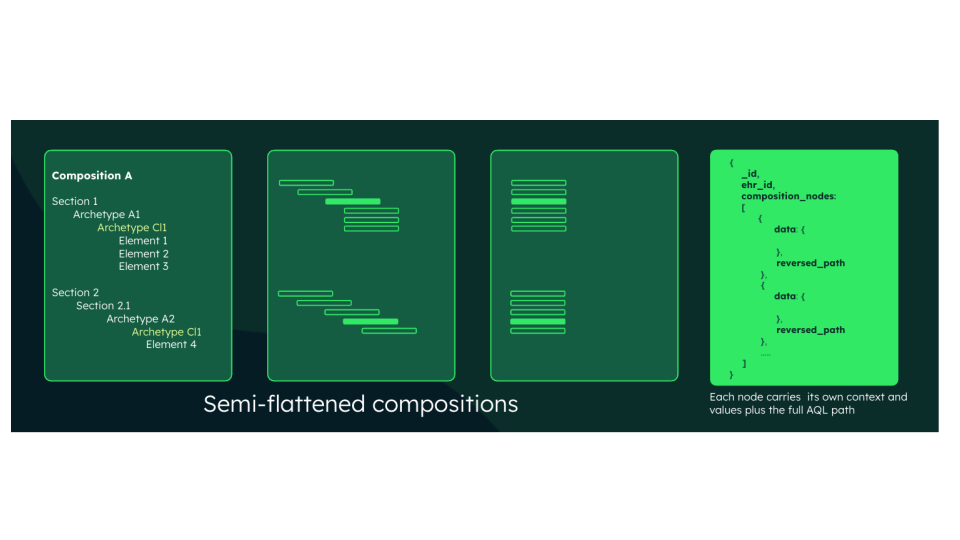
Figure 1. Representation of semi-flattened compositions where each node carries its own context and values plus the reversed AQL path
Note
For a concise published summary of the architecture and evaluation, read the peer-reviewed conference abstract. For the full design, including the semi-flattened persistence model, deterministic AQL-to-MQL compilation, and benchmark details, read the full technical paper.
Routing by Workload
For many repositories, a single semi-flattened collection and wilcard indexes are sufficient. For larger deployments, the model can use a slim search projection that contains only the data needed for wide cross-patient filtering. Query execution is then routed by scope. A slim search projection is a smaller derived collection that stores only the node fields needed for broad cross-patient filtering. It does not replace the main composition document. It reduces index breadth and search cost for wide operational queries.
Therefore, it provides the following modalities:
Patient-scoped queries run on the main composition collection, using targeted indexes such as a compound index on fields like
ehr_idandreversed_path.Cross-patient queries run against the slimmer projection, compiling path constraints into wildcards or matches on the reversed path, and value predicates into equality, range, or search operators.
This execution model provides a single query interface, allowing different physical access paths based on workload size and selectivity.
Why Supporting Operation Cohort Queries Matter
Modern clinical applications increasingly need both query families on the same platform. A clinician might need to open one patient record immediately and ask questions such as:
Which patients received a certain medication in a given time window?
Which patients match a protocol or safety rule?
Which prior cases are clinically similar to this one?
These operational questions require answers without pushing data through repeated ETL cycles into separate systems.
A document-first, semi-flattened model preserves the strengths of openEHR and makes those workloads practical. It keeps the composition as the authoritative operational unit, preserves clinical fidelity through reconstructable structure, and avoids forcing application teams to choose between a patient-centric store and a separate cross-patient platform. Smaller repositories can remain simple, with one semi-flattened collection. Larger repositories can add a smaller projection to reduce the cost of broad operational filtering.
In our evaluation, this approach maintained low end-to-end latency across both workload types, with low response times for patient-scoped and cross-patient queries, even at large scale. This efficiency validates it as a practical foundation for openEHR repositories that must support operational retrieval, provenance-aware processing, semantic enrichment, and AI-driven workflows from one platform.
Note
Production proof point: This architecture is validated in production on a repository with more than 1.2 billion persisted documents.
You can explore this pattern with kehrnel, an experimental reference runtime and toolkit for document-first clinical data strategies.
Following this approach gives you the following practical benefits:
A reconstructable semi-flattened model that preserves composition fidelity.
Efficient patient-scoped querying without forcing a relational shred of the clinical document.
Support for cross-patient operational retrieval without defaulting to a warehouse-first architecture.
One operational query surface for application teams, instead of duplicated stores and fragmented logic.
A path to lower ETL overhead, lower governance drift, and lower total cost of ownership.
What Is Kehrnel and Why Use It?
Kehrnel is a strategy runtime that turns healthcare data models into operational capabilities. Kehrnel exists because defining a healthcare data model is not enough. Teams also need a repeatable way to validate data, transform it into an operational representation, ingest it, query it, maintain it, and evolve it as requirements change. Without that execution layer, models often remain documentation, storage schemas, or isolated specifications.
The goal is broader than building an openEHR engine. Kehrnel provides a repeatable document-first approach for making healthcare data models executable, inspectable, and reusable across APIs, tooling, and AI workflows. Over time, the same runtime pattern can support other model families and operational strategies, including FHIR, synthetic data workflows, semantic catalogs, natural language retrieval, and other domain-specific tools.
Kehrnel is designed around exposed workflows that can be customized for the needs of each persistence strategy. Each strategy can define its own activation, validation, ingestion, transformation, query, synthetic-data, and maintenance operations, while still using a consistent runtime model.
Kehrnel starts with openEHR because openEHR is a demanding, semantic-rich model. It includes archetypes, templates, paths, terminology, and complex query behavior. That makes it a strong foundation for proving a model-driven runtime approach.
For this solution, Kehrnel serves as the reference runtime and toolkit for the document-first persistence pattern.
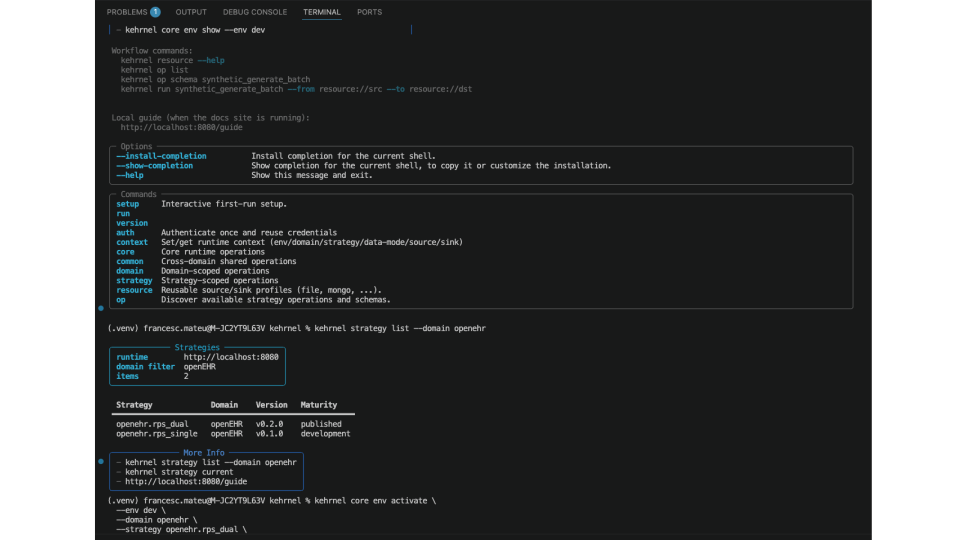
Figure 2. Kehrnel CLI screenshot
Reference Architectures
Figure 3 shows the end-to-end flow of this strategy in kehrnel, from canonical openEHR input to routed query execution.
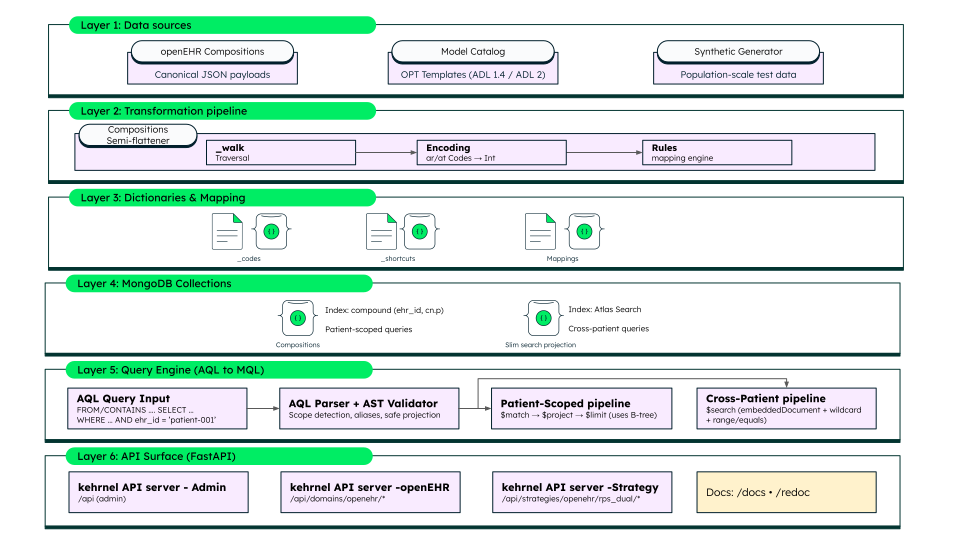
Figure 3. AQL compiler and routing runtime (kehrnel)
Layer 1: Data sources starts with canonical openEHR compositions, the model catalog of operational templates, and optional synthetic data used for testing at scale. The OPT is the compiled runtime artefact derived from archetypes and templates. Operational systems use the OPT for validation and path-aware processing.
Layer 2: The transformation pipeline converts each incoming composition into the persisted representation used by this strategy. The semi-flattening step scans the composition hierarchy, applies path and code encoding, and uses mapping rules to materialize queryable nodes. The result produces one semi-flattened MongoDB document per composition, with stored nodes that keep a local clinical subtree, positional metadata, and a reversed path key.
Layer 3: Dictionaries and mapping store the helper artefacts required for this strategy. _codes and _shortcuts support compact path resolution and encoding. Mappings store the strategy-specific rules that drive transformation and query compilation.
Layer 4: MongoDB collections show the persistence options. The primary compositions collection stores the semi-flattened composition documents and serves patient-scoped execution through a compound index on ehr_id and cn.p. For large repositories, the optional search collection stores a slim projection of the node data points needed for cross-patient filtering. This collection is indexed with MongoDB Atlas Search. The dual-collection pattern keeps search mappings narrower and search cost lower.
Layer 5: Query engine is where kehrnel parses and routes AQL. The runtime accepts an AQL statement, validates the AST, resolves aliases and safe projections, detects whether the query is patient-scoped or cross-patient, and emits the appropriate MQL route. When the query includes ehr_id, the runtime emits a patient-scoped aggregation pipeline over the compositions collection, typically using stages such as $match, $project, $sort, and $limit. When the query is cross-patient, the runtime emits a search-first pipeline over the slim projection, using operators such as embeddedDocument, wildcard, range, and equals inside a compound filter. While it can keep some cross-patient queries on the base collection when template/time/order predicates are match-friendly.
Layer 6: Runtime interfaces, exposes this strategy through both the kehrnel CLI and the HTTP API. The CLI supports operator workflows such as environment setup, strategy activation, compilation, and query execution. The API exposes the same runtime capabilities for integration, automation, and interactive documentation.
This layered design provides application teams one logical operational query surface and enables different access paths based on repository size, query scope, and workload selectivity.
Data Model Approach
Store each composition as one MongoDB document, persisted in a semi-flattened form. Each stored node contains:
Local clinical subtree
Reversed path key
Positional metadata for reconstruction
This structure makes the model document-first and queryable at scale. You avoid creating a table-per-archetype layout, and forcing every query to use only the original nested JSON shape.
In this model, openEHR paths remain first-class. The persisted document keeps the composition as the operational unit, and the node array gives the compiler a deterministic structure to query.
The following simplified document shows a readable persisted composition example. It is formatted for explanation, so field names and path values are easier to follow than in a compact production encoding.
{ "_id": "...", "ehr_id": "patient-001", "composition_id": "c-001", "template_id": "openEHR-EHR-COMPOSITION.vaccination_list.v0", "version": 1, "cn": [ { "p": "ACTION.medication.v1.SECTION.immunisation_list.v0.COMPOSITION.vaccination_list.v0", "kp": "content[0]/items[0]", "pi": [0,0], "bk": "b1", "data": { "time": { "value": "2026-01-15T10:30:00Z" }, "other_participations": { "performer": { "identifiers": { "id": "038321545" } } }, "code": { "value": "J07BX03" } } } ] }
How to Read This Document
One MongoDB document represents one openEHR composition. The cn array stores the queryable nodes extracted from that composition. Each node keeps a local clinical subtree in data, a reversed path key in p, and positional metadata such as kp, pi, and bk so the original structure can be reconstructed.
The public example shows the path key in a readable form to make the translation easier to follow. In production, you can store the same path as compact dictionary-encoded tokens to reduce path size and index footprint
Reversed Path Encoding
The stored path field represents the key optimization. Reference-model attributes and archetype node identifiers build openEHR paths. This solution uses a reversed stored path, allowing containment constraints to be evaluated with prefix-friendly matching instead of leading-wildcard scans. This setup works with standard regex-based matching in the patient-scoped route and with wildcard-style matching in the search route.
Deterministic AQL to MQL Translation
AQL is independent of the storage-model, making deterministic compilation effective. SQL clauses translate to MQL as follows:
FROMandCONTAINSbecome structural path predicates.WHEREbecomes value predicates on the matched node payloads.SELECTbecomes projection.ORDER BYbecomes sorting.
The following example illustrates an AQL query.
SELECT e/ehr_id/value AS ehrId, c/uid/value AS compositionId, med_ac/description[at0017]/items[at0140]/items[at0141]/value/defining_code/code_string AS locationCode FROM EHR e CONTAINS COMPOSITION c[openEHR-EHR-COMPOSITION.vaccination_list.v0] CONTAINS ( CLUSTER adminInfo[openEHR-EHR-CLUSTER.admin_salut.v0] AND SECTION[openEHR-EHR-SECTION.immunisation_list.v0] AND ACTION med_ac[openEHR-EHR-ACTION.medication.v1] ) WHERE med_ac/time/value >= '2000-04-13T07:54:16.345Z' AND med_ac/time/value <= '2026-02-13T07:54:16.345Z' AND adminInfo/items[at0007]/items[at0014]/value/defining_code/code_string = 'E08019820' AND med_ac/other_participations/performer/identifiers/id = '038321545' ORDER BY med_ac/time/value DESC
What This AQL Asks For
This query combines structural and value-based constraints. The CONTAINS clause defines the required openEHR structures, in this case a vaccination composition that contains an administrative cluster and a medication action. The WHERE clause then adds predicates on the action time, the performer identifier, and an administrative code.
This query type benefits from deterministic compilation. It expresses conditions over hierarchical clinical structures and node-local values.
How the Compiler Maps AQL to MQL
The compiled MQL follows the same logic as the AQL:
The top-level
ehr_idfilter makes the query patient-scoped.The
$allclause requires all structural branches described by the AQL to be present in the same composition.Each
$elemMatchbinds a path predicate and its value predicates to the same stored node.The predicate on
pis the compiled form of the structuralCONTAINSlogic.The predicates under data are the compiled form of the
WHEREconditions.In a full pipeline, the compiler then adds the projection and sorting stages that correspond to
SELECTandORDER BY.
The next example shows a simplified patient-scoped MQL pattern generated from the AQL query above. It illustrates the compiler logic, not a byte-for-byte runtime payload.
// Simplified compiler output for a single-EHR query. // Projection and sorting stages are omitted here for clarity. db.compositions.aggregate([ { "$match": { "ehr_id": "b416bc97-de39-43f5-9d47-712af6688947~r1", "cn": { "$all": [ { "$elemMatch": { "p": { "$regex": /^ACTION\.medication\.v1(?:\.[^.]+)*\.SECTION\.immunisation_list\.v0(?:\.[^.]+)*\.COMPOSITION\.vaccination_list\.v0$/ }, "data.time.value": { "$gte": ISODate("2000-04-13T07:54:16.345Z"), "$lte": ISODate("2026-02-13T07:54:16.345Z") }, "data.other_participations.performer.identifiers.id": "038321545" } }, { "$elemMatch": { "p": { "$regex": /^at0014\.at0007\.CLUSTER\.admin_salut\.v0(?:\.[^.]+)*\.COMPOSITION\.vaccination_list\.v0$/ }, "data.value.defining_code.code_string": "E08019820" } } ] } } } ]);
How the Same Logic Moves to the Search Route
The logical translation stays the same in the cross-patient route. The difference is physical execution. Instead of matching on the main compositions collection, the compiler targets the slim search projection. Structural constraints on the reversed path become wildcard filters, and value predicates become range and equality filters.
The next example shows a MQL pattern generated from an AQL not bound to one patient. As before, it illustrates the compiler logic, not a byte-for-byte runtime payload.
{ "$search": { "index": "search_nodes_index", "compound": { "filter": [ { "embeddedDocument": { "path": "sn", "operator": { "compound": { "filter": [ { "wildcard": { "path": "sn.p", "query": "ACTION.medication.v1*SECTION.immunisation_list.v0*COMPOSITION.vaccination_list.v0" } }, { "range": { "path": "sn.data.time.value", "gte": ISODate("2000-04-13T07:54:16.345Z"), "lte": ISODate("2025-04-13T07:54:16.345Z") } }, { "equals": { "path": "sn.data.other_participations.performer.identifiers.id", "value": "038321545" } } ] } } } } ] } } }
Repeated Structures and Same-Path Siblings
Some openEHR structures can contain repeated sibling nodes with the same effective path, for example repeated EVENTs. These cases require the compiler to push the predicates deeper so the conditions are satisfied by the same repeated item. In standard aggregation, that means deeper nested $elemMatch. In the search route, the equivalent is embeddedDocument, which binds multiple conditions to the same embedded array element.
Build the Solution
Use the kehrnel, available in this repository, as the reference runtime and toolkit for this pattern. Kehrnel provides the strategy lifecycle, validation flow, semi-flattening pipeline, and AQL compilation path used to ingest canonical openEHR compositions and route operational queries through the correct execution path.
At activation time, kehrnel exposes the strategy through manifest.json, uses defaults.json as the activation baseline, validates overrides with schema.json, and applies the storage and index plan described by the strategy implementation and spec.json. The recommended path is to let kehrnel create collections and B-tree indexes from the active config rather than creating them manually in MongoDB first.
The repository positions kehrnel as an experimental runtime for demonstration, teaching, rapid prototyping, and proof-of-concepts. To reproduce this solution in your own environment, follow these steps:
Set up MongoDB on Atlas
Create an Atlas cluster and decide which database will hold the strategy data.
At this stage, you only need the target database name and the connection string.
For MacOS and Linux:
export MONGODB_URI="<your-atlas-connection-string>" export MONGODB_DB="openEHR_demo"
For Windows Powershell:
set MONGODB_URI=<your-atlas-connection-string> set MONGODB_DB="openEHR_demo" exit
Clone the GitHub repository and start the kehrnel
Clone the repository, and start the runtime with ./startKehrnel. This entrypoint prepares the local environment automatically and keeps the first run simple.
git clone https://github.com/mongodb-industry-solutions/kehrnel cd kehrnel ./startKehrnel export RUNTIME_URL="${RUNTIME_URL:-http://localhost:8080}" Alternative direct API entrypoint: uvicorn kehrnel.api.app:app --reload --port 8080
After startup, confirm the runtime is reachable and use kehrnel as the control plane for the rest of the workflow.
Once started, kehrnel exposes a Docusaurus site at the route http://localhost:8080/guide. Figure 4 shows the site.
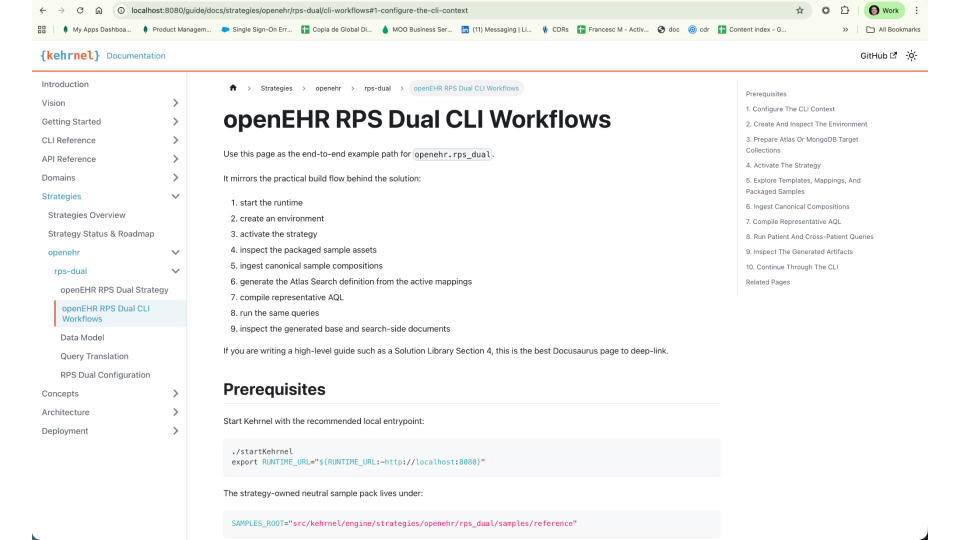
Figure 4. Kehrnel documentation
Configure the CLI context and create an environment
Point the CLI to the running runtime, create the target environment, and inspect it. The environment is the unit of activation in kehrnel. It isolates strategy configuration, bindings, generated artifacts, and operational state without forcing changes in strategy code.
Point the CLI at the running kehrnel runtime kehrnel context set --runtime-url "$RUNTIME_URL" kehrnel core health kehrnel core env create --env dev --name "Development" kehrnel core env list kehrnel core env show --env dev
Discover and activate the strategy
Kehrnel supports multiple environments, domains, and strategies. In this walkthrough, explicitly select the openehr domain and the openehr.rps_dual strategy.
Use src/kehrnel/engine/strategies/openehr/rps_dual/defaults.json as the baseline config, and add a small override file only when you want to change collection names, field labels, search enablement, dictionaries, separators, coding policies, or mappings.
Activation is the step where kehrnel materializes the configured collections and B-tree indexes from the active strategy config. For the packaged reference example, the activation override file points the strategy to the packaged projection mappings. Dictionary bootstrap is then applied according to the strategy’s activation settings.
Note
To understand the full openehr.rps_dual configuration surface and the supported changes you can apply, see the strategy configuration guide. This guide explains what each setting in the strategy baseline controls, including collection names, field labels, search-side enablement, dictionary seeds, path separator, and coding policies
mkdir -p .kehrnel Local plaintext MongoDB bindings for the walkthrough cat > .kehrnel/bindings.mongo.yaml <<EOF db: provider: mongodb uri: ${MONGODB_URI} database: ${MONGODB_DB} EOF Packaged activation override for the reference dual-collection example kehrnel core env activate \ --env dev \ --domain openehr \ --strategy openehr.rps_dual \ --config src/kehrnel/engine/strategies/openehr/rps_dual/samples/reference/activation.config.json \ --allow-plaintext-bindings \ --bindings .kehrnel/bindings.mongo.yaml \ --force Ensure bundled dictionaries are present kehrnel run ensure_dictionaries --env dev --domain openehr Generate the Atlas Search definition derived from the active mappings kehrnel strategy build-search-index \ --env dev \ --domain openehr \ --strategy openehr.rps_dual \ --out .kehrnel/search-index.json
Prepare templates, mappings, and canonical compositions
Work with strategy-owned sample assets under src/kehrnel/engine/strategies/openehr/rps_dual/samples or with your own canonical openEHR inputs.
Use OPT templates to validate or generate compositions.
Use the packaged projection mappings when you want the search-side collection to be built from the same configuration that drives ingest and search-index generation.
SAMPLES_ROOT="src/kehrnel/engine/strategies/openehr/rps_dual/samples/reference" Inspect the packaged reference assets ls "$SAMPLES_ROOT/templates" ls "$SAMPLES_ROOT/queries" ls "$SAMPLES_ROOT/envelopes" ls "$SAMPLES_ROOT/projection_mappings.json" \ "$SAMPLES_ROOT/search_index.definition.json" \ "$SAMPLES_ROOT/manifest.json" Optional: generate and validate a sample composition from a packaged OPT kehrnel common generate -- \ -t "$SAMPLES_ROOT/templates/sample_laboratory_v0_4.opt" \ -o .kehrnel/composition.json \ --random kehrnel common validate -- \ -c .kehrnel/composition.json \ -t "$SAMPLES_ROOT/templates/sample_laboratory_v0_4.opt" \ --stats Optional: generate a starter source-to-canonical mapping skeleton kehrnel common map-skeleton -- \ "$SAMPLES_ROOT/templates/sample_laboratory_v0_4.opt" \ -o .kehrnel/mapping.skeleton.yaml \ --macros
Ingest compositions
Ingest compositions through the strategy. The packaged NDJSON envelopes are canonical openEHR composition wrappers that include the masked composition plus metadata such as ehr_id, template_id, composition_version, and time_committed.
Use kehrnel run ingest here, while this walkthrough starts from canonical openEHR envelopes and needs the strategy to produce the semi-flattened base document and, when mappings exist for the template, the optional search-side projection document.
The local-file flags below are only a guardrail that allows the runtime to read the packaged sample NDJSON from your working tree.
When mappings exist for a template, kehrnel also creates the optional search-side document in compositions_search. If no mappings exist for a template, it skips that sidecar instead of emitting empty arrays.
The CLI expands the local NDJSON into documents before sending the request. kehrnel run ingest \ --env dev \ --domain openehr \ --strategy openehr.rps_dual \ --set file_path="$SAMPLES_ROOT/envelopes/all.ndjson"
Compile and inspect AQL
Compile representative AQL before executing it.
Confirm the resolved scope, the emitted MQL, and the selected execution path.
This compilation step is the key operational contract of the pattern. Applications stay on AQL, while kehrnel handles deterministic translation and execution planning against the storage model.
Compile only: inspect the execution plan without running the query kehrnel core env compile-query \ --env dev \ --domain openehr \ --aql "$SAMPLES_ROOT/queries/patient_laboratory_by_ehr.aql" kehrnel core env compile-query \ --env dev \ --domain openehr \ --aql "$SAMPLES_ROOT/queries/cross_patient_laboratory_by_performing_centre.aql"
Run operational queries
Run both a patient-scoped query and a cross-patient query against the same environment. This execution demonstrates the core value of the pattern: one operational query surface, with the runtime choosing the right physical execution path for the workload.
For patient-scoped queries, the runtime can target the main semi-flattened collection with indexed $match, $project, $sort, and $limit stages. For broader operational retrieval, the runtime can route through the search-oriented path when the query shape benefits from it.
Execute both representative queries kehrnel core env query \ --env dev \ --domain openehr \ --aql "$SAMPLES_ROOT/queries/patient_laboratory_by_ehr.aql" kehrnel core env query \ --env dev \ --domain openehr \ --aql "$SAMPLES_ROOT/queries/cross_patient_laboratory_by_performing_centre.aql"
Explore the generated artifacts
Inspect the generated MongoDB documents, the optional search-side projection, and the Atlas Search index definition to verify the document-first design.
You can see how canonical compositions remain the source input, how the semi-flattened form supports deterministic querying, and how mappings drive the search-side projection rather than duplicating the whole document blindly.
Inspect the generated base and search-side documents mongosh "$MONGODB_URI/$MONGODB_DB" <<'MONGOSH' db.compositions_rps.findOne({}, { ehr_id: 1, tid: 1, time_c: 1, cn: { $slice: 3 } }) db.compositions_search.findOne({}, { ehr_id: 1, comp_id: 1, tid: 1, sort_time: 1, sn: 1 }) MONGOSH Inspect the generated Atlas Search definition cat .kehrnel/search-index.json
Extend the pattern through the CLI
Once the base flow works, continue with the CLI rather than dropping straight into custom API wiring. The CLI already exposes the main operational building blocks:
Environment lifecycle
Strategy activation
Dictionary setup
Search-index generation
Query compilation
Query execution
This toolkit makes kehrnel the natural control plane for strategy work. A separate application or UI can sit on top of it, but the strategy itself remains portable, inspectable, and operable directly through the runtime and CLI.
Continue through the CLI for strategy operations and discovery kehrnel op capabilities --env dev kehrnel op schema synthetic_generate_batch --strategy openehr.rps_dual kehrnel run rebuild_codes --env dev --domain openehr kehrnel run rebuild_shortcuts --env dev --domain openehr kehrnel run build_search_index_definition \ --env dev \ --domain openehr \ --strategy openehr.rps_dual
Note
Do you want to experiment with this pattern in a guided sandbox? The Healthcare Data Lab builds on kehrnel to help teams model, query, and test document-first healthcare data strategies, including this openEHR persistence approach. It is currently available in private preview. Contact your MongoDB account representative to request access.
Key Learnings
Persist compositions as semi-flattened documents: Keep one MongoDB document per composition, but store it in a reconstructable semi-flattened form rather than as a raw nested payload.
Encode and reverse paths for efficient matching: Turn AQL structural paths into compact reversed tokens so
CONTAINScan map to prefix-friendly predicates.Route AQL by scope: Use
ehr_idto keep patient-scoped queries local and send cross-patient queries to Atlas Search when appropriate.Choose one collection or two based on scale: A single semi-flattened collection can work well, but very large repositories benefit from a slim search projection.
Keep one operational query surface: Let application teams stay on AQL while the runtime handles deterministic compilation and execution planning.
Authors
Francesc Mateu Amengual, MongoDB
Giovanni Rodriguez, MongoDB
Greg Cox, MongoDB
Juan Crossley, MongoDB
Learn More
Check the openEHR standards
Check the openEHR AQL specifications