Learn how to model, search, navigate, and ground SNOMED CT clinical terminology with MongoDB Atlas.
Use cases: Interoperability
Industries: Healthcare
Products: MongoDB Atlas, MongoDB Search, MongoDB Vector Search, Voyage AI
Solution Overview
Healthcare applications need to understand clinical meaning, not only store clinical text. A doctor may write “heart failure,” “cardiac failure,” or “insuficiencia cardíaca.” Different words can describe the same clinical idea. Clinical coding gives applications a standard way to represent that meaning with stable identifiers.
Healthcare teams use different coding systems for different purposes. Some coding systems group diagnoses and encounters for reporting, statistics, reimbursement, or hospital activity analysis. SNOMED CT focuses on clinical meaning inside the health record. It can represent problems, findings, procedures, body structures, organisms, substances, products, and many other clinical ideas. SNOMED CT supports applications to search, exchange, analyze, or reason over clinical facts recorded in an electronic health record.
SNOMED International describes SNOMED CT as a clinical terminology with concepts that have unique meanings, formal definitions, and hierarchical organization.
SNOMED CT has a graph-like structure. There are more than 500,000 clinical concepts where each can have several human-readable descriptions, including synonyms and translations. It can have parent concepts, child concepts, ancestors, and formal relationships to other concepts. SNOMED CT represents terminology content through concepts, descriptions, and relationships as follows:
A concept represents a clinical idea.
A description links a human-readable term to that concept.
A relationship connects one concept to another.
This structure is powerful, but it creates implementation challenges. Application teams need fast term search, multilingual lookup, hierarchy navigation, descendant expansion, and relationship inspection. They also need to use SNOMED’s terminology inside workflows such as clinical note review, problem-list creation, decision support, cohort discovery, and semantic search. Traditional implementations often split these needs across several systems:
A relational database for the terminology files.
A search engine for text lookup.
A graph database for hierarchy traversal.
A vector database for semantic search.
This solution shows how to operationalize SNOMED CT on MongoDB Atlas as follows:
Store each SNOMED concept as a MongoDB document that keeps the concept identity, descriptions, relationships, parents, children, and ancestor paths together.
Build one term-level search projection for MongoDB Search and MongoDB Vector Search.
Use ancestor arrays and multikey indexes to support common hierarchy and descendant queries without a separate graph database.
Use the same terminology service to ground clinical notes to SNOMED candidates
Store reviewed codings with evidence, context, and ancestor paths.
For example, a user can search for “heart failure,” inspect the selected clinical concept, see its parent and child concepts, review its formal relationships, and expand specific concepts below it. SNOMED CT, often utilizes ECL to express this type of descendant expansion. ECL functions as a compact query language for describing sets of SNOMED CT concepts. For example, the expression << Heart failure refers to “heart failure and all concepts below it in the hierarchy.” In MongoDB’s schema design, this pattern maps naturally to a query over precomputed ancestor arrays. SNOMED’s official ECL reference defines the operator << as “descendant or self of,” which retrieves a concept and its subtypes.
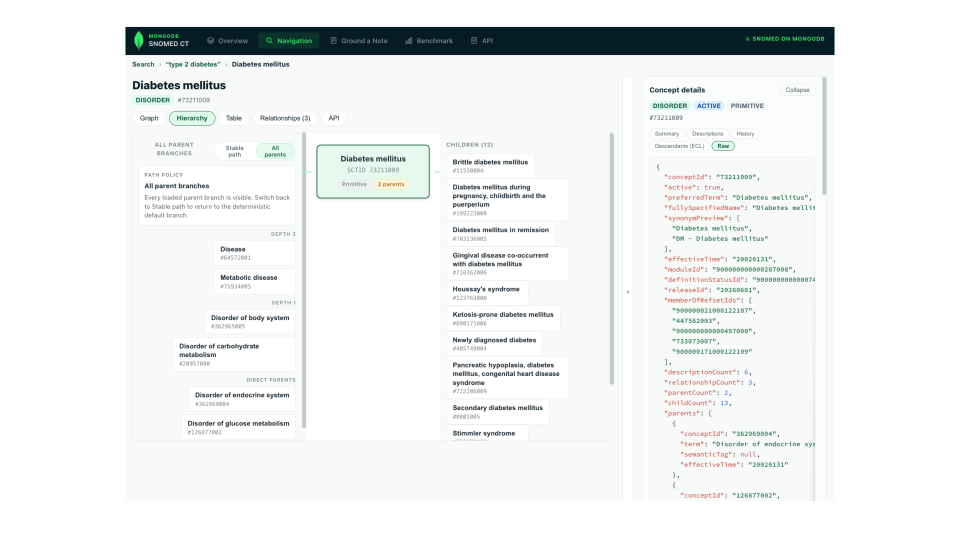
Figure 1. Clinical concept with its hierarchy of parents and children
The solution also demonstrates clinical note grounding. A note may contain present findings, past history, family history, planned actions, uncertain statements, and negated findings. The application extracts candidate clinical terms, searches SNOMED CT through MongoDB, proposes candidate concepts, and stores reviewed codings only after confirmation. The stored coding keeps the original evidence span, the selected SNOMED concept, the assertion context, the reviewer status, and the ancestor path. Downstream applications can then query by clinical meaning, not only by exact words.
Use this solution when you need to:
Search clinical terms, synonyms, translations, and SNOMED identifiers.
Navigate parent, child, ancestor, descendant, and relationship views.
Support lexical, semantic, and hybrid terminology search from one MongoDB collection.
Expand concept sets with ECL-style hierarchy expressions such as “all descendants of heart failure.”
Ground clinical notes to SNOMED CT candidates with evidence spans and human review.
Store reviewed SNOMED codings with ancestor paths for indexed downstream queries.
This pattern gives application teams one operational platform for terminology data, terminology search, semantic retrieval, hierarchy queries, clinical evidence capture, and audited coding output. It reduces the need to run separate systems for document storage, search, semantic retrieval, and graph-style navigation.
SNOMED CT licensing note: The public repository associated with this solution, includes only a small sample dataset. SNOMED CT requires proper licensing.
Reference Architectures
This reference architecture consists of a Navigation and a ground Clinical Note workflow.
Navigation helps a terminology user search, inspect, and scope SNOMED CT concepts. Ground Clinical Note reuses the same terminology retrieval layer, using deterministic lexical search by default, to propose SNOMED CT candidates from clinical text and store only reviewed codings.
The architecture uses a set of MongoDB collections:
The
snomed-irbdcollection stores the source-of-truth terminology view.The
snomed-term-searchsupports high-quality terminology search.The
grounded_notescollection stores reviewed application output, not source terminology data.
SNOMED CT content is graph-shaped. This architecture keeps connected structures together in MongoDB documents and uses search projections and ancestor arrays to make them operational.
Architecture at a Glance
This implementation starts with an authorized SNOMED CT content package that is already available as a JSON concept model. In the current demo, the source model comes from the Spanish national SNOMED CT distribution used by the Ministry of Health. The public repository includes only a sample dataset. It does not redistribute the full SNOMED CT terminology.
The architecture is source-format independent. If an organization receives SNOMED CT as JSON, it can load that model directly into MongoDB.

Figure 2. MongoDB as the code authority, with an optional, candidate-bounded LLM gateway.
The target model has the following terminology collections:
snomed-irbd: Stores each clinical concept with its descriptions, relationships, parents, children, ancestors, active status, release metadata, and membership metadata. Applications use this collection for concept lookup, hierarchy navigation, relationship inspection, and descendant expansion.snomed-term-search: Stores one searchable document per active term, language, and release. Applications use this projection for lexical search, semantic search, hybrid search, language filtering, and scope filtering.
The Navigation API uses the snomed-term-search to find matching concepts. It then enriches selected results from the snomed-irbd collection. A user can search for a clinical phrase such as “heart failure,” inspect the selected concept, view broader and more-specific concepts, and open API examples for the same operation.
The Grounding API reuses the terminology retrieval layer inside a clinical-note workflow. Grounding retrieval defaults to deterministic lexical search, while Navigation offers lexical, semantic, and hybrid modes. The optional LLM tier can help interpret text and choose among MongoDB-provided candidates, but it must not create new SNOMED CT identifiers.
After review, the application stores confirmed codings in grounded_notes. Each coding keeps the selected SNOMED CT concept, the evidence text, assertion context, subject context, reviewer status, and ancestor IDs. Downstream applications can then query reviewed clinical facts by meaning, not only by exact words.
Navigation Workflow
A user searches for a clinical term such as “heart failure.” The application queries the term search projection and returns concept-level results grouped by SNOMED concept.
Each result shows:
The term that matched the user query
The preferred display for the concept
The formal clinical name
The SNOMED identifier
The active status
The semantic category
The release
The search provenance
The user can then open the concept focus view. This view shows the concept summary, descriptions, parent concepts, child concepts, relationships, descendants, raw document, and API examples.
Navigation supports these search modes:
Lexical search uses MongoDB Search for exact terms, synonyms, formal names, identifiers, prefixes, and fuzzy text.
Semantic search uses MongoDB Vector Search, which auto-embeds the term's
embedTextfield with the voyage-4 reference model. As such, retrieval by meaning runs on the same collection without requiring a separate vector store or embedding pipeline.Hybrid search combines lexical and vector retrieval. If a Voyage cross-encoder reranker is configured, the application reranks the fused candidate pool; otherwise it falls back to fusion order.
The search screen also supports semantic scope. A user can limit results to a broad clinical area, such as Clinical finding, Procedure, Body structure, or Substance. A user can also use a descendant expression such as << 404684003 to restrict results to a concept and its more-specific concepts.
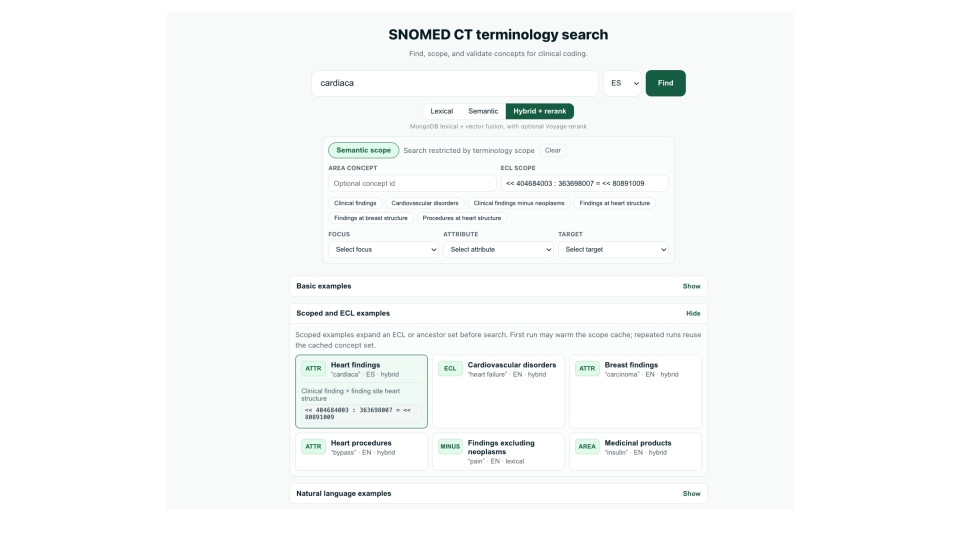
Figure 3. Expanded semantic search with ECL scopes
Ground Clinical Note Workflow
A user pastes a clinical note. The workflow extracts clinical mentions and context cues, such as present findings, negation, history, family history, planned actions, uncertainty, and temporal expressions.
The workflow then searches SNOMED CT candidates through MongoDB. It returns reviewable candidates with evidence spans and context. A reviewer can accept, reject, or mark each candidate for review.
The optional LLM tier can assist with text interpretation and candidate selection. It should only choose from candidates returned by MongoDB. It must not create new SNOMED identifiers or persist codings without review.
After review, the application stores the confirmed codings in grounded_notes. Each saved coding includes the evidence span, selected SNOMED concept, assertion, subject, status, and ancestor IDs. This pattern enables downstream applications to query for meaning. For example, an application can find reviewed notes containing any accepted descendant of a selected clinical concept.
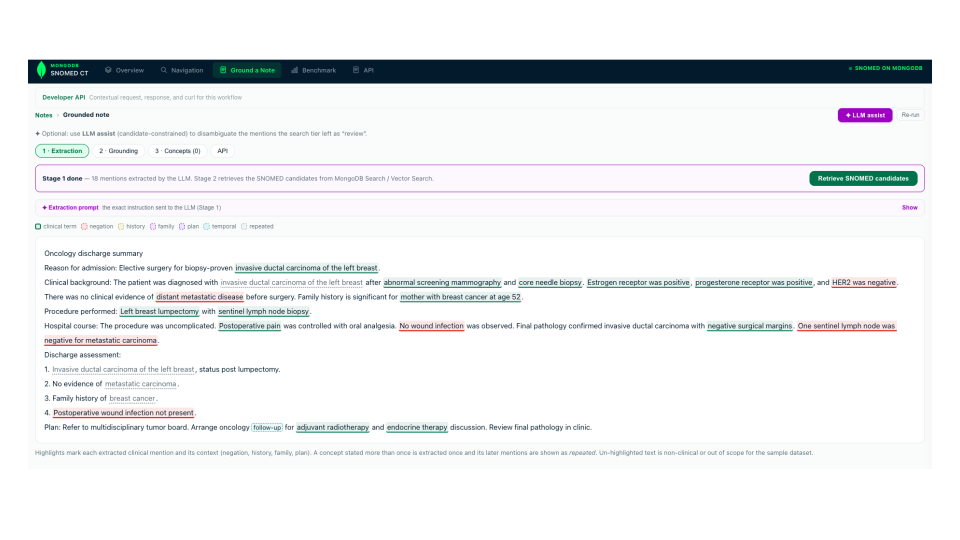
Figure 4. Grounding a clinical note - LLM process
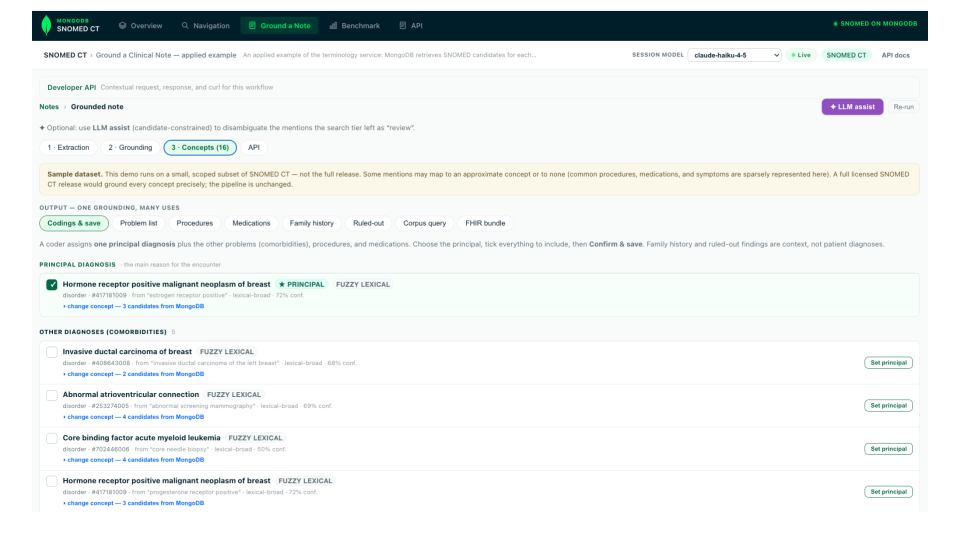
Figure 5. Grounding a clinical note after terms search with MongoDB
Example API Snippets
The solution exposes APIs for both the Navigation and Ground Clinical Note workflows. These snippets show the core request patterns.
Search SNOMED Terms and Concepts
Use this endpoint to search the term-level projection. The response groups matching terms back to SNOMED concepts. It returns concept-level results with the matched term, preferred display, semantic category, and search provenance.
POST /api/navigator-search { "query": "heart failure", "languageCode": "en", "mode": "lexical", "limit": 24 }
Use lexical mode when the user searches by a known term, synonym, formal name, or SNOMED identifier. The API also supports semantic and hybrid modes when the demo is configured for MongoDB Vector Search and reranking.
Expand a Concept and Its Descendants
Use this endpoint to expand a concept set. SNOMED CT uses ECL to describe sets of concepts. In this example, the expression << 84114007 means “Heart failure and all more-specific concepts below it.”
POST /api/ecl { "expr": "<< 84114007", "languageCode": "en", "limit": 200 }
The implementation resolves this expression with precomputed ancestor arrays in MongoDB. This pattern makes common descendant queries fast without requiring a separate graph database for the demo architecture.
Ground a Clinical Note to SNOMED Candidates
Use this endpoint to extract candidate clinical mentions from text and retrieve bounded SNOMED candidates from MongoDB. The response generates reviewable output without persisting codes automatically.
POST /api/nlp-map { "text": "Patient with chronic systolic heart failure and type 2 diabetes. No evidence of chest pain at present.", "languageCode": "en" }
The grounding workflow detects clinical mentions and context such as negation, history, family history, plans, and temporal expressions. MongoDB provides the candidate SNOMED concepts. A reviewer confirms the final codings.
Save Reviewer-Confirmed Codings
Use this endpoint after review. The application only stores confirmed codings and enriches them with ancestor IDs to enable downstream semantic queries.
POST /api/coding-confirm { "text": "Patient with heart failure.", "languageCode": "en", "codings": [ { "mention": "heart failure", "conceptId": "84114007", "displayTerm": "Heart failure", "semanticTag": "disorder", "accepted": true } ] }
The saved document keeps the selected SNOMED concept, evidence text, assertion context, reviewer status, and ancestor IDs. This schema enables downstream queries to locate notes by either a general concept or a specific descendant.
Query Grounded Notes by Meaning
Use this endpoint to retrieve reviewed notes that contain a selected SNOMED concept or its clinical descendants.
POST /api/grounded-corpus { "conceptId": "84114007", "includeDescendants": true, "limit": 10 }
This endpoint demonstrates the downstream value of storing ancestor IDs with reviewed codings. Applications can query clinical meaning instead of searching only for exact words.
Data Model Approach
SNOMED CT represents connected data. A clinical concept can have many human-readable terms, several broader concepts, many more-specific concepts, and formal relationships to other concepts.
MongoDB works well for this pattern because most operational applications need a concept-centered view. When a user opens a concept, the application needs the concept identifier, display terms, descriptions, parents, children, ancestor path, relationships, active status, and release metadata together.
This approach does not remove the graph structure. It stores the relationships and adds query-friendly arrays for common navigation patterns. For example, each concept document can store its direct parents and its ancestor path. This pattern lets the application find broader concepts, child concepts, and descendants with indexed MongoDB queries.
Why This Model Works
The design choices below address specific operational requirements: fast lookups, accurate searches, rapid hierarchy traversal, and auditable coding.
Keep Concept Data Together: A terminology application often needs to render a complete concept card. Embedding descriptions, relationship summaries, parent IDs, child IDs, and ancestor IDs keeps the most useful operational view in one document.
Separate Search From Source Terminology: Search is term-level, not concept-level. One concept can have many descriptions across languages and dialects. A term-level projection lets MongoDB Search and MongoDB Vector Search rank the exact term that matched while still returning the canonical concept.
Precompute Hierarchy Paths: SNOMED CT has a rich hierarchy. Many applications need fast descendant queries, such as “find this concept and all more-specific concepts below it.” Store ancestor IDs on each concept and each reviewed clinical coding. Then use multikey indexes for common hierarchy queries.
Store Evidence With Reviewed Codings: Coding delivers more value when the application can explain its origin. Store the selected SNOMED concept together with the clinical text span, assertion status, subject context, and reviewer status. This pattern supports audit, review, and downstream queries.

Figure 6. SNOMED CT metamodel and MongoDB collection mapping
SNOMED CT Metamodel and MongoDB Collection Mapping
The solution uses three terminology collections, plus a separate telemetry collection. The sections below describe the document shape and the main fields of each one.
The snomed-irbd collection
Use snomed-irbd as the source-of-truth view for a SNOMED CT concept. Each document represents one concept in one release, carrying its RF2 descriptions, defining relationships, parent concepts, child concepts, active status, release metadata, and the precomputed ancestor closure that powers hierarchy and subsumption.
{ "conceptId": "44054006", "active": true, "effectiveTime": "20020131", "moduleId": "900000000000207008", "definitionStatusId": "900000000000074008", "descriptions": [ { "id": "73465010", "term": "Diabetes mellitus type II", "typeId": "900000000000013009", "languageCode": "en", "acceptabilityMap": { "900000000000509007": "..." } } ], "relationships": [ { "typeId": "116680003", "destinationId": "73211009", "relationshipGroup": "0", "active": "1" } ], "inferredParentIds": ["73211009"], "inferredAncestorIds": ["73211009", "64572001", "138875005"], "inferredChildIds": ["..."], "relationshipAttributeKeys": ["116680003|73211009"], "memberOfRefsetIds": ["..."], "releaseId": "20260601", "releaseDate": "2026-06-01T00:00:00.000Z", "releaseAppliedAt": "2026-07-06T00:00:00.000Z" }
The snomed-irdb contains the following relevant fields:
conceptId: Represents the SNOMED identifier (SCTID); the stable concept identity.descriptions[]: Represents the human readable names for the concept. Each name is a synonym or the fully specified name (the formal clinical name), and records its language and whether it is preferred or acceptable in that language. These entries map to the description rows in the SNOMED CT release filesrelationships[]: Represents the concept's relationships to other concepts. "Is a" relationship defines the hierarchy. Attribute relationships define clinical properties such as finding site or causative agent.relationshipAttributeKeys[]: Represents each attribute relationship as a single indexed value. This lets the application find concepts by a specific attribute, and return results with an index instead of a full scan.inferredParentIds,ChildIds,AncestorIds: Represent bounded precomputed closure for subsumption without graph traversal. Descendants are queried with the{ inferredAncestorIds: conceptId }clause rather than stored on every parent concept.
The snomed-term-search collection test
Use snomed-term-search as the search projection. Each document represents one active description term in one language and one release, denormalized for MongoDB Search, scoped filtering, and auto-embedded MongoDB Vector Search. This structure enables users to type a synonym, abbreviation, localized term, formal clinical name, or natural-language phrase.
The search document repeats concept context to make each search result self-contained. A result can show the matched term, the preferred display, the semantic category, active status, release, and hierarchy scope without fetching the full concept document for every candidate.
{ "conceptId": "44054006", "descriptionId": "116680003", "term": "Type 2 diabetes mellitus", "preferredTerm": "Type 2 diabetes mellitus", "fsn": "Type 2 diabetes mellitus (disorder)", "semanticTag": "disorder", "semanticTagKey":"disorder", "termType": "synonym", "preferred": true, "languageCode": "en", "definitionStatusId": "900000000000074008", "moduleId": "900000000000207008", "effectiveTime": "20020131", "parentIds": ["73211009"], "ancestorIds": ["404684003", "73211009"], "topRoots": ["404684003"], "areaTags": ["disorder"], "releaseId": "20260601", "releaseDate": "2026-06-01T00:00:00.000Z", "embedText": "Type 2 diabetes mellitus | disorder | ..." }
The snomed-term-search collection contains the following relevant fields:
conceptId,descriptionId: Link back to the concept and the specific description.term,preferredTerm,fsn: Provide matched term and concept context, so search results are self-contained.semanticTag,semanticTagKey,termType,preferred: Provide filtering and ranking signals.parentIds,ancestorIds,topRoots,areaTags: Scope filters without joining back tosnomed-irbd.releaseId,releaseDate,effectiveTime: Provide release-scoped search and release maintenance visibility.embedText: Contains the field that MongoDB auto-embeds use for Vector Search.
This snippet explains the most important design choice: the search projection is term-level. It shows why a search for “High blood sugar” can still return the canonical concept “Diabetes mellitus”
With auto-embedding, you store only the human-readable embedText field, and MongoDB Vector Search generates and maintains the embedding for that field automatically. You do not require a separate embedding pipeline or vector store, because the semantic layer lives on the same collection.
The grounded_notes collection
Use grounded_notes to store application output after review. These documents are not source terminology data. Each document stores the following data:
The source text
The selected SNOMED CT concept
The evidence span
The assertion context such as present or absent
The subject context such as patient or family member
The review status
The ancestor IDs
The example below shows this shape.
{ "tenantId": "demo-hospital", "languageCode": "en", "text": "Patient with type 2 diabetes mellitus.", "codings": [ { "conceptId": "44054006", "system": "http://snomed.info/sct", "display": "Type 2 diabetes mellitus", "semanticTag": "disorder", "role": "principal", "target": "Condition.code", "assertion": "present", "subject": "patient", "status": "accepted", "evidence": { "text": "diabetes mellitus tipo 2" }, "ancestorIds": ["44054006","75934005"] } ], "recordedAt": "2026-07-07T16:22:47.210Z", "createdAt": { "$date": "2026-07-07T16:22:47.210Z" } }
This design turns clinical text into queryable clinical meaning. An application can later search for reviewed notes that contain a concept or any more-specific concept below it in the SNOMED CT hierarchy. Each coding keeps its evidence, so a reviewer can trace every code back to the exact text and context that produced it, which supports audit and confident downstream use.
The telemetry Collection
Use a separate telemetry collection for search events, hierarchy requests, note-grounding activity, feedback, and diagnostics. Keep telemetry data outside the conceptual data model.
Build the Solution
The public repository includes the application code, scripts, and a sample dataset. Licensed users can replace the sample dataset with their own SNOMED CT release files.
Prerequisites
A MongoDB Atlas cluster with MongoDB Search enabled.
Access to a licensed SNOMED CT release or a small sample dataset for demo purposes.
Node.js and npm for the demo application.
Optional: MongoDB Vector Search automated embedding configuration for semantic search.
Optional: Voyage reranking key or other configured reranker for hybrid mode.
Optional: LLM gateway for bounded extraction and candidate disambiguation.
Procedure
Prepare licensed terminology input
Use the SNOMED CT RF2 distribution from your organization, or a JSON distribution. Load this input into MongoDB as the canonical concept collection using your own ingestion process. The default terminology corresponds to snomed-irdb. This collection is a prerequisite.
The scripts in this repository operate on a pre-loaded canonical collection; they do not read RF2 files. Do not commit a full release to a public repository.
Prepare canonical concept documents
The canonical collection stores each concept as a concept-centric document, containing its descriptions, relationships, parents, ancestors, and hierarchy information. This schema contains source metadata to support active and inactive status, release-aware lookup, description inspection, and relationship navigation.
Once you load the collection, normalize the fields for consistent lookups, and record the release version on each document, so results are reproducible across releases.
NORMALIZE_APPLY=true npm run model:harden # normalize SCTIDs / strings RELEASE_ID_TARGET=20260601 RELEASE_ID_OVERWRITE=true npm run releaseid:stamp
Build the term sidecar
Generate snomed-term-search from the canonical concept collection. The sidecar stores one active term document per release, language, description, and concept. It repeats key concept context so search results do not need to join back to the concept collection for every result card.
# Curated demo branches TERM_PROJECTION_SCOPE=demo npm run terms:rebuild # Full licensed local release TERM_PROJECTION_SCOPE=full npm run terms:rebuild # Replace documents while preserving index definitions when possible npm run terms:rebuild:replace
Create MongoDB indexes
Create the btree indexes for concept lookup and hierarchy expansion. Create the MongoDB Search index for lexical terminology lookup. Create the MongoDB Vector Search index for semantic search if you use semantic or hybrid mode.
npm run indexes:build
Use the following recommended source collection indexes:
db.getCollection("snomed-irbd").createIndex({ releaseId: 1, conceptId: 1 }) db.getCollection("snomed-irbd").createIndex({ releaseId: 1, active: 1, conceptId: 1 }) db.getCollection("snomed-irbd").createIndex({ releaseId: 1, inferredAncestorIds: 1, active: 1 })
Semantic search uses MongoDB Vector Search auto-embedding with voyage-4 as the default model. Hybrid mode adds the Voyage rerank-2.5 reranker. A manual Voyage embedding fallback exists for clusters without auto-embedding.
Configure semantic search & reranking
Semantic and hybrid search use MongoDB Vector Search auto-embedding. Create a Vector Search index on the embedText field with an embedding model configured on the cluster.
Hybrid mode adds an optional Voyage reranker; set VOYAGE_API_KEY to enable it. Without a key, hybrid search still works and falls back to fusion order. The reranker tries your configured base URL, then the MongoDB-hosted Voyage gateway corresponding to https://ai.mongodb.com/v1, then Voyage's own native platform endpoint.
Run the demo application
npm install npm run dev
Use a lean .env.local file. Keep operational defaults in code or configuration files, not as a long list of environment variables.
MONGODB_URI= MONGODB_DB=terminology VOYAGE_API_KEY= ENABLE_LLM_GROUNDING=false LLM_BASE_URL= LLM_API_KEY= LLM_AUTH_HEADER=api-key LLM_GROUNDING_MODEL=gpt-5.5 # Semantic / hybrid search MONGODB_VECTOR_MODE=autoEmbed MONGODB_VECTOR_INDEX=snomed_voyage_idx MONGODB_VECTOR_AUTO_EMBED_MODEL=voyage-4 VOYAGE_API_KEY= VOYAGE_RERANK_MODEL=rerank-2.5
Validate Navigation
Execute the following operations to verify your Navigation workflow:
Run a lexical search for diabetes and heart failure.
Run a semantic or hybrid search for natural-language phrases such as high blood sugar or trouble breathing.
Open a concept and inspect summary, descriptions, hierarchy, relationships, descendants, and raw JSON.
Run an ECL-style expansion such as the expression
<< 84114007.Verify that result cards show matched term, preferred term, semantic tag, active status, and search provenance.
Validate Ground Clinical Note
Execute the following operations to validate your Ground Clinical Note workflow:
Load a simple clinical note and a richer discharge-summary example.
Verify span extraction and context detection for present, negated, family-history, historical, planned, and uncertain mentions.
Verify that the system does not over-code generic symptoms to overly specific descendants.
Confirm only reviewed codings and save them to the
grounded_notescollection.Run a MongoDB query on
ancestorIdsto prove operational searchability.
Key Learnings
Operationalize SNOMED CT in MongoDB Atlas: Serve graph-shaped clinical terminology through a document-centered operational model that supports search, hierarchy, relationships, and application workflows.
Unify terminology navigation and semantic search: Use MongoDB Search and MongoDB Vector Search to help users find, inspect, and scope SNOMED CT concepts from the same Atlas-backed service.
Ground clinical text with reviewed evidence: Use the terminology service to propose SNOMED CT candidates from clinical notes, then store reviewed codings with evidence, context, and ancestor paths.
Authors
Francesc Mateu Amengual, MongoDB
Giovanni Rodríguez, MongoDB
Diego Canales, MongoDB
Learn More
MongoDB Search Overview: Learn how MongoDB supports full-text search, autocomplete, filtering, scoring, and search-driven application experiences.
MongoDB Vector Search Overview: Learn how MongoDB supports semantic retrieval and vector search inside Atlas.
Get SNOMED CT: Review how organizations access SNOMED CT and understand the licensing path for their country or territory.
SNOMED CT concepts, descriptions, and relationships: Learn the basic SNOMED CT building blocks that this solution maps into MongoDB documents.