Use cases: Artificial Intelligence, AI Agents
Industries: Financial Services
MongoDB Products: MongoDB Atlas, MongoDB Vector Search, Change Streams, MongoDB Time Series collections, MongoDB Aggregation Pipeline
Partners: Amazon Bedrock, LangChain
Solution Overview
Traditional lending systems rely on disconnected legacy applications that were not built for real-time data, automation, or digital-first customer experiences. Customers now expect instant decisions and full transparency, while lenders manage rising risk, regulatory pressure, and growing data complexity.
This solution shows you how to build a modern digital lending system. It replaces a linear, paper-heavy process with a data-driven, real-time workflow that connects origination, underwriting, approval, funding, and servicing into one pipeline.
Why MongoDB?
Agentic workflows generate several distinct types of state: operational records, embeddings, activity metrics, and the agents' own memory. Separate systems for each type add infrastructure and create consistency problems between them. MongoDB Atlas stores all of these in one modern data platform with one query language, which reduces the integration work.
Schema flexibility and the document model
A loan application accumulates detail through its lifecycle from borrowers, documents, credit data, risk metrics, and decisions. It stays one document that grows, instead of an entity spread across a dozen tables joined on every read.
Polymorphic detail fits naturally in this model. Employment income and self-employment income carry different fields inside the same array, with no nullable columns and no subtype tables.
Agent-generated fields appear without migrations. When the underwriter agent adds a new metric, it writes the field directly with no coordinated schema change, and no deployment ordering.
Atlas Vector Search for Semantic Understanding
Embeddings live on the documents they describe. One query returns a semantic match together with its business data, which removes the need to keep a database and a separate vector index in sync.
Pre-filtering scopes a search to a single application. This keeps one borrower's documents out of another's results, turning an access-control requirement into a search parameter instead of application logic.
Aggregation Pipelines for Explainable Scoring
Risk scoring runs where the data lives. One pipeline joins credit and income records, derives the ratios, and returns a bounded score, with no data transfer to application code.
Because the calculation is declarative, the solution exposes each stage to the interface. Explainability becomes part of the implementation, not a separate reporting effort.
Change Streams for Real-Time Interfaces
The officer queue, the borrower status tracker, and the activity log all read change events from the database. No separate message broker sits between a committed write and the interface that shows it.
Streams resume from a stored position after a connection failure, so a transient network fault does not create a gap in the audit feed.
LangGraph MongoDB Checkpointer for Agent Memory
- Workflow state persists to Atlas at each step. An application paused for human review survives restarts and redeployments, and resumes with full context.
Together, these capabilities let a single platform carry an agentic lending workflow end to end, from document intake through underwriting, human review, and portfolio monitoring, without the integration surface a multi-database architecture requires.
Reference Architectures
The solution consists of the following:
Frontend: The experience layer: Borrower Portal, Loan Officer Dashboard, Demo Flow, and Renewal Dashboard.
Backend: A FastAPI service that hosts the LangGraph agent pipeline and exposes it over REST, SSE, and WebSocket.
MongoDB Atlas: The intelligent data platform for operational records, vectors, time series metrics, real-time change events, and agent memory.
AI and observability: Amazon Bedrock (Claude Haiku 4, tool use for structured output), and Voyage AI (multimodal embeddings).
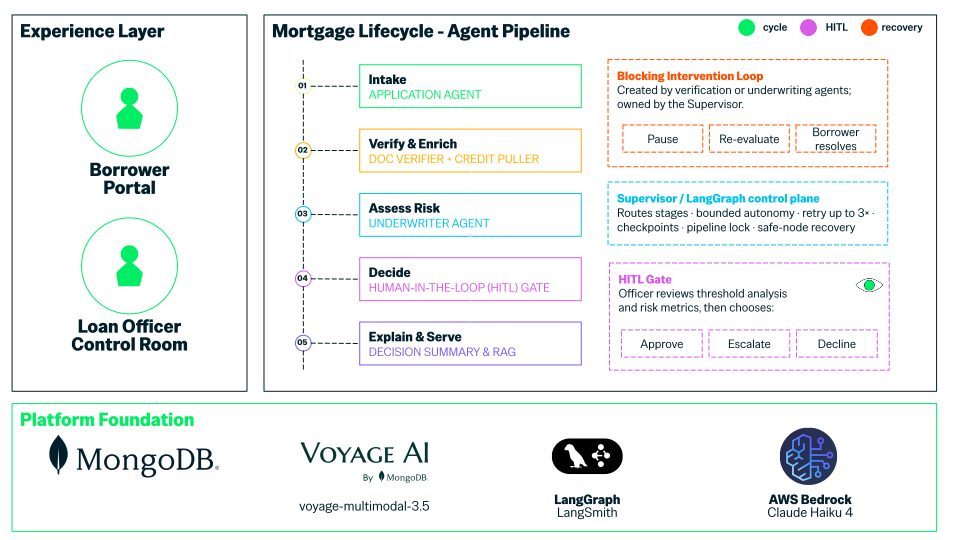
Figure 1. High-level architecture: Agentic Lending with MongoDB.
Agents
The LangGraph Agent Pipeline is composed by the following:
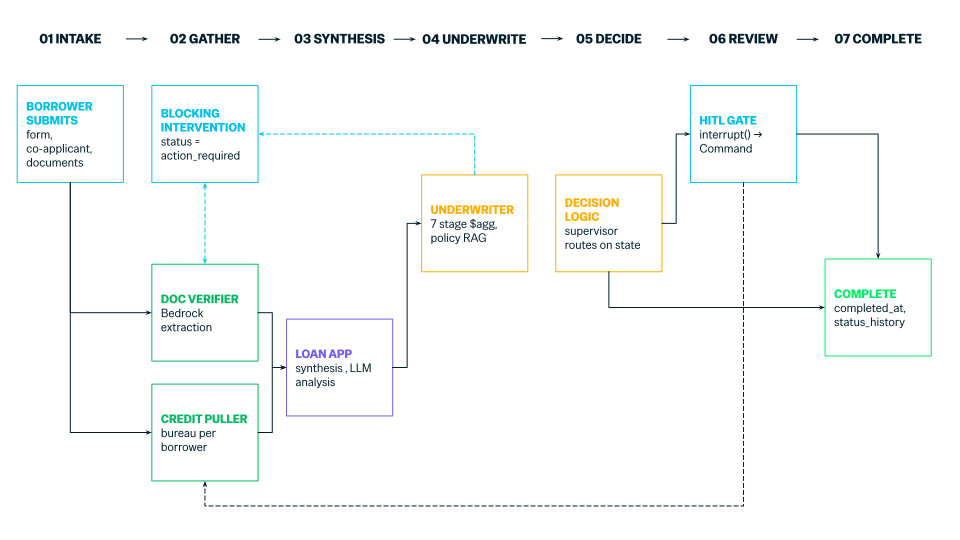
Figure 2. Agentic Flow.
Supervisor: Inspects workflow state after every step and decides what happens next: fan out to gather data, proceed to underwriting, escalate to a human, or complete. It owns the retry policy and the pause condition when an application is blocked on borrower input.
Document verifier: Checks completeness against required document types, flags failed extractions, detects duplicate uploads by hashing extracted text, and cross-checks applicant names across documents.
Credit puller: Retrieves bureau records for each borrower on the application and attaches the scores to workflow state.
Loan application agent: Synthesizes gathered documents and credit data into a coherent application narrative and advances the application's status.
Underwriter: Runs the risk aggregation, computes affordability ratios and the stress test, retrieves governing policy through vector search, and produces a structured recommendation: approve, decline, or escalate.
Application assistant agent: Operates outside the pipeline and answers borrower questions using context from their own file and the policy corpus.
The supervisor dispatches the document verifier and credit puller concurrently. Document extraction and credit retrieval have no dependency on each other, so overlapping them removes the largest sequential wait in the pipeline.
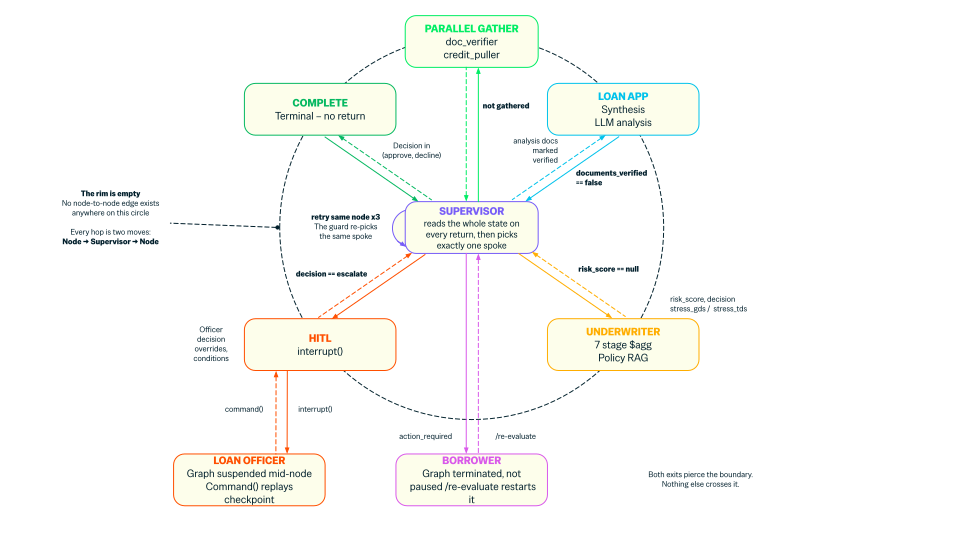
Figure 3. LangGraph Agent Pipeline.
Autonomy and human oversight (HITL)
The supervisor runs under one of four autonomy modes: observe, suggest, bounded, or auto. The default, bounded, lets the pipeline act autonomously within policy limits and escalates to an officer when a threshold trips — for example, a purchase price above $500K or GDS/TDS ratios past policy limits. Every officer decision (approve, decline, or modify and continue) carries the officer's ID and writes to an immutable audit collection. The pipeline resumes through the LangGraph checkpointer, so a human review does not lose workflow state.
Data Model Approach
The workflow produces the following types of data, and MongoDB Atlas stores all of them:
Structured operational records: Each record evolves through the loan lifecycle as one growing document instead of a fixed row joined across tables.
Collections: applications, borrowers, credit reports, chat history, officers, renewals.
{ _id: ObjectId('67500c01000000000000a002'), id: ObjectId('67500c01000000000000a002'), loansId: 'APP-2026-00011', borrowerIds: [ ObjectId('67500b01000000000000f002') ], borrowerNames: [ 'Grace Hopper' ], loanAmount: NumberInt('595000'), purchasePrice: NumberInt('850000'), downPayment: NumberInt('255000'), product: '7yr Fixed (30yr Amort)', property: { address: '226 W 108th St, New York City, NY 10025', type: 'Detached', purchasePrice: NumberInt('850000'), annualTax: NumberInt('11200') }, incomeSummary: { combinedGross: NumberInt('110400'), primary: NumberInt('110400'), coApplicant: null }, existingMonthlyDebt: NumberInt('0'), status: 'approved', statusHistory: [ { status: 'submitted', timestamp: ISODate('2026-03-05T14:32:11.000Z'), detail: 'Application received' }, { status: 'underReview', timestamp: ISODate('2026-03-07T10:00:00.000Z'), detail: 'Bureau pull complete; in underwriting' }, { status: 'conditionallyApproved', timestamp: ISODate('2026-03-12T15:30:00.000Z'), detail: 'Conditional approval pending appraisal' }, { status: 'approved', timestamp: ISODate('2026-03-20T11:15:00.000Z'), detail: 'Final approval issued' } ], createdAt: ISODate('2026-03-05T14:32:11.000Z'), updatedAt: ISODate('2026-03-20T11:15:00.000Z'), seedComplete: true }
Unstructured content with vectors: Extracted PDF text and its 1024-dimension embedding (voyage-multimodal-3.5) live on the same document, so one query returns the semantic match and its business data together.
Collections: documents, policies.
{ _id: ObjectId('69deb9600e702ecf5ed0b9c5'), application_id: 'APP-2026-00002', doc_type: 'government_id', filename: '01_government_id.pdf', extracted_text: 'This is a British Columbia Government Identification Card document package issued by ServiceBC Registry Services on March 1, 2024 (Document Reference: SA-2024-BC-00847). The package contains identification cards for two individuals: Jane Marie Doe (applicant), born March 14...', structured_data: { persons: [ { full_name: 'Jane Marie Doe', date_of_birth: '1992-03-14', gender: 'F', height: '5\'7"', address: null, id_number: 'BC-7241-5583-JMD', expiry_date: '2029-03-14' }, { full_name: 'John Robert Doe', date_of_birth: '1990-08-22', gender: 'M', height: '5\'10"', address: null, id_number: 'BC-8392-6147-JRD', expiry_date: '2029-08-22' } ], text_summary: 'This is a British Columbia Government Identification Card document package issued by ServiceBC Registry Services on March 1, 2024 (Document Reference: SA-2024-BC-00847). The package contains identification cards for two individuals: Jane Marie Doe (applicant), born March 14, 1992, female...', issuing_authority: 'ServiceBC -- Registry Services', issuing_address: 'Service BC, 4946 Canada Way, Burnaby, BC V5G 4J6', issue_date: '2024-03-01', document_reference: 'SA-2024-BC-00847', document_type: 'Government Identification Card', jurisdiction: 'British Columbia, Canada', note: 'SYNTHETIC DOCUMENT -- FOR DEMONSTRATION PURPOSES ONLY' }, embedding: [ Double('0.0546875'), Double('-0.00074005126953125'), Double('-0.03955078125'), Double('0.018798828125'), ...... ], embedding_type: 'multimodal', embedding_pages: NumberInt('1'), status: 'parsed', created_at: ISODate('2026-04-14T22:02:08.271Z') }
Agent memory: LangGraph state per thread, so a paused workflow resumes exactly where it stopped.
Collections: checkpoints, checkpoint writes, and checkpoint metadata.
{ _id: ObjectId('69deb00d938a6c352b22f83c'), thread_id: 'APP-2026-00002', idx: NumberInt('0'), checkpoint_id: '1f138480-5fd5-6ee2-bfff-20577a825d23', checkpoint_ns: '', task_path: '~__pregel_pull, __start__', task_id: 'd8f52fef-26db-0a3b-e30d-67652af78130', channel: 'messages', type: 'msgpack', value: BinData(0, 'kA==') }
Coordination and audit records: Blocking conditions, officer decisions, and distributed locks stored as documents, with the same query language as the rest of the data — no separate audit system to maintain.
Collections: interventions, hitl audit, pipeline locks.
HITL_audit
{ _id: ObjectId('6a85cf398ec04b841ebc2a71'), application_id: 'APP-BA96654D', officer_id: 'officer-001', action: 'decline', notes: 'Declined after manual review', conditions: [], overrides: {}, timestamp: ISODate('2026-08-19T15:43:53.719Z') }
Interventions: Stores typed, agent-generated action items with internal risk context and borrower-safe guidance. Blocking items pause workflows until resolved and trigger re-evaluation.
{ _id: ObjectId('6a8c34e671e78aca4e8ca9ae'), application_id: 'APP-4E8CA981', type: 'stress_test_failure', status: 'pending', internal_context: { source_node: 'underwriter', risk_flag: 'osfi_b20_failure', severity: 'blocking', stress_gds: Double('0.6876'), stress_tds: Double('0.9604'), stress_rate: Double('0.0689'), gds_limit: Double('0.39'), tds_limit: Double('0.44'), is_insured: false }, borrower_context: { summary: 'Your application did not pass the OSFI B-20 mortgage stress test at the qualifying rate of 6.89%.', action_required: 'The stress test ensures you can afford payments if rates rise. You may improve your result by increasing your down payment, reducing existing debts, or choosing a less expensive property.', document_types_accepted: [] }, resolution: null, created_at: ISODate('2026-08-24T12:11:18.585Z'), resolved_at: null }
Keeping these together is what makes the solution manageable. A conventional stack places the operational records in a relational database, the vectors in a dedicated vector store, the metrics in a time series database, and the agent state in a cache — then spends most of its engineering effort keeping four systems consistent.
Build the Solution
This section shows you how to implement the agentic lending solution. For the full implementation guide, clone the repository and follow the setup instructions in the GitHub README.
Building this solution follows these steps:
Build the agent pipeline in LangGraph.
Implement the supervisor and its routing logic, the parallel document-verifier and credit-puller nodes, the underwriter's seven-stage risk aggregation, and the HITL interrupt/resume gate backed by MongoDBSaver checkpoints.
Checkpoints also work as a forensic record. You can reconstruct what the agents knew at the moment of a decision, a different artifact from a log of what they said.
Since a mortgage application is a long-running, multi-day process with human-in-the-loop steps (underwriter review, document re-submission, conditional approval). MongoDBSaver persists the entire graph state after each execution. That means an application can sit paused for 3 days waiting on a borrower's pay stub, and when it resumes, the graph picks up exactly where it left off with full state intact.
An example setup:
from langgraph.checkpoint.mongodb import MongoDBSaver from langgraph.graph import StateGraph from pymongo import MongoClient client = MongoClient(ATLAS_URI) checkpointer = MongoDBSaver(client, db_name="lendflow") graph = StateGraph(MortgageState) # ... add_node(intake), add_node(document_verification), # add_node(underwriting), add_node(human_review) ... app = graph.compile(checkpointer=checkpointer) If the graph hits an interrupt() at the human-review node, invoke returns with state paused. FastAPI can return a 202 to the client immediately. When the underwriter approves via a separate endpoint days later, you just invoke again with the same config and new input, and LangGraph resumes from the last checkpoint, not from scratch.
Note
This demo implementation ships a Canadian mortgage configuration, including an OSFI B-20 style stress test and GDS/TDS affordability ratios. The rules live in one function and one collection, so you reconfigure the solution for a different market by changing the underlying configuration-as-data MongoDB document rather than rewriting the code.
Key Learnings
Unify agent state with a single platform, MongoDB Atlas: Agentic workflows produce operational records, embeddings, and checkpointed memory. Storing all four in Atlas removes the integration and consistency work of a four-database stack.
Model the loan as one evolving document with the Flexible Document Model: The document model lets borrower, credit, and risk data accumulate on a single record through the whole lifecycle, so new agent-written fields and polymorphic income types need no schema migration.
Query vectors next to the data they describe with Atlas Vector Search: MongoDB stores each embedding as a field on the document it describes, and Atlas Vector Search queries it there. One query returns the semantic match and its business data together, and scoping the search to a single application keeps one borrower's documents out of another's results.
Make risk scoring explainable and configurable by design with the Aggregation Framework: Running the risk calculation as a declarative aggregation pipeline exposes every stage of the score, so explainability comes from the implementation rather than a separate reporting layer.
Persist agent memory for reliable human review with the LangGraph MongoDB Checkpointer: The checkpointer lets a workflow paused for officer review survive restarts and resume with full context, and doubles as an audit trail of what the agents knew when they made a decision.
Authors
Peyman Parsi
Mehar Grewal
Andrea Alaman Calderon
Learn More
Learn more about how MongoDB and agentic AI power an end-to-end digital lending journey that streamlines workflows, reduces risk, and elevates borrower experiences.