This reference architecture describes how to implement an Operational Data Layer (ODL) on MongoDB Atlas to consolidate siloed operational data and serve downstream operational, analytics, and AI workloads.
An ODL is an architectural pattern that integrates and organizes data from existing systems of record into a centralized, queryable layer. It decouples modern applications and data products from legacy platforms, enabling initiatives such as single view, Data‑as‑a‑Service, and AI/agentic AI use cases without the need to fully replace those systems. MongoDB Atlas provides the core data platform for the ODL, and combines a flexible document model with transactional, search, analytical, and vector capabilities in a single service.
ODL implementation levels
Read-only: Serves as a high-performance read replica to offload queries from source systems and expose stable APIs over operational data.
Enriched: Combines source data with metadata and external datasets to provide contextual views for analytics and AI, without modifying upstream systems.
Read-write: Accepts writes as part of business workflows to modernize operations and gradually reduce dependence on legacy systems of record.
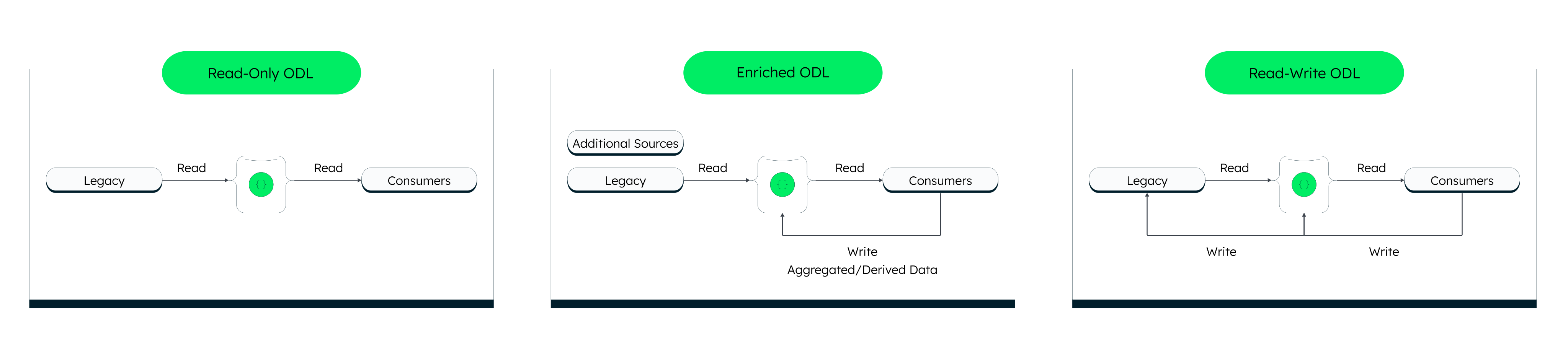
Figure 1. Implementation levels of an Operational Data Layer with MongoDB.
Note
The following diagram illustrates the different levels at which you can implement an Open Data Layer (ODL). It is for conceptual clarity only and is not intended as the reference architecture for this solution.
Diagram
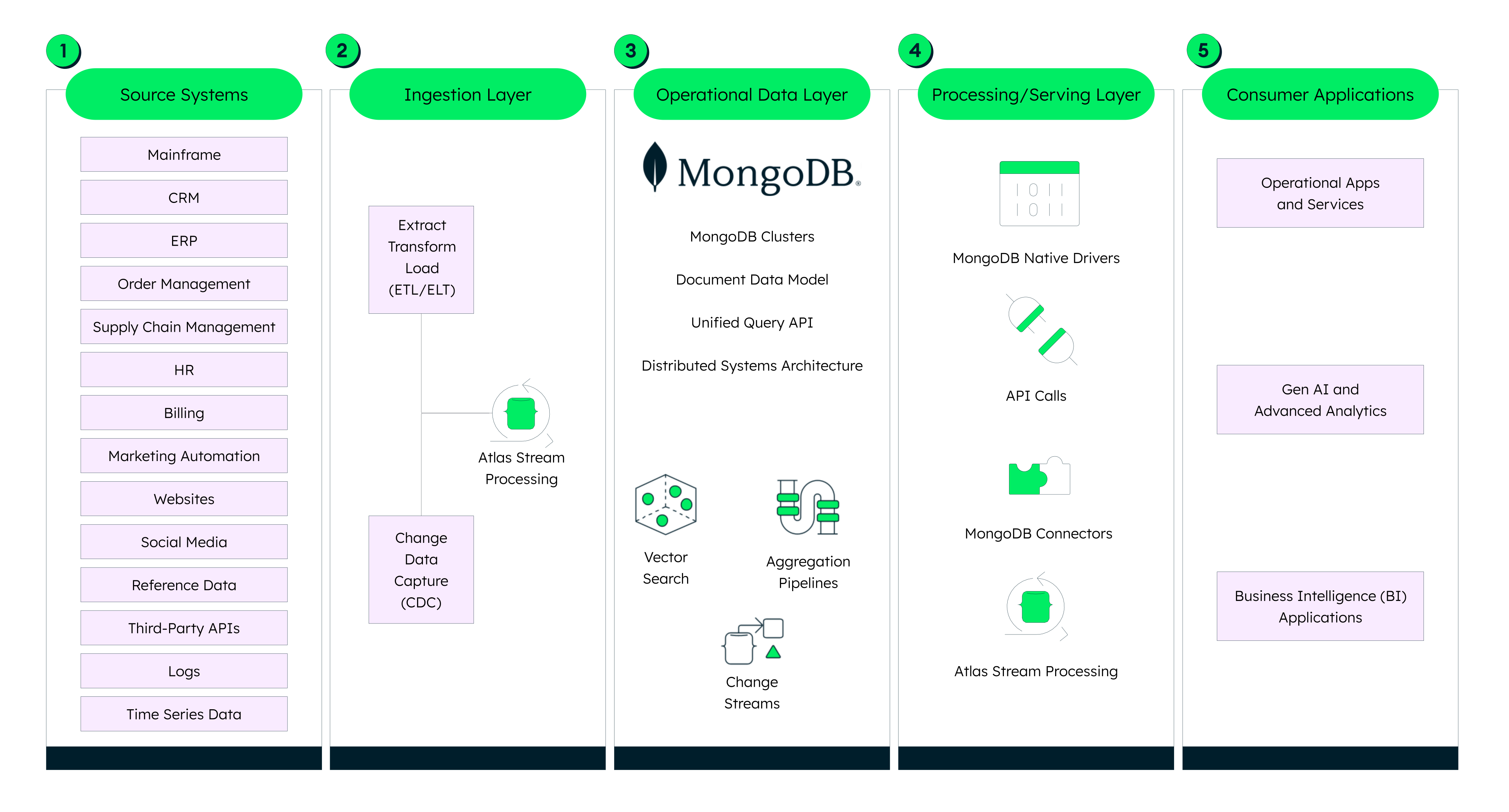
Figure 2. Operational Data Layer Reference Architecture
Data Flow
Source systems
Enterprise applications, operational databases, third‑party APIs, and legacy platforms act as systems of record. They capture business transactions and events that you synchronize into the ODL for real-time and contextualized access.
- Common source systems include: Mainframe, CRM, ERP, Order Management, Supply Chain Management, Human Resources, Billing, Marketing Automation, Websites, Social Media, Reference data, Third-Party APIS, Logs, Time-series data, and many more.
Ingestion Layer
Data moves from source systems into MongoDB Atlas through batch Extract-Transform-Load (ETL)/Extract-Load-Transform (ELT) jobs and real-time streaming or change data capture (CDC). Use tools such as mongoimport, Bulk Write APIs, ETL platforms, the MongoDB Kafka Connector, and Atlas Stream Processing to load, transform, and route events according to latency and throughput requirements.
Operational Data Layer (MongoDB Atlas)
MongoDB Atlas clusters consolidate structured, semi‑structured, and unstructured data into a document data model that supports hybrid workloads: transactional processing, real-time analytics, full‑text search, and vector search through a unified query API. The ODL runs in the cloud and scales horizontally through sharding and replica sets.
Processing/Serving Layer
An API gateway sits at the edge, managing authentication, rate limiting, and external access. A service mesh governs service‑to‑service communication, and a data proxy layer routes queries based on workload type while applying connection pooling, caching, and policy enforcement. MongoDB Change Streams and Atlas Stream Processing can publish data changes to downstream consumers without polling.
Consumer applications
Operational applications, Gen AI and agentic AI systems, and BI tools connect to the ODL using MongoDB native drivers, Atlas SQL, and connectors. They benefit from a consolidated, governed, and near real‑time view of enterprise data, without direct dependency on legacy systems.
Exceptions, Caveats, and Tradeoffs
To maintain a high‑performance ODL on MongoDB Atlas, you must balance complexity against architectural goals:
Dual‑write coordination (read‑write ODL): A read‑write (“Y‑loading”) ODL introduces the risk of data drift between the ODL and legacy systems. Use messaging platforms or API gateways together with patterns such as the transactional outbox and saga model to coordinate writes and define clear consistency guarantees instead of relying on distributed locks or 2PC (Two‑Phase Commit).
Workload Isolation — OLTP, Online Analytical Processing (OLAP), and AI: Running analytical or AI workloads directly on primary nodes degrades transactional performance. To avoid this, use replica sets with
secondaryPreferredreads, sharded clusters, and dedicated search and vector indexes to isolate each workload type, ensuring that Online Transactional Processing (OLTP), analytics, and Retrieval-Augmented Generation (RAG)/AI queries do not compete for the same resources.Latency vs. ingestion cost: The ODL can serve low‑latency queries, but data freshness depends on how you ingest data. Batch ETL/ELT, CDC, and real‑time streaming (for example through the MongoDB Kafka Connector and Atlas Stream Processing) have different operational and cost profiles. Reserve always‑on streaming for use cases that truly require near–real‑time updates .
Schema evolution and document growth: MongoDB’s flexible document model supports rapid schema evolution, but you still need disciplined design. Apply established schema design patterns and embedding‑vs‑referencing guidance to avoid document bloat, deeply nested structures, and incompatible schema drift across teams, especially in highly enriched ODLs.
Where ODLs Fit: ODLs are best suited for unifying fragmented operational data; they are not intended to replace pure analytics platforms. While an ODL is not designed to be a direct replacement for core systems of record, it can serve as a first step in a multi-step migration strategy that ultimately replaces a legacy system of record over time.
Implementation Guide
Define your approach
Identify your primary use cases and business domains (for example, payments hub, customer 360, unified commerce, network assurance, and so on).
Choose an architectural style such as event‑driven, microservices, or API‑centric, and align it with your existing landscape.
Decide whether to start with a read‑only, enriched, or read‑write ODL based on risk tolerance, dependency on legacy systems, and modernization objectives.
Design data ingestion and modeling
Design collections: Using MongoDB schema design patterns. Embed data you read together frequently; reference large or independent entities to reduce duplication and keep documents manageable.
Batch ingestion: Use
mongoimport, Bulk Write APIs, Atlas Data Federation materialization, or ETL tools to load scheduled exports from source systems.ETL/ELT: Use the MongoDB Spark Connector and orchestration tools to extract data, then either transform before loading (ETL) or load raw data into Atlas and transform with the Aggregation Pipeline (ELT).
Real‑time ingestion: Use the MongoDB Kafka Connector and Atlas Stream Processing for event‑driven pipelines that capture CDC streams or topic events and write them into Atlas with minimal latency.
Configure query routing
OLTP: Route transactional reads and writes to primary nodes to guarantee consistency and low‑latency operations for core business flows.
OLAP/BI: Route analytical and reporting workloads to secondary nodes using secondaryPreferred, and consider Atlas Data Federation or materialized views for historical or cold data to avoid impacting operational workloads.
AI/RAG: Use MongoDB Vector Search for semantic and hybrid search over embeddings stored alongside operational data, and combine results with metadata through aggregation pipelines to serve agentic and LLM‑driven applications.
Establish security and data trust
Encrypt in transit and at rest: Enforce TLS for all external access points and use built‑in encryption features in Atlas to meet data protection requirements.
Manage identities and access: Implement industry-standard protocols such as OpenID Connect (OIDC) and OAuth 2.0 to handle authentication and issue standardized tokens (such as JSON Web Tokens) containing role-based claims. Leverage a decoupled authorization pattern to enforce fine-grained, policy-based access control at both the API and service layers, ensuring security logic is separated from application code.
Centralize secrets: While OIDC and OAuth 2.0 handle user and service identity, an ODL still relies on credentials and keys that exist outside the token lifecycle. These include database connection credentials, OAuth client secrets, TLS certificates, and encryption keys. Store and rotate these using a dedicated secrets management solution—such as a vault service, an HSM-backed key manager, or a cloud-provider-native secrets store—then inject them into runtimes rather than embedding them in configuration files.
Audit and governance: Use the ODL as the enforcement point for data masking, aggregation, and access policies so that producers and consumers remain decoupled while governance is applied consistently across domains.
Learn More
Explore how different industries implement an ODL:
Financial Services: Agentic AI-Powered Investment Portfolio Management
Manufacturing: Unified Namespace Data Integrity
Retail: Unified Commerce Solutions
Learn all about the operational data layer in our white paper: The Operational Data Layer.