Today, the race to deploy AI is at an inflection point—2026 is the year of the mandate, and making good on AI’s promise. Enterprises are no longer satisfied with chatbots; they are focused on building the next generation of AI applications: autonomous, agentic systems that can reason, act, and execute complex business logic.
As organizations tackle this next frontier of agentic AI, one thing has become clear: memory is the key to success. But LLMs today are fundamentally stateless—they forget context, preferences, and progress between interactions. To bridge this gap, organizations need a data foundation that doesn't just store records, but serves as a persistent, shared memory layer. That is the means to the end for every successful AI strategy.
That’s why I’m looking forward to connecting with our partners and customers at Google Cloud Next 2026: to discuss how MongoDB’s evolved collaboration with Google Cloud is meeting this moment. From our award-winning customer success to new technical integrations and enhanced developer experiences, we are providing the integrated, modern data foundation teams need to move trustworthy, stateful AI into production and ship the next generation of transformative applications.
A year of momentum
As we kick off our week in Las Vegas, I am incredibly proud to share that MongoDB has been named the 2026 Google Cloud Partner of the Year: Marketplace - Data. This marks MongoDB’s seventh consecutive year as a Google Cloud Partner of the Year. More than just a trophy, it’s a testament to the success of joint customers like UKG, L’Oreal, and Stax.AI.
This recognition underscores MongoDB Atlas's role as the trusted data layer for the Google Cloud ecosystem, and more broadly, the importance of proprietary data to AI. It shows that when organizations look to solve their most complex challenges—from global application scaling to real-time, agentic AI—they are choosing the combined power of MongoDB and Google Cloud to turn their data into action.
.png)
Voyage AI joins Gemini Enterprise Agent Platform Model Garden to deliver trustworthy agentic AI
We are also marking a major milestone in the MongoDB-Google partnership: Voyage AI by MongoDB is officially available for one-click deployment within Google Cloud’s Gemini Enterprise Agent Platform Model Garden.
By bringing our latest embedding models into the Google Cloud ecosystem—including the industry-first shared embedding space from the Voyage 4 family, which eliminates the time and cost of re-indexing your data when switching between models in the family—we are providing industry-leading retrieval capabilities as a native, frontier-level experience in customers’ Google Cloud environments. Now, enterprises get the benefit of Voyage AI’s models without the operational headache of managing separate infrastructure, as everything scales and bills directly through their Google Cloud account.
To build agentic AI systems that are truly stateful and trustworthy, those agents must be able to retrieve and reason over proprietary data with precision. Embeddings are the backbone of that memory—the lens that allows an agent to understand context, maintain memory, and act reliably on an organization’s data. Now that our state-of-the-art embedding models are available within Gemini Enterprise Agent Platform, we are helping to ensure that the bridge for customers to achieve their most ambitious agentic AI goals with Voyage AI is shorter, more accurate, and more cost-effective than ever.
By bringing Voyage AI’s embedding models into the Gemini Enterprise Agent Platform Model Garden, we are giving developers the frontier embedding capabilities they need to build next-generation AI applications with state-of-the-art accuracy
”Removing infrastructure hurdles by integrating directly with Google Cloud’s Application Design Center
What’s more, we know that the gap between a great idea and a live application is often filled with manual configurations and infrastructure hurdles. And in the world of agentic AI, these hurdles are even higher. An agent is only as effective as its access to context: if the infrastructure supporting its memory is fragmented, the agent becomes unreliable.
To bridge this gap, we are integrating MongoDB Atlas directly into Google Cloud’s Application Design Center (ADC). This collaboration allows developers to move from architectural visualization to a fully provisioned environment in minutes.
By dragging and dropping MongoDB Atlas components onto the ADC canvas, the platform automatically handles the heavy lifting—from provisioning Atlas clusters via Terraform to securely providing connection strings to your Google Cloud compute resources like Cloud Run or Google Kubernetes Engine. For a developer building a customer service agent, for instance, this update means they can instantly architect the memory layer that the agent needs to retrieve history and take action. It turns developers’ architectural blueprints into a functional, stateful reality, helping to ensure that their AI foundation is consistent, secure, and ready to scale the moment they hit deploy.
Bringing agents real-time context via Google Cloud Pub/Sub
Finally, we are streamlining how teams manage the flow of real-time data across their Google Cloud infrastructure. Agentic AI applications cannot rely on static snapshots, which instantaneously become stale. Instead, they need a continuous pulse of real-time context to maintain its state and trigger precise actions.
To help teams act faster, we’ve launched native support for Google Pub/Sub within Atlas Stream Processing. This gives developers a native path to route processed data streams directly back into their Google Cloud ecosystem without custom connectors or glue code.
Consider an autonomous retail agent: as inventory shifts and customer trends emerge in real-time, Atlas Stream Processing captures those events via Pub/Sub, updates the agent’s memory in Atlas, and triggers the agent to proactively adjust logistics and personalized offers.
By eliminating the need for complex, custom-built connectors, teams can focus on building secure, event-driven systems instead of managing the plumbing. With built-in compatibility for Google Cloud Private Service Connect, data stays on customers’ private network from pipeline to destination, helping to ensure the real-time inputs powering AI applications remain trustworthy and secure.
New MongoDB Overview with Google Cloud skill badge now available
As developers build toward an agentic future, the last mile is upskilling on the latest integrated technologies. To help lead this shift, MongoDB is launching the MongoDB Overview with Google Cloud skill badge this week at Google Cloud Next 2026.
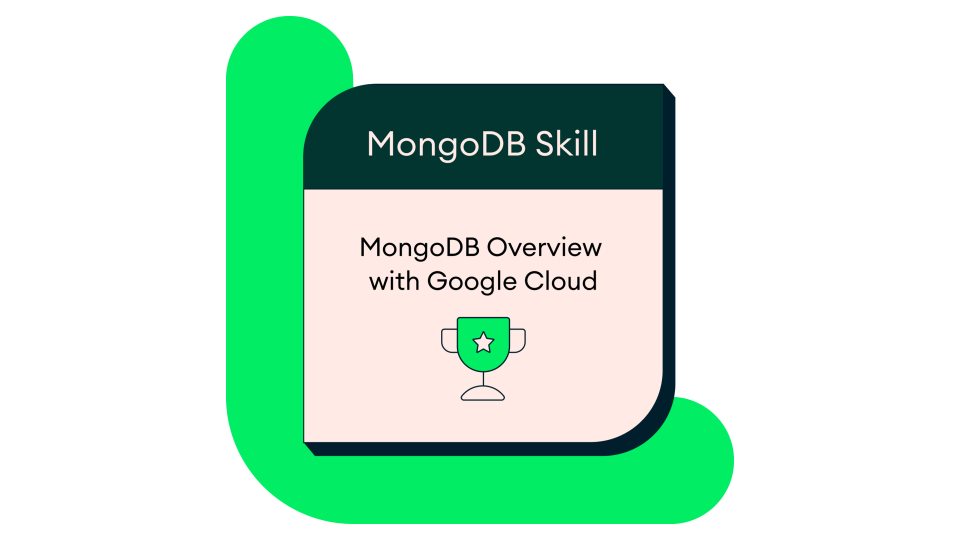
Developers can earn the MongoDB Overview with Google Cloud skill badge and demonstrate their understanding of how MongoDB's flexible document model and distributed architecture integrate with Google Cloud's powerful infrastructure to build modern, scalable, AI-powered, and agentic applications. Complete the 10-question skill check online at any time, or visit MongoDB’s booth at Next for a flash badging session with quick training and exclusive swag!
Next Steps
Stop by Booth #1623 at Google Cloud Next 2026 or join one of MongoDB’s featured sessions to discover how we are shaping the future of application intelligence. Let’s build the next generation of AI together.