Retail discovery is moving from clicks and filters to a conversation an AI agent conducts on a customer’s behalf. A customer may ask an AI answer engine like ChatGPT or Gemini for a carry-on bag that fits a 16-inch laptop and has strong sustainability credentials. They may instruct an AI agent to watch for price drops in high-end bean-to-cup coffee machines. The products selected by AI agents in those scenarios will not be based on the most persuasive product description on a retailer’s website or even on a slew of customer reviews. Instead, AI recommendations will favor products that can be systematically retrieved, understood through rich context, and compared across surfaces for consistency.
The urgency is already emerging. McKinsey estimates that AI agents could orchestrate $3 trillion to $5 trillion globally by 2030, while Bain estimates 30% to 45% of U.S. consumers already use AI answer engines to research products. Research on generative engine optimization (GEO) has demonstrated visibility gains of up to 40% when content is made more legible to AI systems. For retailers, this creates a new discoverability challenge where product data must be:
Rich enough for AI systems to reason over
Consistent across every surface the retailer publishes product data to
Fast enough to serve inbound agentic commerce traffic.
The need to be recommended ahead of competitors’ offerings makes AI discovery a product-data challenge, one that MongoDB is positioned to help retailers solve. Retailers need a single, context-rich catalog that can project its products to three distinct surfaces:
Outbound product feeds used by AI answer engines
Agentic commerce endpoints that support inbound requests for live catalog data sent by autonomous AI agents
Structured data on product detail pages (PDPs).
MongoDB’s AI-ready data platform provides the foundation. It offers a flexible document model for enriched agentic context, real-time synchronization to keep operational data current, and integrated keyword, vector, and hybrid retrieval to help AI agents find the right products.
The retailers that gain a sustainable competitive advantage in the agentic commerce era will build machine-readable, enriched product catalogs as a foundation, making it easier for AI agents to evaluate and recommend. Focusing on three priorities can help retailers achieve that goal.
1. Enrich the catalog with the context agents need to reason
Traditional product catalogs often prioritize the fields needed to render a product detail page: title, image, price, and availability. Those remain essential, but they are no longer sufficient. An AI agent also needs the facts and relationships that answer an intent-shaped question. That means it needs to know what the product is suitable for, what it works with, how it compares with alternatives, and which policies or reviews support the recommendation.
A practical enrichment model has three tiers:
Tier one establishes identity and transactability with fields such as GTIN, SKU, brand, price, currency, condition, availability, and canonical URLs.
Tier two makes products filterable using structured attributes such as dimensions, materials, capacity, compatibility, ingredients, certifications, and care instructions.
Tier three adds agentic context: use cases, frequently asked questions, compatible accessories, substitutes, fit guidance, sustainability attributes, returns and shipping policies, ratings, review summaries, and semantic embeddings.
MongoDB’s document model can help answer those questions. A product is naturally a richly nested object, not a collection of unrelated rows that must be reassembled on every request. Retailers can represent core attributes, variants, offers, policies, relationships, and agentic context together in the same JSON-like format that is the lingua franca of agentic commerce. Frequently used, feed-critical fields can be strongly typed and indexed, while long-tail category attributes can be modeled flexibly without creating a new schema for every product type.
The business outcome created by tier three data is an improved likelihood of being matched to a shopper’s intent and included in AI-generated shortlists. Highlighting facts also reduces ambiguity when an AI answer engine compresses a catalog into a comparison table or a product card.
2. Make every discovery surface a projection of one live catalog
AI agents can discover products through two paths. On the indexed path, third-party AI platforms ingest structured data from PDPs and product feeds, then reason over their own product index. On the programmatic path, an AI agent calls a retailer’s API or model context protocol (MCP) server for live catalog, offer, inventory, or policy data.
Figure 1. The enriched product catalog is discovered via two paths: the indexed path and the programmatic path.
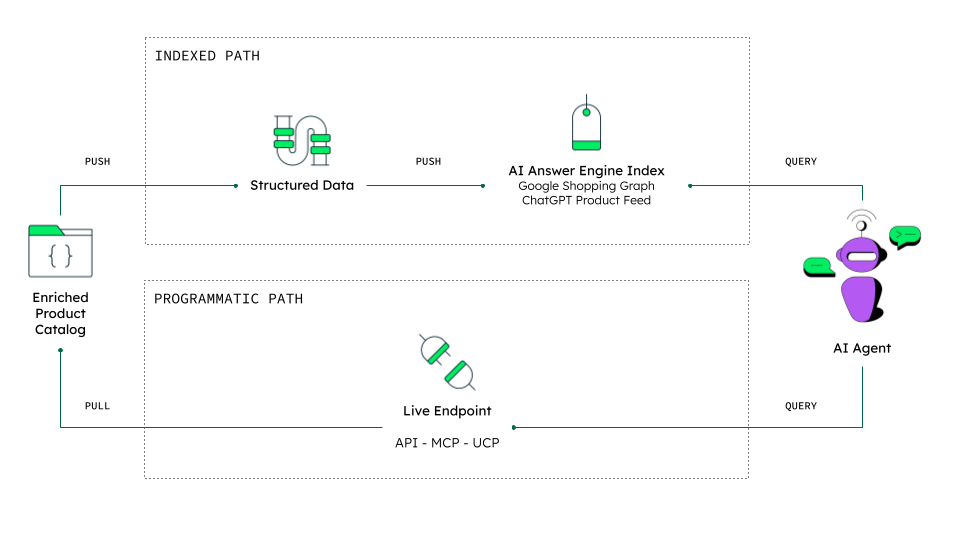
Retailers should support both paths, but without having to create separate, independently maintained catalogs for each. The recommended pattern is to establish an enriched product catalog in an operational data layer (ODL) and project it consistently to three machine-readable surfaces: product feeds for AI platforms; REST APIs and/or MCP for direct agent access; and schema.org JSON-LD on PDPs.
MongoDB helps make that single-source-of-truth approach practical. Change streams and stream processing can propagate updates from systems such as PIM, ERP, pricing, inventory, and reviews into a canonical product representation. Aggregation pipelines can then reshape that representation for the exact contract required by an outbound product feed, an API response, or a schema.org Product payload on a PDP.
That consistency matters because AI agents cross-check signals. If a price, availability state, or product identifier disagrees between a product feed and a PDP, confidence falls. A product catalog that is rich in one channel, but stale in another will be less discoverable than a simpler catalog that is accurate everywhere. With MongoDB, the same operational data can drive each projection, while change events keep downstream surfaces aligned as product and inventory conditions change.
3. Design for semantic retrieval and inbound agentic traffic
Once products are visible, AI agents need to retrieve the right candidates quickly. Their queries are likely to be continuous, automated, and shaped around intent rather than exact keywords. “A carry-on that fits a 16-inch laptop” or “A high-end bean-to-cup coffee maker” requires a combination of literal filtering and semantic matching.
MongoDB brings keyword, vector, and hybrid search together with the operational product document. MongoDB Search can retrieve on explicit fields, while MongoDB Vector Search can match the meaning of a query against product context and embeddings. Automated embedding helps keep those embeddings synchronized as relevant product data changes, reducing the risk that the semantic representation describes an older version of the product.
Figure 2. Three surfaces have consistent product representations, with tier-three agent context and vector embeddings in the enriched catalog driving semantic discovery.
.png)
The same foundation also supports the performance requirements of inbound agentic traffic. Autonomous agents will expect low latency, high availability, and current data when they request a catalog response. A retailer should not expose fragmented systems of record directly to that traffic or depend on a long chain of synchronous joins to assemble a product at request time. An ODL architecture creates a governed intermediary that is optimized for the consumers that need fast, reliable access.
MongoDB’s role-based access control (RBAC) and the native MongoDB MCP server provide a path to governed, programmatic access for inbound agentic traffic. This enables retailers to safely expose selected discovery features directly, ensuring AI agents retrieve accurate, up-to-date catalog data without compromising system performance or exposing backend operational systems.
The goal is to create a durable product data foundation that can adapt as platforms, protocols, and consumer behavior evolve in the agentic commerce era. A flexible document model, real-time synchronization, integrated retrieval, and scalable access are useful whether discovery happens through an outbound product feed today, an MCP interaction tomorrow, or a new agentic commerce standard that emerges in the future.
Enrich your product catalog for agentic discovery
Agentic commerce is changing the product catalog from a publishing asset into an operational system. Retailers must enrich product data with the context AI agents’ value, keep that context reconciled across product feeds, PDPs, and APIs, and serve it with the speed and reliability that agentic traffic demands. The alternative is becoming invisible to the agentic commerce systems that are increasingly filtering, comparing, and deciding which products get presented to consumers.
MongoDB is built for modern AI use cases, such as agentic commerce. Its flexible document model keeps enriched product representations similar to the way AI agents consume them in a changing landscape. Change streams, stream processing, and aggregation pipelines keep projections to AI surfaces current and consistent. MongoDB Search and Vector Search support an AI agent’s literal and intent-based product discovery goals, while governed access supports production at enterprise scale.
Retailers that make their catalogs machine-readable, context-rich, and consistent across AI-mediated surfaces will be better set up to thrive in the agentic commerce era, regardless of which AI answer engines, autonomous agents, or agentic commerce protocols mediate the shopping journey. The strategic path to agentic commerce discoverability is being paved today. By updating product catalog capabilities to meet the needs of AI-mediated surfaces, retailers can gain a lasting advantage in the rapidly advancing agentic commerce landscape.
Next Steps
Read our white paper, AI-Ready Product Catalogs With MongoDB, for a deeper dive on implementing enriched product catalogs.
If you're beginning your agentic commerce journey, read Three Things Retailers Should Consider When Planning to Support Agentic Commerce.
Discover how MongoDB supports the trust layer for agentic commerce in our blog, MongoDB as the Mandate Ledger for Agentic Commerce: Supporting A2A, Ap2 & UCP.