Retail is moving from a world of search and clicks to one of intent and authorization. Google’s Universal Commerce Protocol (UCP) is emerging as an open standard for agentic commerce, creating a common language for discovery, checkout, and post-purchase flows, while Agent Payment Protocol (AP2) introduces the trust and payment layer through verifiable digital mandates. At Google I/O 2026, Google pushed that direction further with Universal Cart, broader UCP expansion, and new AP2-enabled payment experiences inside its own products.
For retail technology leaders, the volume of new announcements can make the category feel unsettled. However, the architectural implications are becoming easier to read. As retailers plan for agentic commerce, three priorities stand out: understanding the new protocol layer, improving the richness of API responses, and ensuring that agent-facing systems can perform reliably at scale.
MongoDB is the foundational platform needed for retailers’ agentic-ready data architecture: a mandate ledger for trust and auditability, a flexible document model for richer machine-readable responses, and an operational data layer for low-latency, highly available performance at scale.
1. Understand the new protocol layer and what it means for your architecture
UCP allows merchants to expose their capabilities and services in a standardized way, including discovery, checkout, and identity-related flows. As a result, retailers won’t need to build custom point solutions for agents to understand how to interface with their business.
Agentic commerce creates a trust challenge. AI can make mistakes, so how can a retailer be sure an agent’s actions are authorized and verifiable? If software agents are going to add items to cart, request checkout, and complete payments on a customer’s behalf, retailers need a system that records those permissions and outcomes as immutable, auditable artifacts. AP2 addresses the trust and payment side of the commerce journey by specifying tamper-proof digital mandates that prove what an agent is allowed to do at each step of the transaction lifecycle.
Figure 1. AP2 facilitates a series of "verifiable handshakes" that ensure non-repudiable proof at every step.
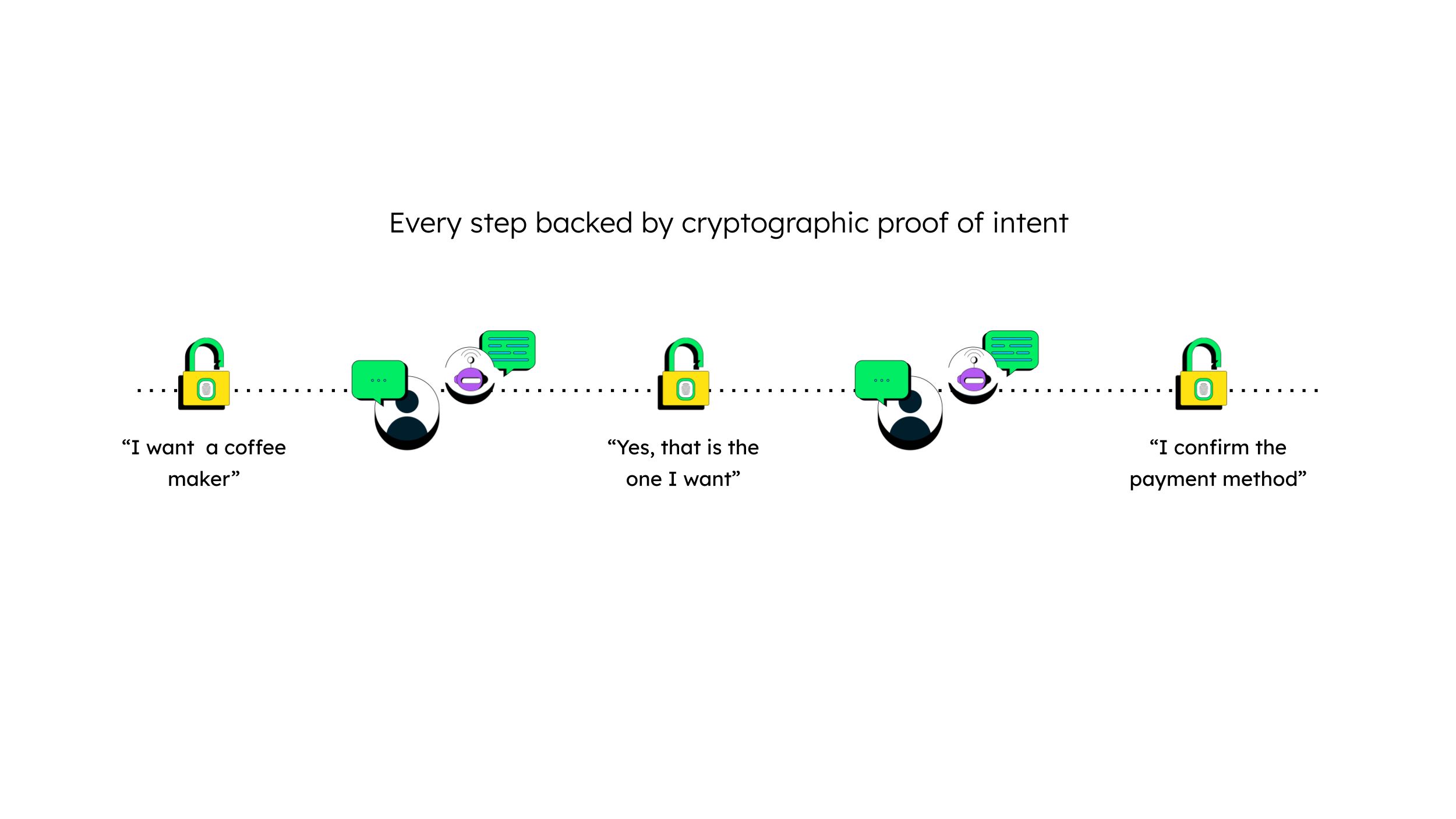
MongoDB fits naturally as AP2’s Mandate Ledger. Because AP2 artifacts are JSON-based, MongoDB’s document model can store mandates, policies, payment instructions, and agent state in their native form as schemas evolve over time. \
Figure 2. MongoDB as AP2’s Mandate Ledger.
.png)
The key point for retailers is that AP2 should not be treated as just another integration task. It introduces a new trust infrastructure that will sit beside identity, payment, and order systems. Retailers that prepare for that layer early will be in a stronger position than those that wait for agentic traffic to force a redesign under pressure.
2. Improve the richness of your API responses
If protocols define how agents interact, data richness determines how well they can reason. Agentic commerce will favor retailers whose APIs are expressive, structured, and easy for machines to consume. Google’s own UCP examples show agent-facing responses carrying rich objects such as capabilities, line items, totals, buyer details, payment handlers, discounts, and status fields. More broadly, Google’s 2026 updates added cart management, real-time catalog queries, and identity linking, which means agent-facing interfaces will need to expose far more than the standard SKU, price, and inventory responses many retailers rely on today.
Figure 3. Google’s UCP Protocol allows retailers to publish their capabilities to agents.
.png)
For many retailers, this is where the existing stack begins to show strain. APIs designed primarily for web or mobile front ends often return only the minimum information required to render a page. Agents require more context: compatibility, substitutions, fulfillment signals, richer product attributes, and clean machine-readable structures that help them interpret and act on the data they receive.
MongoDB’s document model is particularly well-suited to this shift. Retail product data is often polymorphic, sparse, and deeply nested. MongoDB’s flexible schema makes it possible to introduce new conversational or agent-facing attributes without disruptive migrations, while keeping JSON structures close to the payloads already used by applications and services. In practice, this gives retailers a way to enrich APIs continuously as standards evolve, instead of turning every new field into a database redesign exercise.
If retailers want their products to be discoverable, understandable, and actionable inside agentic journeys, thin APIs will not be enough. Richer responses are quickly becoming part of the competitive surface area.
3. Design for agent-facing API performance from day one
The next issue is whether APIs can perform under agentic traffic patterns. Agent traffic will not behave like human traffic. It will be continuous, automated, and far less tolerant of stale data, latency spikes, or availability issues. Google’s Universal Cart vision depends on real-time deal tracking, price history, restock monitoring, and compatibility checks across merchants and surfaces, which raises the bar for the operational systems sitting behind retailer APIs.
For technology leaders, that means evaluating agent-facing APIs with the same seriousness as core checkout infrastructure. Latency, availability, concurrency, and scalability are no longer secondary technical metrics when machines are making decisions in the background. This is where the Operational Data Layer (ODL) pattern becomes highly relevant. An ODL centrally integrates siloed enterprise data and makes it available to consuming applications through a governed intermediary layer between source systems and consumers.
Figure 4. MongoDB as the Operational Data Layer.
.png)
The ODL pattern is strategically useful here because it is designed to expose data as a service, support new requirements without forcing a rip-and-replace of legacy systems, and improve speed and scalability through flexible access to operational data. For retailers, that creates a practical modernization path. You do not need to rebuild the entire estate in one move, but you do need an operational layer that can deliver low-latency, highly available, horizontally scalable access to the data that agents will increasingly depend on.
As highlighted in recent product updates, MongoDB has achieved significant advancements in core database metrics such as increased write throughput, faster read speeds, and enhanced transactional reliability. This ensures that enterprises have access to a platform capable of supporting modern production workloads with the necessary scale, speed, and precision for agentic commerce.
Start planning for agentic commerce today
The planning window for agentic commerce is open. Retail leaders should focus on three things: understand the protocol layer, enrich the machine readability of their APIs, and strengthen the performance characteristics of the operational systems behind them.
The opportunity is significant, but so is the architectural shift it requires. MongoDB offers a dependable data foundation capable of handling the dynamic performance and capability requirements essential for agentic commerce. Retailers that act early will be better positioned not only to participate in agentic commerce, but to shape how trust, data, and performance are delivered within it.
Next Steps
Discover how MongoDB can help you deliver seamless retail experiences across all channels through our solutions page.
Visit MongoDB as the Mandate Ledger for Agentic Commerce: Supporting A2A, AP2 & UCP to learn more about how MongoDB supports agentic use cases.