Transaction routing is a delicate balancing act between authorization rates, execution cost, and latency. A declined transaction can mean a lost sale, making payment optimization one of the most direct levers for top-line revenue growth. Yet payment operations teams remain trapped in manual operational cycles: Pulling batch CSV reports, analyzing spreadsheets, and manually updating rule tables in legacy gateways. And that repetitive cycle can cost you dearly.
Global businesses lose 1.5% to 2.2% of annual revenue to poor payment performance and false declines, according to research by Checkout.com and Oxford Economics. While those percentages may seem small, it actually adds up to more than $50 billion in lost revenue each year. And the impact isn’t seen in weeks, months, or a year later. In fact, the fallout is immediate: 45% of shoppers abandon purchases and shift to competitors after a single checkout decline.
To recover lost revenue, modern infrastructure must decouple routing intelligence from checkout execution. Running a background multi-agent control plane to analyze telemetry, simulate options, enforce cost guardrails, and update JSON rules in MongoDB enables continuous smart routing optimization with execution in milliseconds.
Welcome to our new series on agentic payment smart routing, where we architect a modern payment routing platform. This first installment introduces the core concepts for designing an AI-driven control plane across all payment modalities. In the following series, we will apply these foundational principles to specialized deep dives into card payment and cross-border bank transfer routing.
Foundational principles of smart routing
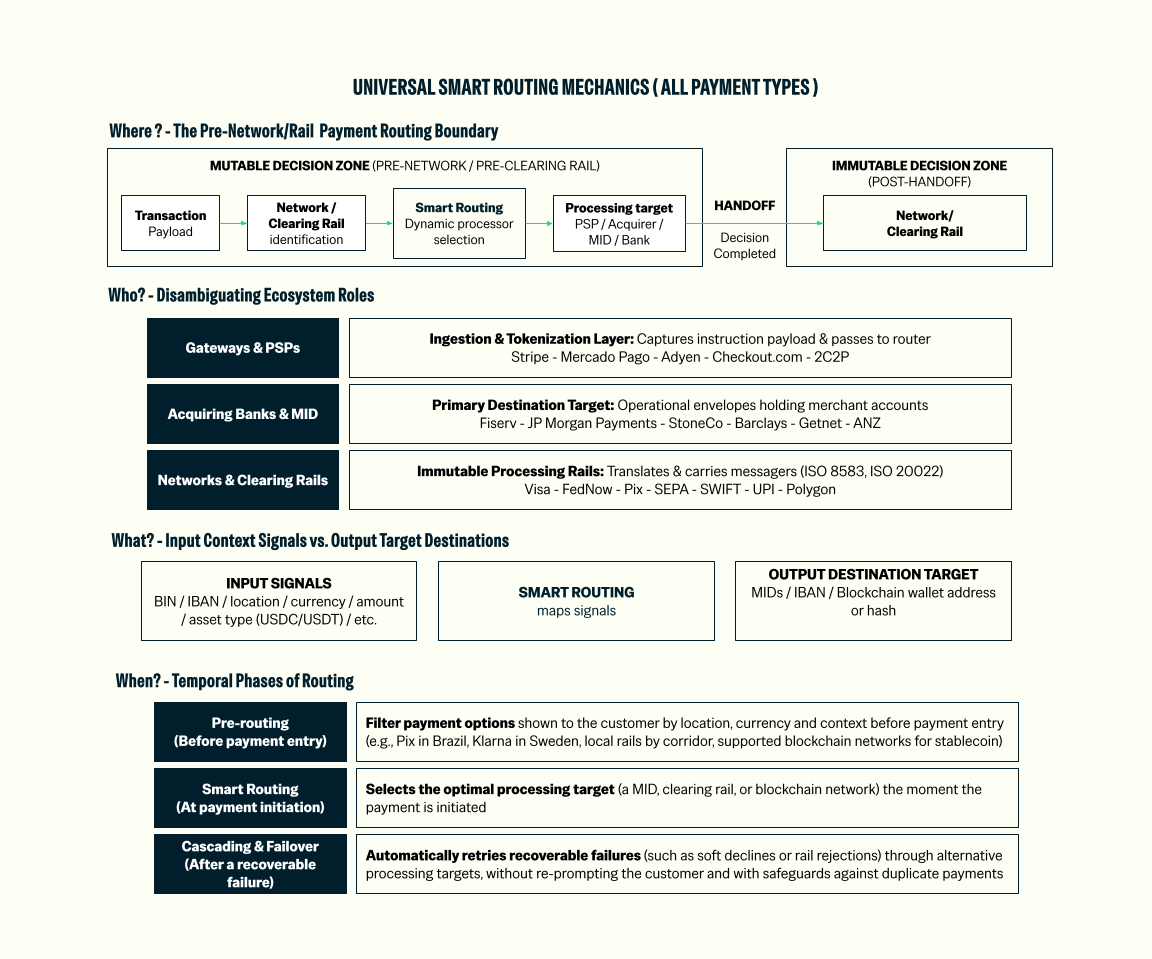
To build a resilient payment stack, you need to understand four universal principles that apply whether processing a credit card, a cross-border, or a crypto stablecoin payment. These four principles answer four questions:
Where? Routing applies only before the transaction enters the network or rail.
Who? Networks, PSPs, and acquirers have distinct roles.
What? Input signals map to an output target: a Merchant ID (MID), clearing rail, or blockchain network.
When? Before payment entry (prerouting), at initiation (smart routing), and after a recoverable failure (cascading failover)
Figure 1 summarizes these principles:
Figure 1. Foundational principles of smart routing (universal across modalities).
Why do scripted payment routing rules fall short?
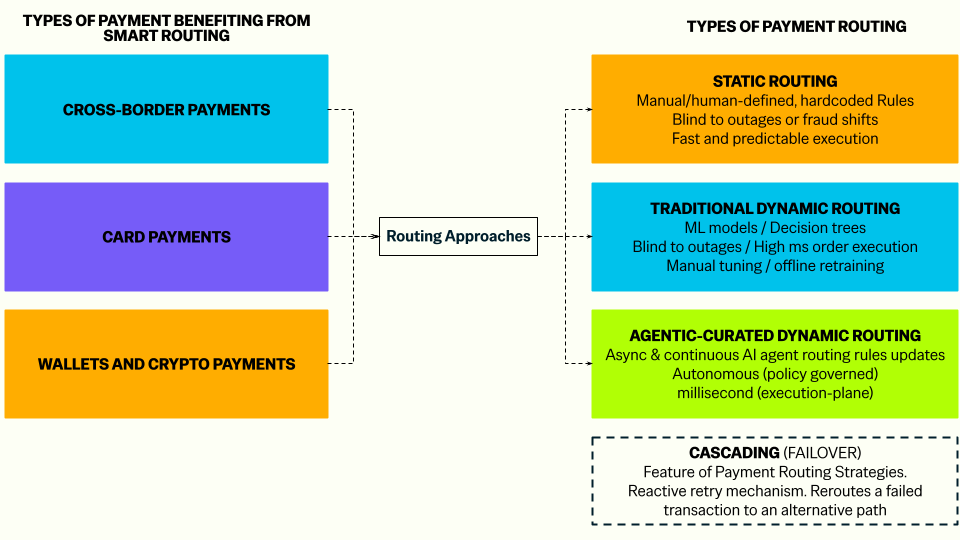
Payment routing selects which gateway, acquirer, or network rail processes a transaction from intent to settlement. Choosing the right architecture requires evaluating three distinct paradigms along the maturity spectrum: static, traditional dynamic, and AI agentic routing.
The business objective is to improve authorization rates without allowing processing costs, fraud exposure, or operational complexity to outpace revenue. A declined transaction can mean a lost sale, and poor payment performance erodes revenue through false declines. Yet many payment ops teams still rely on batch reports, spreadsheets, SQL queries, and manually maintained rule tables.
Figure 2. The evolution of payment routing mechanics.
Robotic process automation and scripted workflows face three main limitations in payment routing:
Dimensionality explosion: Payment performance can shift at complex intersections, such as a specific clearing rail, jurisdiction, routing identifier (BIN, BIC, or chain ID), asset type, or transaction amount range. A script can only analyze combinations that engineers explicitly anticipated.
Unstructured error interpretation: Processing endpoints, banks, and digital asset networks often return inconsistent responses and decline codes. Rigid scripts struggle to process vague signals (such as "Do Not Honor" or generic rejection codes).
Multi-constraint trade-offs: Achieving higher authorization rates often comes at the cost of higher processing fees, network wire or gas costs, foreign exchange spreads, volume commitments, or liquidity constraints. Nested conditions quickly become complex to maintain, explain, and test.
Agentic AI bridges this gap, not by replacing fast execution with slow LLM calls, but by handling background reasoning and continuous rule optimization while preserving a fast, predictable execution path.
An agentic control plane and fast data plane help improve payment routing
An agentic architecture separates background payment rule optimization from payment execution. Payment rule optimization is executed at an asynchronous multi-agent control plane, while payment execution runs on a high-speed execution data plane.
The asynchronous multi-agent control plane does not evaluate individual payment requests in real time. Invoking AI agents on the hot execution path would introduce unsustainable processing costs and unacceptable latency for high-volume scenarios. Instead, the control plane operates continuously in the background to monitor route degradation, simulate net-margin impacts, and present optimized routing rules on an operational dashboard for human payment manager approval. Meanwhile, the high-speed execution data plane handles live transactions at the point of interaction—whether at a POS terminal, an e-commerce checkout, a bank transfer portal, or a Web3 payment widget—by deterministically querying active, declarative rules and evaluating relevant context in milliseconds.
Figure 3. High-level architecture of multi-agent control and high-speed execution data planes underpinned by MongoDB and Atlas Agent Engine.
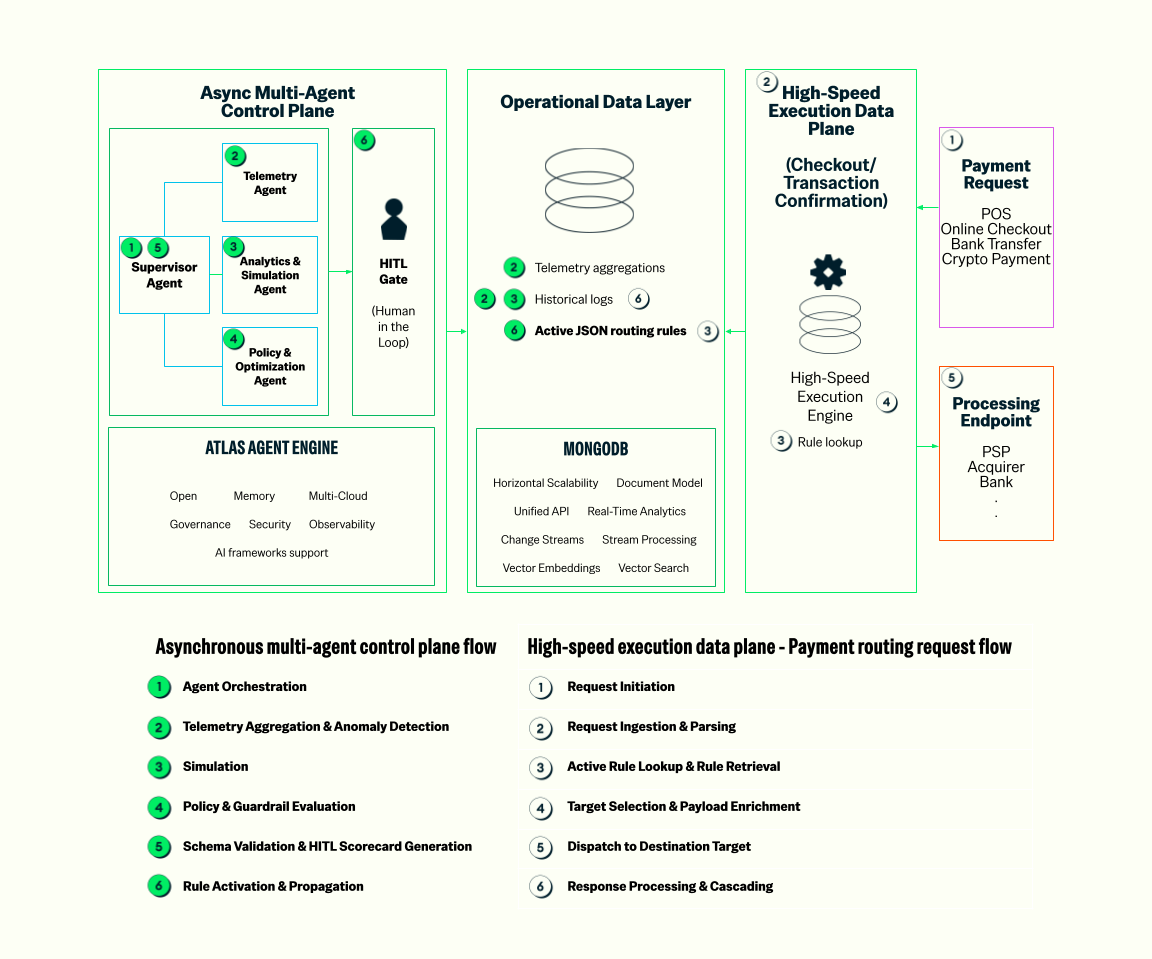
The control plane can automate the five-step payment routing optimization loop typically executed manually by the human payment analyst. The asynchronous multi-agent control plane works continuously in the background. Specialized agents can divide the optimization loop into focused responsibilities:
While this is a simplified example applicable to card payment routing, these concepts can be easily adapted to bank transfers and crypto payments.
A telemetry agent detects that U.K. Mastercard debit transactions have a 78% authorization rate through Gateway Alpha versus a 91% rate through Gateway Beta. The simulation agent estimates moving 50,000 monthly transactions (average $80 value) could recover $520,000 in sales. Gateway Beta charges higher fees, but the 0.18% projected fee increase remains below the 0.5% policy cap. The supervisor agent can present the projection results as a scorecard for approval and then persist an active rule with Gateway Beta as the primary route and Gateway Alpha as the backup.
How MongoDB supports agentic payment routing
Agentic payment routing needs more than a place to store rules. It needs a data platform that unifies telemetry, transaction history, provider profiles, policies, agent state and memory, and active configurations to support investigation and execution.
MongoDB’s document model naturally fits payment data that evolves across providers and rails. An acquirer may return structured decline fields, a clearing house nested ISO 20022 XML error payloads, and a crypto RPC node unformatted event logs. A document model preserves these native payload differences without rigid schema migration or separate extraction pipelines. This flexibility enables AI agents to analyze complete payment context rather than relying only on predefined fields a rigid script anticipated.
MongoDB Atlas brings search and aggregation capabilities together. MongoDB Vector Search helps find similar historical payment contexts, while metadata filters and aggregation pipelines narrow results by country, network, payment modality, currency or token asset, and policy constraints. Agents use these signals to detect hidden performance patterns and rank routes by success rate, similarity, and processing fees.
The database also stores active JSON rules that the execution engine reads. Agents write new rules, record their confidence and justification, set their status to pending approval, and activate them upon manager approval. Time-to-live (TTL) indexes handle rule expiration, while MongoDB Change Streams instantly notify the control-plane components of transaction data or rule updates without waiting for batch jobs.
Deployable anywhere, Atlas Agent Engine is an enterprise platform for managing the full lifecycle of AI agents. It delivers native short- and long-term memory primitives within the database, eliminating custom state pipelines. Running in a sandboxed execution runtime with built-in observability, it enables auditing of agent recommendations. With native safety controls and support for open standards like MCP and A2A, it integrates into existing stacks to deliver secure, audit-ready payment routing.
Security and deployment requirements shape the architecture. MongoDB Queryable Encryption keeps sensitive fields encrypted while supporting specific query patterns, supporting PCI DSS and privacy obligations. Zone-based sharding keeps selected data in target regions, while multi-cloud deployments ensure high availability across cloud providers. These capabilities help build an architecture that meets regulatory, availability, and data residency needs.
Most importantly, MongoDB supports the separation between control and execution. The control plane can analyze telemetry, logs, vectors, and policies, while the data plane retrieves only the active rule and attributes required for a fast decision.
What agentic payment routing enables
Smart payment routing is evolving from static rules into a continuous, self-healing optimization system. Static routing remains useful for deterministic paths, and machine learning can add real-time scoring. But neither approach fully addresses the work of discovering new segments, interpreting changing unstructured decline or failure signals, simulating alternatives, and enforcing competing multi-variable constraints across cards, bank rails, and digital assets.
Agentic AI handles this background work. With a multi-agent control plane and MongoDB, PSPs, orchestration providers, banks, and enterprise merchants can continuously analyze payment performance, test routes, protect margins, and approve impactful changes. MongoDB manages the changing operational context, enables advanced search capabilities across similar payment scenarios, and serves active rules for low-latency execution.
The result is a practical path to smarter payments: Autonomous optimization where reasoning is useful, deterministic execution where speed is essential, and human oversight where governance requires it.
Next Steps
Ready to go further? Explore how MongoDB helps you modernize payments and scale agentic AI with confidence with these resources:
Learn how agentic AI can unlock new capabilities to modernize cross-border payment systems.
See how a benchmark shows MongoDB Atlas managing thousands of payments per second with zero data loss.
References: