Most organizations can get a single agent demo working. The real challenge is choosing a platform that can run many agents, across many teams, over time with the security, governance, observability, and economics your business requires.
This session provides a structured evaluation framework you can apply to any agentic platform, including the MongoDB Agentic Platform.
You’ll learn how to:
Describe the core building blocks of an agentic platform and apply the Golden Rule: build agents with frameworks; operate agents with platforms.
Identify the six key harness components (runtime, orchestration, state and memory, data and retrieval, lifecycle management, observability and evals, and cost controls) and understand how a platform should support them.
Formulate three core validation questions any enterprise-ready platform must answer:
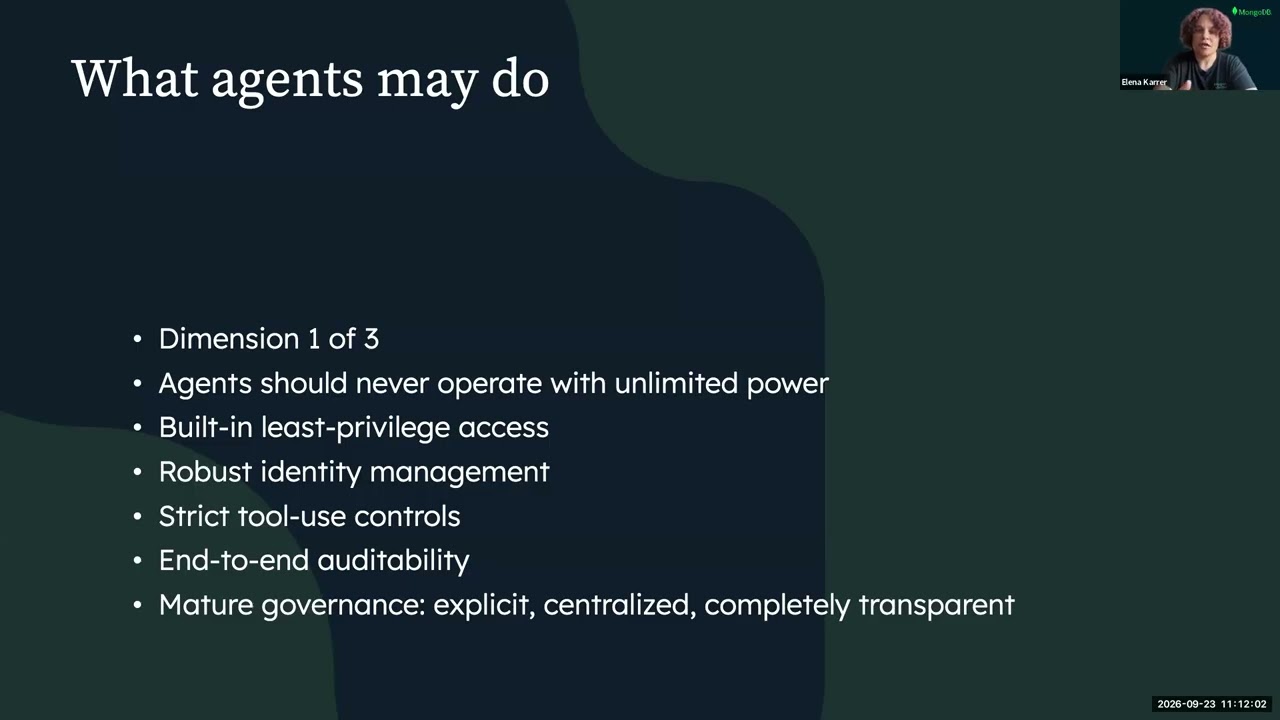
What was the agent allowed to do?
What did the agent actually do?
Did it do it safely and correctly?
Evaluate security must-haves (scoped identity, granular access control, isolation/sandboxing, prompt injection defenses, centralized policy enforcement) and observability must-haves (stack-wide traces, full audit trails, decision traceability, evaluation hooks) as a single “symbiotic governance” standard.
Assess operational and economic sustainability: multi-region and multi-provider deployments, horizontal scaling, workload isolation, data locality, and the Four Scaling Cost Drivers: network egress, HA topologies, storage/backup multipliers, and split architectures.
Apply future-proofing and decoupling principles over an 18‑month horizon so you can preserve flexibility at the edge (frameworks, LLMs, runtimes) while centralizing governance, observability, and cost control.
You’ll walk away with concrete questions and comparison criteria you can use in RFPs, architecture reviews, and platform selection discussions.


