Quantum machine learning (QML) is an emerging technology in computer science, where the immense processing power of quantum computers and quantum algorithms intersects with the adaptability and pattern recognition prowess of machine learning.
This potentially groundbreaking yet primarily theoretical field promises to revolutionize certain tasks like analyzing quantum data, optimizing data in high-dimensional spaces, and simulating quantum systems. However, it's essential to recognize that quantum machine learning is still navigating through different stages of research and development.
Central to the potential of QML are quantum machine learning algorithms. These algorithms, designed to harness the principles of quantum mechanics, stand at the forefront of quantum machine learning innovation, offering the unprecedented ability to process and analyze data far more rapidly than with classical algorithms. The development and practical application of these quantum algorithms and other quantum technologies are linked to improvements in quantum processing, which are advancing rapidly.
Let’s explore what quantum machine learning is and how it differs from classical machine learning. We’ll also touch on the benefits and limitations. Let’s get started.
Table of contents
- Classical machine learning vs quantum machine learning
- How superposition and entanglement work together
- Exploring the cutting-edge advantages of quantum machine learning
- Navigating the challenges of quantum machine learning
- Conclusion
Classical machine learning vs quantum machine learning
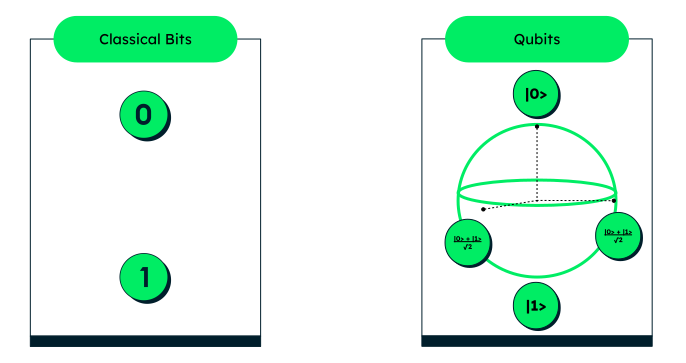
In this section, we explore the shift from classical machine learning methods, rooted in the binary world of bits, to the advanced landscape of quantum computing and machine learning, where qubits reign supreme. This evolution from the traditional “on/off” method of computing using bits (0 and 1) to the quantum realm of simultaneous states (0, 1, and anything in between) promises to dramatically enhance our ability to process data and solve complex problems.
Classical machine learning
In classical computing, information is stored and processed in “bits.” This straightforward, predictable binary system forms the foundation of all digital devices we use today, from smartphones to supercomputers.
Bits are like tiny tiles in a mosaic, collectively creating complex patterns. These patterns manifest as our screens' text, images, and functions. The binary approach of using bits makes classical computing a robust and dependable tool in our daily lives.
Quantum machine learning
In quantum machine learning, the quantum bit, or qubit, is the basic unit of information instead of the bit. Unlike regular bits in classical computing, which are strictly 0 or 1, qubits can exist in multiple states. They can be simultaneously in 0 and 1 states or anywhere between. This unique property allows quantum computers to potentially solve certain problems much faster than classical computers, thanks to two fundamental phenomena: superposition and entanglement.
Superposition
Let's go back to our light switch analogy. In classical computing, the switch is either on (1) or off (0). In contrast, superposition in quantum computing is like having a light dimmer that smoothly transitions between off and on.
A dimmer can represent a range of states between entirely off and fully on. That's similar to how a qubit operates. It can hold and represent a spectrum of states, not just the binary extremes. Superposition allows each qubit to convey a richer and more complex piece of information than a classical bit.
Entanglement
Entanglement is a unique feature that boosts the computational power of quantum computers. It links qubits (the basic units of quantum information) together in a way that the state of one qubit can instantly affect another, no matter how far apart they are. This interconnectedness can significantly enhance a quantum system's processing and analysis capabilities.
Example:
Imagine two qubits entangled in a quantum computer. Think of them like a pair of magic dice. These dice are connected by the rules of quantum mechanics, not by any physical link. When you roll one die (change the state of one qubit), the other die instantaneously shows the same number, even if it's miles away – it's as if they are invisibly communicating with each other.
How superposition and entanglement work together
As noted above, the combination of superposition and entanglement allows quantum computers to complete tasks more efficiently than classical computers. While a classical computer processes information in a linear, straightforward manner, a quantum computer can simultaneously process multiple possibilities.
Example:
To illustrate how superposition and entanglement work together in quantum machine learning, let's use the example of a complex maze with a hidden treasure. In classical computing, solving this maze is like sending in one person who takes one path at a time.
- They walk down a path, hit a dead end, return, and try a different path.
- This process repeats until they find the route to the treasure.
- While eventually successful, this process is time-consuming.
Now, picture quantum computing's approach. Instead of one person, you can send in a team of quantum explorers. Due to superposition, each explorer can simultaneously travel down multiple paths. This is like each person being able to split into several copies of themselves, each taking a different turn at every junction in the maze.
- All explorers travel all possible paths simultaneously, vastly speeding up the search.
- Thanks to entanglement, when one explorer finds a dead end, they can instantly communicate this information to their entangled partners.
- Instant communication helps explorers quickly eliminate wrong paths and focus on the ones that matter.
- In this quantum scenario, the explorers rapidly converge on the correct path to the treasure, which contrasts with the classical approach, where routes are traveled individually.
Quantum computing, with superposition and entanglement, effectively explores all possibilities simultaneously, leading to much faster solutions to complex problems. This capability makes quantum machine learning far more potent than its classical counterpart.
Exploring the cutting-edge advantages of quantum machine learning
It's essential to recognize that the practical application of these advancements is still in various stages of research and development. This section explores a few ideas of what might be theoretically possible with quantum machine learning.
Accelerating information processing in drug discovery
Consider a complex drug discovery process where a computer must understand how a drug interacts with a virus at the molecular level. A classical computer analyzes these interactions step by step, which is slow.
In contrast, a quantum computer could simultaneously evaluate many possible molecular interactions, significantly speeding up the process. Having this ability is like seeing and understanding all the possible ways a drug and virus could interact at once, which could dramatically speed up the search for the most effective treatment.
Handling big data in weather forecasts
Quantum machine learning may potentially move weather forecasting into a new era by processing big data in record time. Traditional computers analyze weather data step-by-step, which can be a slow process.
However, a quantum computer may be able to examine data from various weather stations all at the same time. This capability provides faster and potentially more precise predictions of weather patterns, as it can analyze data from multiple weather stations simultaneously, offering quicker and more accurate weather predictions.
Revolutionizing cryptography and security
Picture a highly advanced security system designed for a locked safe, where the combination shifts unpredictably every time someone tries to examine it. This feature makes it almost impossible for anyone to crack the lock, as the correct combination is always dynamic.
Quantum cryptography operates in a similar way but in digital format. It uses quantum mechanics to secure data, encoding transmitted data in quantum states (like qubits). These quantum states are sensitive to observation, changing when someone tries to intercept or measure them.
So, if a hacker attempts to eavesdrop on a quantum-encrypted message, the very act of their interception alters the quantum state of the message. This breach is immediately detectable and flags the compromised message, making quantum cryptography a highly secure form of encryption.
Navigating the challenges of quantum machine learning
Quantum machine learning faces a range of challenges that highlight its early stage of development. Most applications remain theoretical and require extensive research, much like the early days of classical computing.
Key hurdles include:
- Error rates and stability.
- Complex programming requirements.
- Cost and resource-intensive obstacles.
- Limited understanding of quantum physics.
- Integration challenges.
- Ethical and societal considerations.
These challenges underscore that while quantum machine learning holds immense potential, it remains a field where much is yet to be explored and refined.
Conclusion
At the forefront of quantum computing innovation, researchers are pioneering hybrid quantum-classical approaches, skillfully merging the strengths of both quantum and classical computing. In these groundbreaking systems, quantum computers tackle specific tasks, capitalizing on their extraordinary abilities to manage complex calculations and processing multi-dimensional data. Although still in its nascent stages, the fusion of these advanced technologies holds the promise of a transformative leap in machine learning. As this exciting field continues to evolve, it has promise to reshape our understanding of computation and analysis.