Legacy modernization is the process of upgrading old, slow, or expensive IT systems to modern technology. Instead of just moving old problems to the cloud, it involves simplifying your architecture so your business can move faster, save money, and use new tools like AI. By switching to a unified platform, you trade "bolt-on" complexity for a system that is easier to manage and scale.
Key takeaways
Legacy modernization transforms outdated systems into flexible, scalable, and AI-ready architectures.
Modernizing legacy systems today can accelerate digital transformation, reduce costs, improve security, boost performance, and ensure compliance.
Moving to the cloud alone does not resolve underlying complexity or technical debt.
Bolt-on tools increase fragmentation, cost, and long-term operational risk.
A unified platform approach simplifies architecture and reduces points of failure.
Table of contents
Legacy modernization defined
Legacy modernization is the transformation of outdated legacy systems, legacy applications, and legacy software to better support modern business operations, digital transformation, and evolving business needs. In practice, a strong legacy modernization approach helps organizations reduce technical debt, lower operational costs, improve data accuracy, and build modern systems that can adapt faster to market demands. For example, a customer relationship management (CRM) system built in the early 2000s often requires modernization to integrate with modern cloud platforms and AI-driven analytics.
For many organizations, critical business processes still run on older systems that create high maintenance costs, security risks, and slow release cycles that make it harder to compete. These legacy systems often lack modern security features, data democratization capabilities, and AI integration, which can hinder scalability and operational efficiency.
This matters even more in the age of AI. Most legacy apps were not built for cloud-native development, real-time processing, or unstructured data at scale. As a result, modernization is now a prerequisite of a meaningful application modernization effort.
Why legacy systems fall short
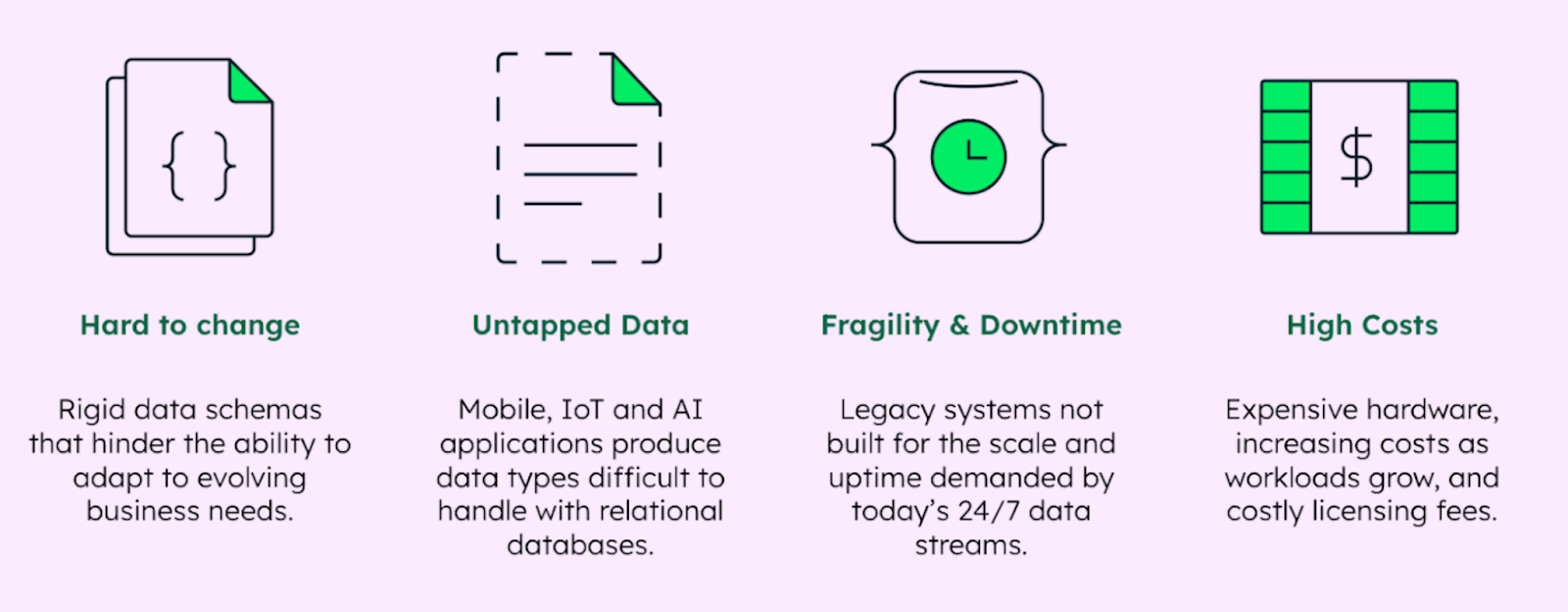
A common misconception is that legacy modernization means simply moving old workloads into the cloud infrastructure. While a basic “lift and shift” can improve hosting efficiency, it rarely fixes the deeper architectural issues inside legacy systems or legacy applications.
Effective legacy application modernization usually includes:
Refactoring or rebuilding legacy apps to improve agility and scalability.
Updating the data layer to support flexible schemas, unstructured data, and smoother data migration.
Reducing dependency on fragmented tools and simplifying the overall platform.
Improving observability, governance, and enhanced security across environments.
Aligning technology choices with evolving business and customer expectations.
These challenges go beyond inconvenience. Legacy software increases operational costs, creates data silos, introduces security risks, and makes systems harder to update or integrate. Over time, the business pays through slower delivery, higher support costs, and reduced flexibility.
What the legacy modernization process involves
A common misconception is that modernization is equivalent to moving systems to the cloud. This “lift and shift” approach may improve performance marginally, but it does not resolve underlying architectural issues.
Effective modernization typically includes:
Application refactoring or re-architecting to decouple services and improve agility.
Data model transformation to support flexible, evolving data structures.
Platform consolidation to reduce tool sprawl and simplify operations.
Process changes to support continuous delivery and rapid iteration.
In some cases, teams also optimize existing code before deciding whether to refactor, replatform, or rebuild. The right choice depends on technical constraints and business goals.

The legacy modernization process
Modernization is not a single step. It’s a structured progression that reduces risk while improving systems incrementally.
Analyze legacy systems: Assess current applications, data models, and dependencies. Identify technical debt, performance bottlenecks, and areas where complexity limits speed or scalability.
Define modernization goals: Align business and technical priorities. Focus on outcomes such as faster delivery, improved reliability, AI readiness, and reduced operational overhead.
Prioritize and plan: Identify high-impact systems to modernize first. Break the effort into manageable phases to minimize disruption and maintain continuity.
Refactor or rebuild applications: Decouple monolithic architectures into more flexible services. Redesign components where necessary to support modern development practices.
Modernize the data layer: Move to a flexible data model that supports both structured and unstructured data. Reduce reliance on rigid schemas and complex migrations.
Consolidate onto a unified platform: Replace fragmented, bolt-on tools with integrated capabilities. Simplify architecture to reduce failure points and operational burden.
Enable real-time and AI capabilities: Incorporate stream processing, search, and AI-ready data pipelines to support modern use cases.
Test, deploy, and iterate: Continuously validate performance and reliability. Modernization is ongoing, with improvements rolled out in cycles rather than a single release.
Done well, this process gives teams a practical path for modernizing legacy applications without creating another layer of complexity.
The problem with bolt-on architectures
Many modernization efforts fail because they rely on incremental additions rather than structural change. Adding new tools to legacy environments can solve short-term needs, but it introduces long-term complexity so that:
Multiple systems must be integrated and maintained.
Data becomes fragmented across platforms.
Performance and reliability become harder to manage.
Costs increase as infrastructure and licensing expand.
Over time, this creates a cycle where each new requirement leads to another workaround. A more durable approach prioritizes consolidation and simplicity.
The case for a unified platform
Modernization is most effective when built on a unified platform that integrates core capabilities. A unified platform enables:
Consistent data models across applications.
Built-in scalability without re-architecture.
Integrated services such as search, analytics, and processing.
Reduced operational overhead and fewer failure points.
Instead of stitching together multiple systems, organizations can develop and operate applications within a cohesive environment. This approach reduces complexity and improves long-term resilience.
What modern architectures enable
Modernized systems are designed to support continuous change and emerging technologies. They allow organizations to:
Build and deploy applications faster.
Support real-time and event-driven workloads.
Integrate AI and machine learning capabilities.
Scale globally with predictable performance.
Consolidate structured and unstructured data.
These capabilities are increasingly required across industries.
Industry use cases for legacy modernization
Legacy modernization is relevant across sectors where data, speed, and reliability are critical.
Financial services: Modern platforms support real-time trading, fraud detection, and regulatory compliance. For example, many banks replace legacy mainframe-based CRM systems with modern cloud-based solutions to improve customer service and streamline operations.
Retail and e-commerce: Modernization enables personalized experiences, dynamic pricing, and omnichannel operations.
Healthcare: Organizations modernize to unify patient data, improve analytics, and support AI-driven diagnostics.
Manufacturing and IoT: Modern systems ingest and process high-volume sensor data for predictive maintenance and optimization.
Legacy modernization strategies
Organizations can choose from several modernization strategies depending on budget, priorities, and the condition of existing systems. Choosing the right modernization strategy depends on the type of:
Legacy system
Desired outcomes
Budget
Risk tolerance
Successful legacy modernization requires careful assessment, a clear understanding of business objectives, and a plan that aligns with both the set budget and timeline.
Rehosting
Often called lift and shift, this approach moves workloads to new cloud infrastructure with minimal code changes.
Refactoring
Teams modify code to improve performance, scalability, and compatibility with cloud native environments.
Replatforming
Applications move to a more modern platform with selective architectural updates.
Rebuilding
Organizations rewrite legacy applications entirely when older designs can no longer support evolving business needs.
In many organizations, legacy app modernization starts with a few high-value workflows before expanding into broader legacy system modernization across the business.
In most cases, the best legacy modernization initiatives happen in manageable phases. That allows teams to prioritize critical business processes, reduce disruption to business operations, and control risk throughout the modernization process.
Data migration in modernization projects
Data migration is one of the most critical parts of any modernization initiative. As organizations move from older systems to modern environments, they must preserve data quality, consistency, and security while minimizing disruption.
A strong migration strategy starts with a clear inventory of data assets, dependencies, and legacy code. Breaking migration into manageable phases reduces risk and makes testing and validation easier at each stage.
Security and data integrity should remain central throughout the process. Encryption, access controls, and monitoring help protect sensitive data and support regulatory requirements.
Modernization projects may also require teams to rebuild or refactor code for compatibility with new systems. Cloud-native tools, containers, and automation can help streamline migration and reduce manual effort.
When done well, data migration supports modernization by improving efficiency, preserving continuity, and creating a stronger foundation for future growth.
Supporting resources for your modernization journey
To evaluate and plan modernization efforts, organizations often rely on a combination of technical and strategic resources, including:
White papers on modernization frameworks and best practices.
Industry case studies demonstrating measurable outcomes.
Architecture guides for cloud-native and AI-ready systems.
Webinars and videos exploring real-world implementations.
These resources help align stakeholders across business and technical teams.
Moving from strategy to implementation
As organizations move from planning to execution, modernization efforts become more complex. Teams must untangle dependencies across legacy systems, protect data accuracy during data migration, and minimize disruption to business operations.
Effective implementation and change management are crucial to minimize disruptions and ensure user adoption during legacy modernization. Resistance to change from employees can hinder modernization efforts, so effective change management strategies are essential to overcome employee resistance and ensure user adoption.
At this stage, a practical legacy modernization approach should focus on:
Reducing dependencies between legacy applications and external tools.
Preserving continuity for critical business processes.
Lowering operational costs and high maintenance costs over time.
Improving enhanced security, governance, and resilience.
Creating a simpler platform that can adapt to evolving business needs.
This is where platform choice becomes especially important. Adding more bolt-ons may solve a short-term problem, but it often recreates the same modernization challenges a few years later.
How MongoDB supports legacy modernization
MongoDB provides a unified, developer-friendly data platform designed for modern application architectures. For organizations focused on legacy system modernization, it offers a simpler way to modernize legacy applications and supports broader legacy software modernization without relying on fragmented bolt-on tools.
Its document data model aligns closely with how applications are built, reducing the need for complex data transformations.
Key capabilities include:
Flexible data model that supports both structured and unstructured data.
Built-in search and vector search for AI-powered applications.
Stream processing for real-time data pipelines.
Global scalability with distributed clusters.
Integrated tooling that reduces reliance on external systems.
By consolidating these capabilities into a single platform, organizations can reduce complexity and eliminate many of the failure points associated with fragmented architectures. By modernizing legacy systems with MongoDB, organizations can build new business functionality three to five times faster, scale to millions of users wherever they are on the planet, and cut costs by 70% or more. What's more, upgrading legacy systems also enables the next critical phase of legacy application modernization.
Find the resources you need for your modernization efforts. Start with Bridging the Modernization Gap a white paper that explains best practices for bringing people, processes, and technology together to drive legacy system modernization. Next, read Modernizing Legacy Applications with AI. This white paper explores how MongoDB leverages modular, slice-based modernization strategies supported by dependency graphs and AI augmentation to help enterprises achieve modernization goals while maintaining data integrity and continuity for business operations.
The long-term view: building for continuous change
Legacy modernization is not a one-time event. It is an ongoing capability that helps organizations keep pace with market demands, digital transformation, and evolving business needs.
When organizations choose simplicity over sprawl, they reduce the risk of rebuilding the same problem later. A thoughtful legacy modernization approach can lower operational costs, improve security, support cost savings, and create a stronger foundation for continuous change.
Related resources
- Legacy Modernization — Explore how to transform your legacy debt into an agile, cost-effective data foundation.
- Bridging the Application Modernization Gap — Get a strategic framework for aligning your people and technology during a complex digital transition.
- Modernizing Legacy Applications with AI — Discover how to leverage AI-augmented strategies to accelerate refactoring while maintaining data integrity.
- Lift-and-Shift vs. Transformation: A MongoDB Perspective — See why moving beyond basic cloud migration is essential for achieving true architectural agility.
- Why the Best AI Apps are Built on MongoDB — Understand how a modern data layer enables you to build and scale generative AI applications.
- What is a Flexible Data Model? — Learn how a document-based data model removes the rigid constraints that hold legacy systems back.