

INTRODUCTION
The Forefront of High-Frequency Trading in Crypto
Based in Taipei, Kronos Research is a science and technology-driven trading firm established in 2018. The company has been at the forefront of technology and markets, leading in new markets by applying quantitative research for high-frequency cryptocurrency trading (HFT).
HFT is a trading method that uses powerful computer programs to transact a high volume of orders quickly, sometimes in fractions of a second. Using complex algorithms, HFT analyzes multiple markets and executes orders based on market conditions. Traders with the fastest and most accurate execution speeds usually generate more profit than those with slower ones. High-frequency trading has been used in traditional equities trading since the 1980s and grew in popularity in the early 2000s.
Kronos Research is a leader in developing HFT for cryptocurrency and derivatives trading. Robust trading and research infrastructure is at the heart of Kronos. This enables world-class researchers to build, test, and trade advanced machine learning/AI models trained on large volumes of proprietary market data to capitalize on the best opportunities. Kronos refers to these trained models as trading bots.
The firm’s strategies outperform the market and predict prices by:
- Applying advanced machine learning techniques to identify profitable and repeatable market phenomena that are usually not visible to the human eye
- Building and designing in-house systems to operate extremely quickly and accurately
- Using an extensive operations suite to control risk, prevent trading errors and ensure correct behavior even during severe turbulence.
As a result of this approach, Kronos has grown from two people in Taipei in 2018 to a team of over 80 entrepreneurs, quantitative researchers, traders, engineers and scientists located in Taipei, Shanghai, Singapore and Poland.
THE CHALLENGE
How to gain an edge in the race for prediction intelligence
The hardware environment for traditional securities has been in physical data centers that were as close as possible to the actual exchanges to limit latency. In modern markets, crypto exchanges are natively in the cloud, so it requires a different approach for high-frequency traders to be physically located close to them.
Compared to traditional HFT infrastructure, a big difference is that all of Kronos’s production infrastructure is in the cloud. The choice of cloud infrastructure is limited by what the exchanges are using.
To be closest to the data, most of the trading by Kronos is in AWS because of its popularity with exchanges. By leveraging AWS Regions and Availability Zones that are physically close to the exchanges, Kronos Research can maintain the low latency required for high-frequency trading. By using AWS's machine learning processing tools, Kronos Research was also able to save 4 or 5 hours each day to shorten its time-to-market for new training models.
Different trading strategies have different sets of parameters and configurations that quantitative researchers need to refine. The configuration and parameter data are not as structurally rigid as market data, i.e., bid and ask prices and trades. Some bots might have 20 configurations or key-value pairs, while others might only have six. So quantitative researchers at Kronos needed a way to efficiently store the configuration and parameter data. They also needed a way to analyze how configurations change over time and how they have been updated and selected.
Kronos had been using flat files, which was a quick and easy solution, but it didn’t provide the capabilities they needed for quantitative data analysis.
In addition, many of the team members of Kronos have combinations of high-value skills – such as data engineering, development and trading – so having them upgrade and provision databases was disruptive, inefficient and expensive.
THE SOLUTION
MongoDB Atlas Charts enables Kronos to quickly update its models and parameters
To more efficiently store and use parameter data, Kronos began using the free version of MongoDB, but then switched to MongoDB Atlas to take advantage of its native charting capabilities. Charts is a data visualization tool that makes it easy to create, share, and embed visualizations from Atlas and Atlas Data Federation. Using Charts, the Kronos team can easily create dashboards with multiple charts in just a few clicks. Charts dashboards also update automatically, so researchers get a real-time view of data.

Hank Huang, Chief Technology Officer at Kronos, explained how MongoDB, with its charting capabilities, fits into the firm’s research.
“Kronos uses MongoDB for the later stages of research around higher-level data,” Hank said. “We’re using MongoDB for configuration data for specific strategies and the simulation results for those configurations. MongoDB greatly simplifies the final part of the research workload. Atlas Charts enables our researchers to visualize the different relationships and adjust the dials for trading bots without additional ETL or data movement.”
“Our team members use MongoDB to chart the relationships between the results by configuration to a price change for Bitcoin or looking at a cross-section, it could answer something like, ‘On a given day, what’s the distribution of profit and loss results across the different configurations?’ This is an example of what MongoDB Atlas enables us to do.”
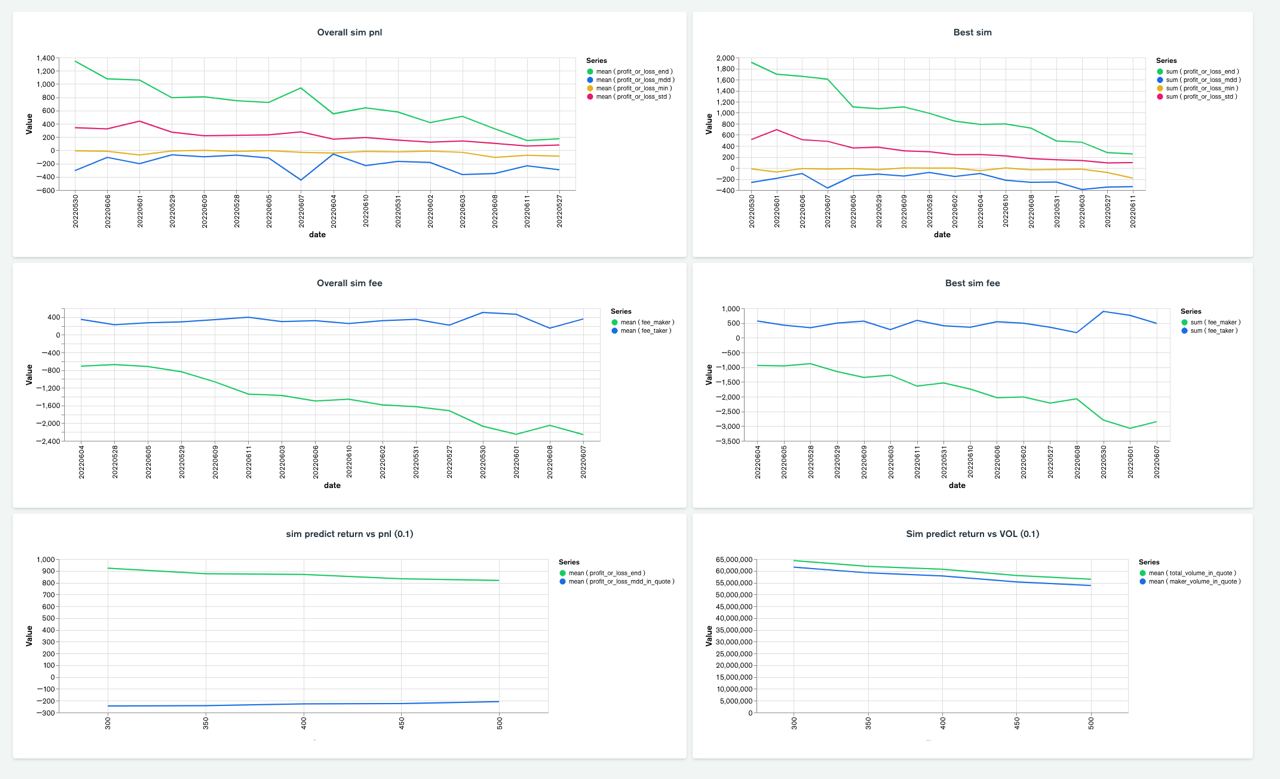
“If we’re talking about quant data, the edge is in how quickly you can update your models and parameters and how you can select the right parameter for changing market conditions. We use MongoDB Atlas to give us more insight into these factors, which saves us a lot of time and brainpower,” Hank said.



_1.svg)