Transitioning from on-premises infrastructure to the cloud can be challenging. Many organizations lack a clear understanding of cloud fundamentals, and establishing a foundational environment is often complex and time-consuming. For every enterprise in particular, security is a critical priority and must be robustly implemented from the outset. Additionally, for new teams building applications, the initial setup presents significant difficulties, as they may not have clear guidance on the precise steps required to create a secure and reliable cloud environment.
This is where alignment with the Google Cloud architecture framework becomes vital. Without a structured approach, organizations risk "technical debt" in their IAM hierarchy and network topology that is difficult to unwind later. These fundamental challenges are resolved by Google Cloud Foundation Fabric, which offers an organization-wide landing zone toolkit designed specifically for this purpose. This toolkit is a reference implementation that dramatically accelerates the often time-consuming process of establishing a production-ready Google Cloud organization. It provides a comprehensive, pre-configured landing zone that includes the typical foundational elements required by enterprise customers, allowing them to bootstrap their cloud foundation quickly and securely. Crucially, Cloud Foundation Fabric follows a "GitOps" methodology, meaning your entire cloud foundation—from folders to firewall rules—is version-controlled, auditable, and immutable. By bridging infrastructure automation with enterprise-grade data services, this integration ensures that your landing zone isn't just a secure network shell, but a fully production-ready application environment. It drastically reduces the time required to stand up a compliant, fully functional enterprise platform from weeks to minutes, allowing internal development teams to get to work immediately.
Figure 1. MongoDB as a art of the Google Cloud Foundation Fabric.
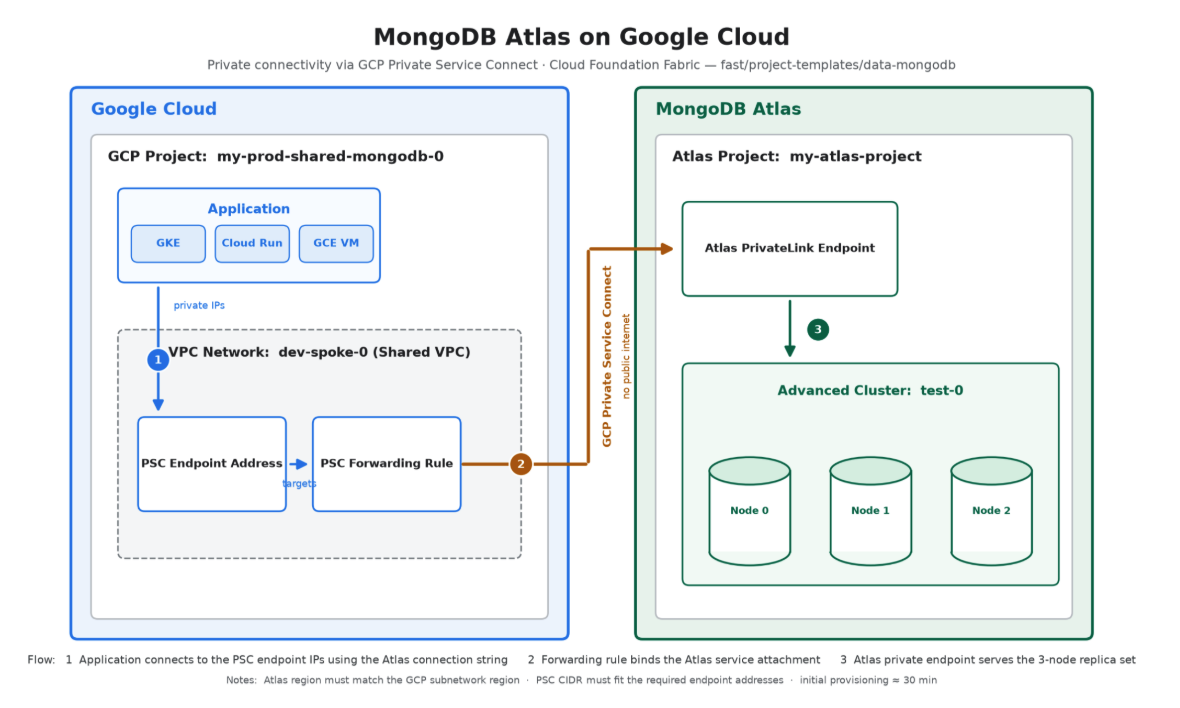
New: A MongoDB Atlas module for FAST
A powerful new solution is now available within our Terraform Examples and Modules for Google Cloud repository: the dedicated module for MongoDB Atlas.
The core mission of the FAST framework is now powerfully supported by the addition of the MongoDB Atlas module, offering a significant advantage for users by providing a robust Solution that addresses critical cloud adoption needs. This module enables Seamless Data Infrastructure Deployment by incorporating MongoDB Atlas directly into the FAST framework, allowing customers to provision their critical data infrastructure with the toolkit's signature speed and adherence to enterprise best practices.
Security by design with Private Service Connect (PSC)
Crucially, it ensures Security by Design through the use of Private Service Connect (PSC). For GCP Solution Architects, the shift from VPC Peering to PSC is a significant architectural upgrade. Unlike peering, PSC consumes no IP address space in your VPC (avoiding CIDR conflict issues), respects project boundaries by design, and eliminates the complexity of transitive routing rules. It creates a unidirectional, consumer-producer relationship that strictly controls data egress. This guarantees that Google Cloud resources connect to the MongoDB Atlas deployment privately and securely, making it an integral and easily provisionable element of the foundational build-out. Furthermore, by routing traffic strictly over Google’s private global fiber network, PSC bypasses the public internet entirely. This setup integrates seamlessly with Google Cloud KMS for Customer-Managed Encryption Keys (CMEK) and Client-Side Field Level Encryption (CSFLE), providing uncompromising data privacy and sovereignty. By coupling this with Google Cloud Service Directory, application teams benefit from native, zone-aware routing and managed endpoint rotation, eliminating complex internal DNS forwarding.
This Expanded Foundation broadens our existing comprehensive suite of modules—covering foundational, networking, compute, and data components—making it simpler than ever to provision secure, high-performance NoSQL databases as a fundamental part of a Google Cloud organization's initial structure.
In essence, the addition of the MongoDB Atlas module to FAST ensures that foundational build-out, cloud security, and critical data service provisioning can all be achieved with maximum efficiency and confidence, solving the initial adoption and setup challenges for all users.
Connecting to Google Cloud's data and AI ecosystem
Once your secure foundation and MongoDB Atlas cluster are established, they serve as the ultimate launching pad for Google Cloud’s premier data and AI ecosystem
Real-Time Analytics (Datastream & BigQuery): Seamlessly pipe operational data from Atlas into BigQuery using the Datastream source connector for MongoDB. This enables real-time Operational Analytics and Change Data Capture (CDC) utilizing BigQuery’s native JSON functions—without complex, manual ETL pipelines.
Generative AI & Agentic Memory: Power your GenAI workloads by using Atlas Vector Search integrated with Vertex AI. MongoDB Atlas serves as the foundational, long-term memory layer for autonomous agents built on the Vertex AI Agent Development Kit (ADK), transforming operational data into context-aware, production-grade actions.
Firebase Developer Agility: For mobile and web developers, the Firebase Extension for MongoDB Atlas allows one-click synchronization and immediate vector search deployment, offloading backend complexity.
This ensures that your foundational build-out is directly aligned with your long-term modernization and AI strategy.
What the module automates
We've made the setup process incredibly straightforward. This simple configuration allows you to:
Create and set up a managed MongoDB Atlas cluster.
Connect that cluster directly to your local Google Cloud Virtual Private Cloud (VPC) network using Private Endpoints (which leverage Private Service Connect).
Automatically register these endpoints with Google Cloud Service Directory, ensuring that your applications can resolve and reach the database using internal DNS names without complex forwarding rules.
Preparing your Google Cloud project
Before you hit 'deploy,' you need to ensure your Google Cloud Project is ready. The included project.yaml file acts as your checklist:
API Activation: Check the list of APIs under the services section and make sure they are enabled in your project.
Permissions (IAM): The permissions listed under iam must be granted to the user or service account running the Terraform code. Specifically, servicedirectory.admin is required to allow the Terraform provider to register the PSC endpoint for DNS resolution.
All the major adjustments are handled through two main variables: atlas_config and vpc_config. Here are the important things to keep in mind:
VPC Flexibility: The vpc_config can point to a Shared VPC Host network (as shown in the examples) or a standard network located within your project. Using a Shared VPC is the recommended pattern for enterprise landing zones, as it centralizes network administration while delegating application management to the service projects. This pattern is supercharged by Google Cloud's unique Global VPC capability. Unlike other cloud providers, where virtual networks are regionally bound, a GCP Global VPC spans multiple regions natively. This means a single, centralized network can connect your global application microservices to multi-region MongoDB Atlas deployments with dramatically simplified network topologies, lower latency, and reduced egress costs.
PSC CIDR Block: If you use the default (recommended) port-mapping architecture for MongoDB Atlas Private Service Connect, only a single IP address is needed for the PSC endpoint in your VPC. You no longer need to allocate a large block; specify a /32 CIDR for just one address. (Legacy, non-port-mapped endpoints require larger blocks, but are deprecated and will be disabled after April 30, 2027.) Always avoid overlapping any service ranges.
Private Service Connect (PSC):
Endpoint Registration: Atlas PSC endpoints are registered with Google Cloud Service Directory. Make sure you assign the `servicedirectory.admin` IAM role to the Terraform runner service account so your endpoint DNS is configured correctly.
Connectivity and DNS: Applications should always connect to the database using the Service Directory internal DNS name to benefit from managed endpoint rotation and zone-aware routing. Avoid manual DNS mappings or forwarding rules.
PSC Limitations: Standard Google serverless services (Cloud Run, Cloud Functions, App Engine) require a Serverless VPC Access connector to reach Atlas over PSC. GKE clusters are supported if their nodes are on the target subnetwork. Double-check your region matches between the PSC endpoint subnet and the Atlas cluster region to ensure the lowest latency.
Region Matching: This is critical! The MongoDB Atlas region you select must match the region of your Google Cloud subnetwork to minimize latency and avoid cross-region data transfer costs.
Be patient! Bringing up a new MongoDB Atlas cluster and all the associated private network connectivity from scratch usually takes about 20 to 30 minutes.
Your fast track to production-ready data
The Organization Toolkit (Fabric FAST) addresses the core challenges of cloud adoption—complex setup and mandatory security—by providing a pre-configured foundation. The new MongoDB Atlas module enhances this solution by making the secure, private provisioning of high-performance NoSQL data infrastructure effortless. This powerful combination allows users to achieve foundational build-out and critical data service deployment with maximum efficiency, enabling faster time-to-value and assured security.
On a side note, if you are deploying this inside a FAST-enabled organization, the files can be lightly edited to match your configuration and then used directly in the project factory. This integration enables you to leverage MongoDB-backed projects as standardized "products" to your internal development teams, maintaining governance while empowering developers.
Next Steps
Ready to accelerate your journey to a secure, production-ready cloud environment? Explore the MongoDB Atlas FAST project template and provision your landing zone, private connectivity, and managed MongoDB Atlas infrastructure in minutes. With GitOps-driven automation, Private Service Connect, and Service Directory integration, you can establish a secure data foundation today and start building your next-generation applications faster.