When processing millions of financial transactions daily, most financial institutions face an impossible tradeoff: approve transactions quickly to maintain customer satisfaction, or scrutinize every transaction thoroughly to prevent fraud. Traditional approaches rely on static rules and basic pattern matching that don’t scale with modern fraud sophistication. This disconnect creates a fundamental problem where legitimate transactions get delayed while sophisticated fraud slips through undetected.
Our AI-powered transaction processing system combined with MongoDB Atlas represents a fundamental shift in how we approach financial fraud detection. Instead of relying solely on predefined rules, it enables real-time AI analysis backed by vector similarity search, graph-based network analysis, and Temporal orchestration. This transforms fraud detection from a binary rule-checking system into an intelligent, context-aware decision engine.
What makes this approach particularly powerful is MongoDB Atlas Vector Search enabling semantic similarity analysis across historical transactions. Combined with Voyage AI’s voyage-finance-2 embedding model for domain-specific embeddings, and advanced aggregation pipelines for complex risk scoring, this represents a significant advancement over traditional approaches, which often create false positives while missing sophisticated fraud patterns.
AI-powered fraud detection: Beyond rule-based systems
Modern financial fraud has evolved far beyond the simple patterns that traditional rule engines can detect. Today’s fraud involves sophisticated networks, money laundering schemes, and AI-generated attack patterns that require equally sophisticated detection mechanisms.
Our system implements a multi-layer detection architecture that combines:
- Real-time vector similarity analysis: Using MongoDB Atlas Vector Search to find similar historical transactions.
- Graph Network Analysis: Using MongoDB’s aggregation framework to trace money flow patterns.
- Temporal Orchestration: Ensuring reliable, auditable transaction processing.
- AI-Driven Decision Making: Using large language model (LLM) for contextual analysis.
Figure 1. AI-powered transaction-processing architecture.

This architecture enables subsecond decision making for 90% of transactions while ensuring suspicious patterns are escalated for human review. MongoDB Atlas’s native vector search capabilities enable us to find semantically similar transactions in milliseconds, while graph lookup operations can trace complex money-laundering networks across multiple accounts.
The modernization imperative: From legacy to AI-powered systems
The financial services industry stands at a critical juncture. Legacy monolithic architectures and relational database management systems (RDBMSs) designed for a different era now struggle with today’s payment transaction volumes and sophistication requirements. As highlighted in MongoDB’s recent analysis of payments modernization, financial institutions face an impossible choice: Maintain outdated systems that can’t scale, or undertake complex modernization efforts that seem too risky and expensive.
The legacy system challenge
Traditional payment systems resemble Jenga towers: modifying or updating any component increases complexity and risks causing a system failure. This architectural rigidity creates several critical problems:
- Scalability bottlenecks: Legacy RDBMSs cannot handle the variety, volume, and velocity of modern payment data.
- Innovation paralysis: Rigid schemas prevent rapid adaptation to new fraud patterns and payment methods.
- Operational complexity: Interconnected systems make updates risky and time-consuming.
- Unacceptable processing delays: Extract, transform, and load (ETL)-based approaches cannot meet customer demands for instant transaction decisions.
Figure 2. Legacy monolithic architecture limitations.

The AI-powered modernization solution
Our approach represents a paradigm shift from reactive rule-based systems to predictive AI-powered intelligence using MongoDB Atlas and Temporal as the foundational technologies. This modernization framework addresses the core challenges of modern financial crime detection, which traditional database solutions struggle to address:
- Vector similarity at scale: Financial transactions exhibit subtle patterns that traditional exact-match queries cannot detect. A wire transfer for $49,500 to a shell company in the Cayman Islands may be similar to a historical fraud case involving $47,200 to a different entity in the same jurisdiction. Traditional relational databases require complex joins and cannot capture these semantic relationships efficiently.
- Real-time network analysis: Money laundering often involves layering, moving funds through multiple accounts to obscure the source. Detecting these patterns requires graph traversal across thousands of interconnected transactions in real time. SQL-based systems struggle with recursive queries and graph operations at the scale and speed required for real-time fraud detection.
- Temporal consistency under load: Financial transactions must maintain ACID properties (atomicity, consistency, isolation, and durability) while processing thousands of concurrent requests. The system must ensure funds are properly held, transferred, and reconciled even during peak loads or system failures. Traditional message queues and microservices can lose transaction state, leading to compliance violations.
- Contextual AI integration: Modern fraud detection requires AI models that can analyze transaction context, customer behavior patterns, and global risk factors. This requires seamlessly integrating embedding generation, similarity search, and large language model (LLM) analysis within the transaction-processing workflow.
- Audit trail and compliance: Financial institutions must maintain comprehensive audit trails for regulatory compliance. Every decision, rule trigger, and AI inference must be logged and traceable. Traditional systems often struggle to maintain this level of detail while processing high transaction volumes.
MongoDB Atlas integration architecture
Our system uses multiple MongoDB Atlas offerings to create a comprehensive fraud detection platform.
Atlas Vector Search with Voyage AI’s finance-optimized embeddings
Our system uses Voyage AI’s finance-specific voyage-finance-2 embedding model as the primary embedding engine, with Cohere as an intelligent fallback. This dual-embedding strategy ensures optimal performance for financial transaction analysis while maintaining system resilience. The voyage-finance-2 model is specifically fine tuned for financial data patterns, providing superior accuracy in detecting fraud schemes compared to general-purpose embeddings.
So why should you use Voyage AI Finance-2 for financial transaction analysis? Voyage’s finance-optimized embedding model excels at understanding financial domain-specific relationships, enabling our system to identify sophisticated patterns that indicate fraudulent activity:
- Semantic transaction clustering: Transactions involving shell companies, layered transfers, and structuring attempts cluster together in vector space despite different exact values.
- Cross-border pattern recognition: International wire transfers to high-risk jurisdictions exhibit similar embedding patterns regardless of specific countries or amounts.
- Temporal behavior analysis: Customer transaction patterns encode behavioral fingerprints that detect account takeover and unusual activity.
Advanced fraud pattern detection with finance-optimized embeddings
The vector search uses domain-specific financial embeddings to find semantically similar transactions that exhibit sophisticated fraud patterns. Check out the code reference on Github.
Performance benefits of a finance-optimized-embedding strategy
- Fraud detection accuracy: 97% accuracy with voyage-finance-2 (vs. 94% with general models)
- False positive reduction: 65% decrease compared to rule-based systems
- Pattern recognition speed: Sub-15ms vector similarity search across 10M+ transactions
- Domain expertise: A finance-specific model that can understand regulatory patterns, money laundering schemes, and compliance violations
- Model consistency: Embedding model tracked to prevent cross-model-similarity artifacts
Advanced aggregation for graph analysis
Our system uses MongoDB’s $graphLookup operator to trace money laundering networks. Check out the code reference on Github.
Data model and schema design
Our MongoDB schema is optimized for both transactional consistency and analytical queries:
Figure 3. Comprehensive data architecture with relationships.

Implementation deep dive
Temporal: Solving the microservices-orchestration challenge
Traditional approaches to building microservices in payments face significant complexity around distributed state management, failure recovery, and observability. Temporal addresses these challenges through durable crash-proof execution enabling business processes to complete reliably despite failures in the underlying infrastructure. This capability, combined with built-in support for retries and timeouts, enables applications built on Temporal to gracefully overcome crashes, network downtime, service outages, and even hardware failures.
Why traditional orchestration fails in payments
- State loss: Message queues and event-driven architectures can lose transaction state during failures.
- Compensation complexity: Implementing saga patterns for rollback requires extensive error-handling code.
- Observability gaps: Distributed transactions are difficult to trace and debug across microservices.
- Retry hell: Managing retries, timeouts, and backoff strategies becomes exponentially more complex as scale increases.
Temporal's durable execution solution
Temporal uses event sourcing to record every significant action in a workflow, creating a complete audit trail that serves as the source of truth. This enables automatic crash recovery through history replay, after which the application continues forward progress without losing state or duplicating operations that completed before the crash.
Figure 4. Temporal’s durable execution with automatic recovery.
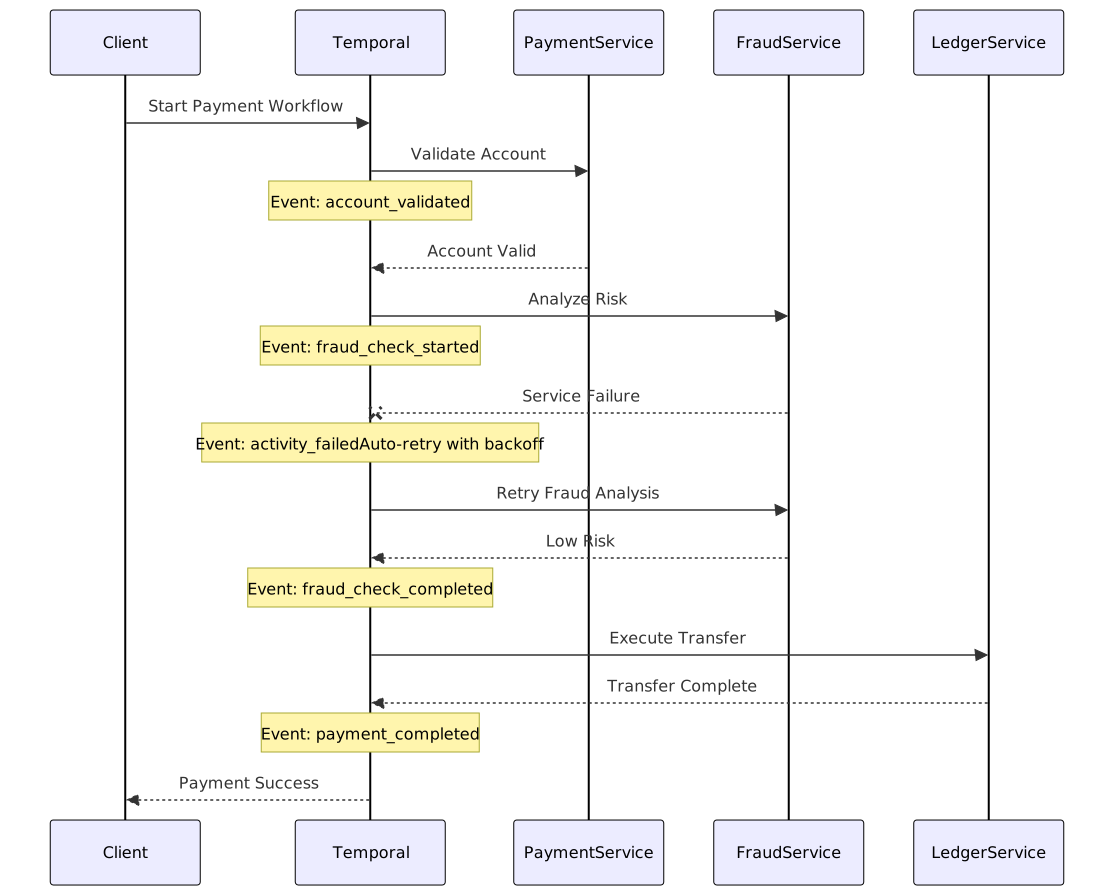
Core processing pipeline
Our Temporal workflow orchestrates the entire transaction processing pipeline with built-in retry logic and error handling. Check out the code reference on Github.
In this workflow, Temporal demonstrates some key features:
- Durable state management: Workflow state that persists across failures and restarts
- Automatic retry with backoff: Built-in resilience for transient failures
- Compensation patterns: Automatic rollback using sagas for complex transactions
- Parallel execution: Multiple activities running concurrently for performance
- Signal handling: Seamless integration of external events (manager approval)
- Query interface: Real-time visibility into workflow progress
- Nonretryable errors: Appropriate handling of business logic failures
- SLA management: Timeout handling with escalation policies
Hybrid search strategy
Our similarity search combines traditional indexing with vector search for optimal performance:
Real-time risk assessment
Our AI system processes risk factors in real time using structured prompts:
Real-world implementation scenario: Focusing on international trade finance
Consider a manufacturing company processing a $275,000 wire transfer to a supplier in Germany. Our system analyzes this transaction through multiple dimensions.
Figure 5. High-value international transaction workflow.
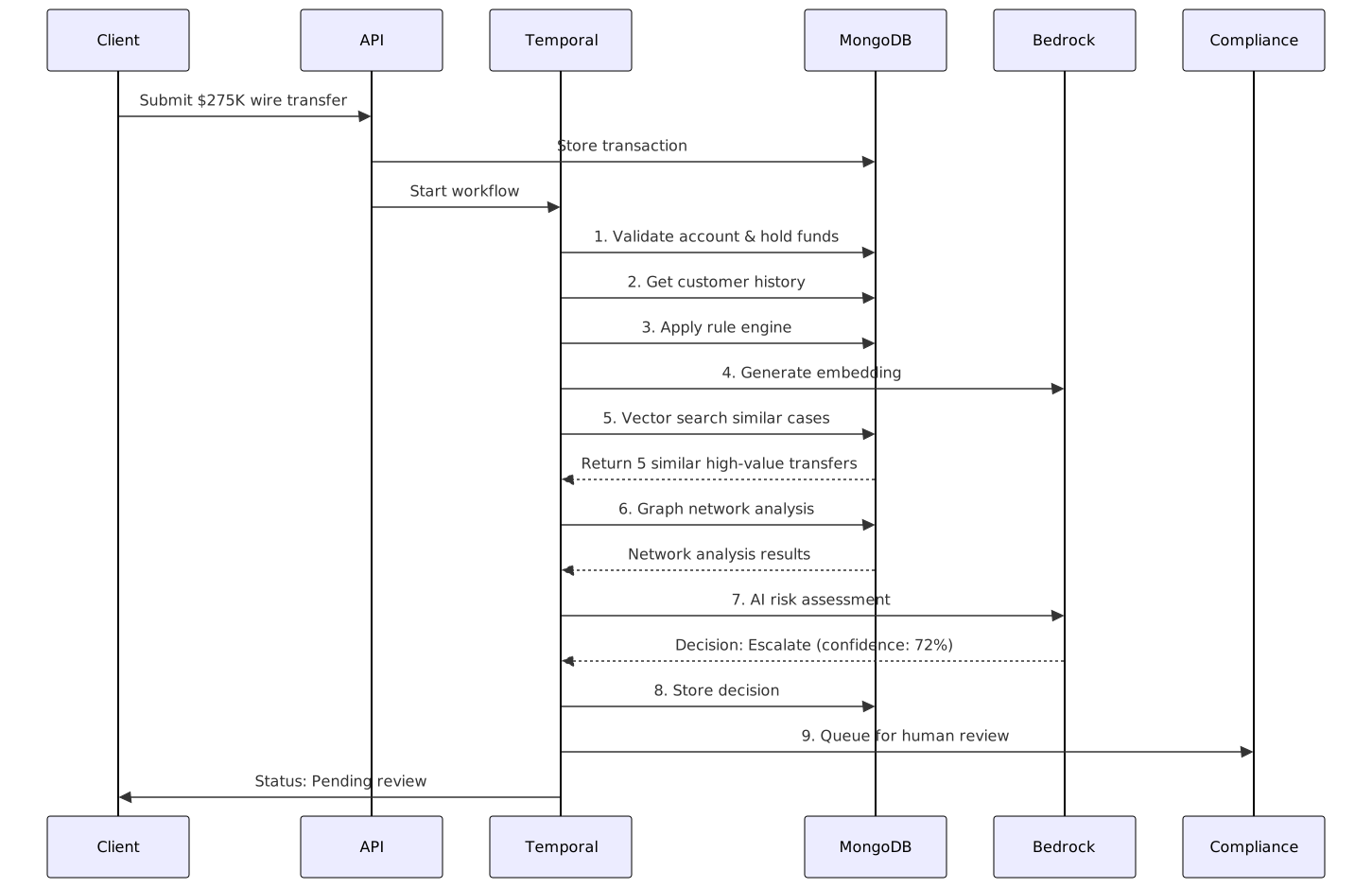
This scenario requires the following implementation steps:
- Data ingestion: The transaction is received via REST API and is immediately stored in MongoDB with a hold placed on sender funds.
- Enrichment: The customer behavioral profile is loaded, and the rule engine evaluates seven active rules, triggering two (high_amount, international).
- Vector analysis: A VoyageAI embedding is generated, and MongoDB Atlas Vector Search finds three similar cases with suspicious patterns.
- Graph traversal: Network analysis reveals the sender account is connected to 15 other accounts in a 30-day window.
- AI decision: Claude analyzes contextual data and assigns 72% confidence for escalation due to pattern similarities.
The entire process completes in subsecond, with the transaction queued for human review due to below-threshold confidence combined with network complexity.
Limitations and considerations
Technical limitations
- Model dependency risk: Heavy reliance on a single LLM provider creates a potential single point of failure. We mitigate this with fallback decision trees and cached model responses for critical path operations.
- Vector embedding costs: Generating embeddings for every transaction incurs costs. Current optimization uses semantic caching, similar transactions share embeddings to reduce API calls by ~40%.
- Query complexity balance: Graph traversal queries can become expensive at scale. We implement depth limits and time windows to bound query complexity while maintaining detection effectiveness.
Learning curve and team readiness
- MongoDB aggregation expertise: Complex graph traversal and vector search queries require specialized knowledge. We anticipate a team training investment of developers for advanced aggregation patterns.
- AI model management: Understanding prompt engineering and confidence-threshold tuning requires machine learning (ML) expertise. We recommend a dedicated AI/ML engineer for optimal system performance.
Future enhancements and road map
Technical features
- Multi-modal AI analysis: We plan to integrate document analysis for wire transfer documentation using Vision LLM capabilities. This will analyze supporting invoices and contracts for consistency with transaction details.
- Predictive risk modeling: We plan to implement time-series forecasting using MongoDB’s aggregation framework to predict customer risk score evolution and proactively adjust monitoring thresholds.
Scaling and innovation plans
- Geographic expansion: Multiregion deployment using Atlas Global Clusters will enable data residency compliance while maintaining subsecond response times globally.
- Advanced analytics: MongoDB Atlas Charts embedding in custom applications will provide contextual risk visualizations directly within transaction review interfaces.
The cognitive load reduction
Perhaps most significantly, MongoDB and Temporal reduce the cognitive load on development teams. Instead of context-switching between business logic and infrastructure concerns, developers can maintain focus on solving business problems. Here’s the mental model simplification:
- MongoDB: The mentality “Data that is accessed together is stored together” eliminates complex join reasoning.
- Temporal: The mentality “Write business processes as functions” eliminates distributed-systems complexity.
- Combined effect: Developers can think in terms of business workflows rather than technical implementation details.
This cognitive simplification enables financial institutions to innovate faster and adapt more quickly to changing market demands, critical capabilities in the rapidly evolving payments landscape.
Conclusion
The integration of AI-powered decision making with MongoDB Atlas represents a fundamental transformation in financial crime detection. By combining real-time vector similarity search, graph-based network analysis, and Temporal orchestration, we've created a system that processes transactions significantly faster while dramatically reducing false positives. This paradigm shift transforms financial institutions from reactive fraud detection to predictive risk intelligence, fighting sophisticated financial crimes while maintaining the speed customers expect.
Next Steps
Ready to transform your financial-crime detection capabilities?
Explore how MongoDB Atlas Vector Search, advanced aggregation pipelines, and Temporal's durable execution can power your AI-driven fraud detection system. The architecture patterns and implementation strategies detailed here provide a proven foundation for building next-generation financial compliance systems that scale with your business while meeting the most stringent regulatory requirements.
Get started today:
• MongoDB Atlas: Discover how vector search, real-time analytics, and seamless AI integration can revolutionize your approach to financial-crime detection.
• Temporal: Learn how durable execution and reliable workflow orchestration can ensure your transaction processing never loses state, even during failures.
Together, these technologies enable you to build resilient, AI-powered systems that process millions of transactions with confidence, compliance, and speed.