This is a guest blog post, written by Devin Pratt, Research Director at IDC.
When I brief IT leaders today, the conversation flips. The question used to be which model to use. Now it is a question of whether their data platform can keep up with software that acts on its own. Generative AI answers questions. Agentic AI takes action, and that one shift changes everything about what a data platform has to do.
This is not a someday problem. According to IDC's April 2026 Worldwide Data Management Survey (n = 715), 30% of organizations already run agentic AI in production, and another 50% are investing behind it, with an established spending plan. Four in five enterprises are past deciding whether agents belong in their operations. They are working out how to run them safely.
Figure 1. Agentic AI is already moving into production.
Q. Which best describes your organization's current state of evaluating or using agentic AI?
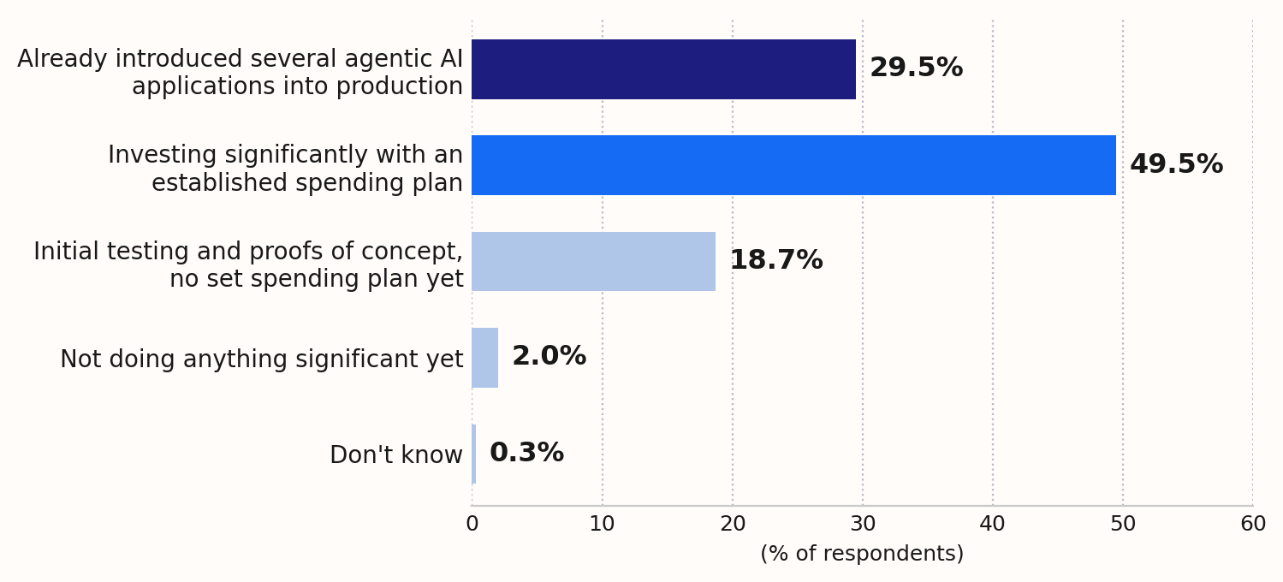
n = 715, Source: IDC's Worldwide Data Management Survey, April 2026
Here is the shift I keep coming back to. A platform built to analyze what already happened is not the same as a platform built to run what happens next. When an agent reads data, decides, and acts in real time, the database stops being a passive store of record. It becomes the control point where real-time context is served, the right information is retrieved, and policy is enforced at the exact moment the agent acts. Get that wrong, and a single bad read becomes a wrong action at machine speed, then repeats.
Real time is now the baseline, not the exception. In the same survey, 64.6% of enterprise data use cases already require real-time or near-real-time delivery; for streaming scenarios, 91.2% need end-to-end latency of under 200ms. Batch-oriented architectures are increasingly on the wrong side of that line.
So, what should IT leaders actually look for? When I work through this with teams, four requirements come up every time.
- A real-time operational foundation that fits AI-shaped data: AI data is unstructured, fast-changing, and high in volume. The foundation has to fit that shape and serve it fast. That is why IDC forecasts non-schematic and data lake systems to outgrow the overall database market, even as relational stays the largest segment.
Elastic scale for unpredictable, agent-driven demand: Agent traffic is bursty and hard to forecast. Teams want to grow on one foundation without the disruptive rebuilding that hard scaling ceilings force. That is the logic behind the move to consolidate on a core platform, with public cloud now at 64.6% of database revenue.
Accurate, always-current retrieval: An agent is only as good as the context it can retrieve. Buyers know this. About 75% favor integrated vector databases over standalone ones, and 47% consider a consistent semantic layer critical for safe and trustworthy AI.
A governed runtime to run agents in production: Durable memory, identity-bound policy, and observability enable a governance team to trust an agent to take real actions. By 2027, IDC expects 80% of agentic AI use cases to require real-time, contextual data access, pushing enterprises from gatekeeping toward federated access with centralized governance.
Knowing the requirements is the easy part. Three things slow teams down in practice, and they are worth naming:
Lock-in worries: With about 95% of organizations reporting data-sovereignty requirements and 90% running open-source databases, enterprises want to run across clouds and on their own infrastructure, not bet the business on one stack.
Governance of autonomous action: When software can act on its own, controllable and auditable access becomes mandatory. Until you can prove it, agents stall in pilot.
Cost that runs away from you: Retrieval-heavy agents create bursts of consumption, and re-explaining context on every step quietly burns tokens. Cost should track use, not unused capacity.
The encouraging part is that these are answerable. A platform that keeps retrieval close to the data, deploys anywhere, and governs agents by default addresses all three directly.
The road ahead
The pattern is already visible. IDC predicts that, by 2029, 60% of enterprise data platforms will unify transactional and analytical workloads in hybrid processing architectures to power agentic AI. The database is no longer where data waits. It is where agents act. Enterprises that treat it that way will move from pilots to production. Those who do not will watch the gap widen.
If you are mapping your own path, the requirements above are a good place to start: a real-time foundation, elastic scale, accurate retrieval, and a governed runtime, with the freedom to run anywhere.
Keep reading
For the full analysis, including the market data behind each of these four requirements, read IDC Spotlight The Intelligent Data Platform Era: Preparing Enterprises for Agentic AI (IDC #US54925526, September 2026), sponsored by MongoDB.