Open Banking and Open Finance (OB&OF) only scale if customers can grant and renew consent in a way that feels safe, transparent, and effortless—yet today consent friction causes more than half of users to abandon otherwise high-value digital experiences. This blog shows how financial institutions can use MongoDB, agentic AI, MongoDB Atlas Vector Search, and the MongoDB MCP Server to turn fragmented consent flows into a single, auditable journey that reduces drop-off and unlocks open finance growth.
As consumers recognize the value of their data, they are increasingly willing to share it when the experience is clear and trustworthy. Recent Mastercard research shows that 76% of consumers would switch providers for superior digital money management, and 82% are willing to share data to simplify loan applications or secure better interest rates.
According to CGAP, Brazil’s Open Finance ecosystem already connects more than 41 million accounts, and in the U.S., the CFPB’s Section 1033 ruling is formalizing consumer data access rights.
Historically, financial institutions largely controlled customers' financial data. OB&OF transforms this model by shifting the balance of power toward consumers while reinforcing institutions' role as trusted custodians of data. In practical terms, consumers gain greater control over which third parties can access their financial data, what data can be shared, and for how long. At the heart of this shift is explicit, informed consent, which enables consumers to authorize and manage access to their financial data. This shift also reinforces the move from a product-centric to a more customer-centric model, as financial institutions increasingly compete to earn and retain customer trust, engagement, and relevance rather than relying primarily on control over the customer relationship and data.
Figure 1. The relationship power shift.
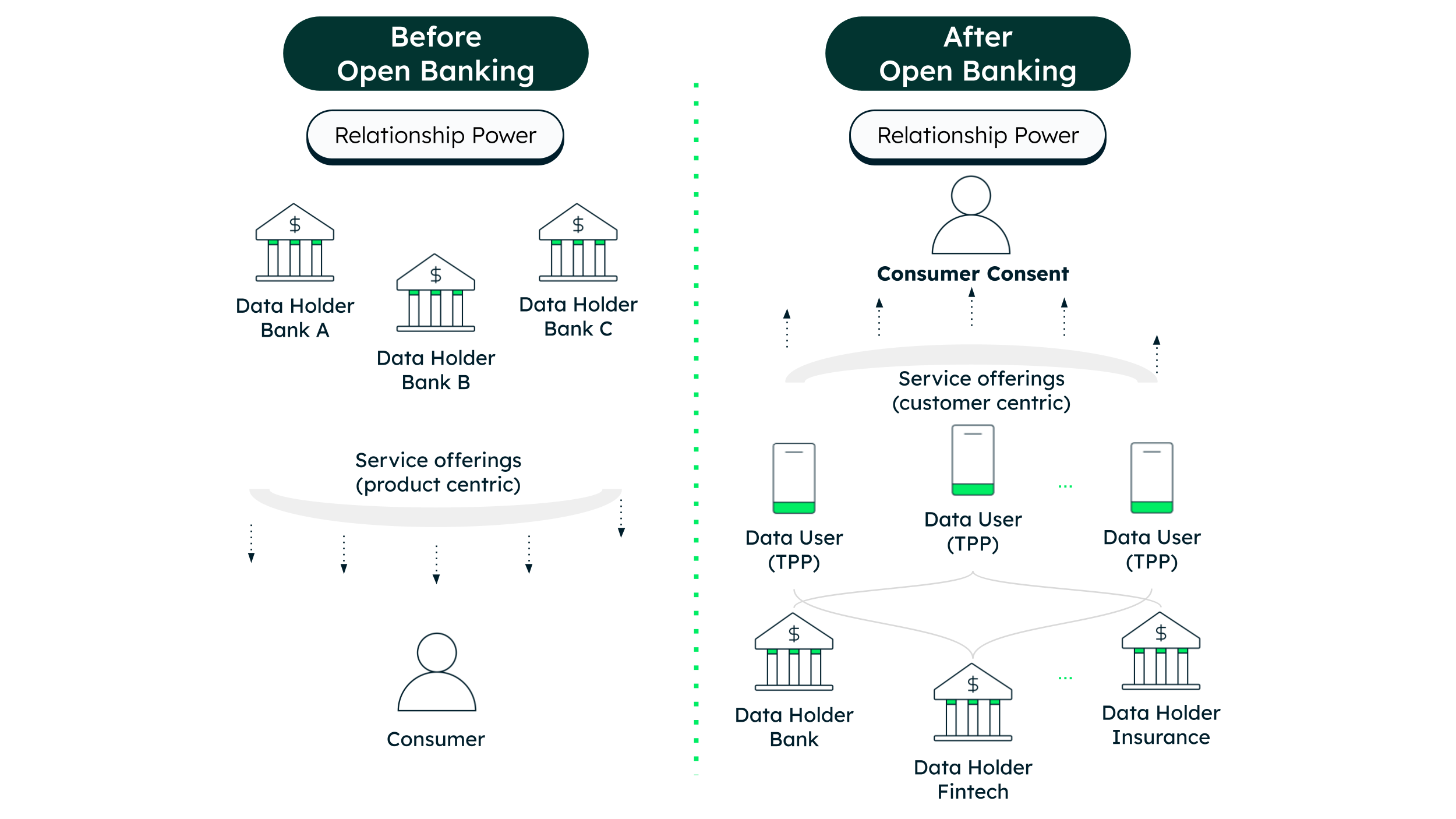
One challenge in OB&OF is that consent journeys have not kept up. Dense legal language, recurring 90-day re-authentication cycles, and disjointed redirects now block adoption more than regulation itself: providers such as TrueLayer report drop-off rates above 50% during consent flows, and CGAP’s analysis of Brazil's market highlights friction in the consent journey as a primary deterrent to ecosystem participation.
To fix this, institutions need a clearer way to define what is being authorized and a better user experience for granting it. The DPSD framework—data scope, purpose, source, and duration—gives everyone a shared model for consent. The rest of this blog shows how an agentic AI copilot, backed by MongoDB as the unified consent and memory layer, can operationalize DPSD without adding more friction.
How does the DPSD framework organize consent in OB&OF?
Effective consent management in OB&OF relies on the DPSD framework, which breaks every consent into four clear parameters:
- Data scope: Defines the specific data clusters and access sensitivity levels being requested, ranging from shareable data to private and highly private records, which have to be formally established in the Terms & Conditions of the service.
- Purpose: Defines the explicit reason for data collection.
- Source institution & identity: Identifies the data holder and the recipient.
- Duration of access: Sets the authorization timeframe for the recipient.
Which OB&OF use cases depend on explicit consumer consent?
As detailed in the whitepaper, Next Generation Open Finance with MongoDB and Agentic AI, various highly valuable, customer-centric offerings cannot operate without this formal permission structure, such as:
- Proactive personal financial management (PFM): Aggregates multi-bank accounts, loans, and investment portfolios into a single dashboard to provide real-time spending insights and credit-improvement strategies.
- Payment Initiation Services (PIS): Enables instant payments, recurring transfers, and cross-provider credit applications within third-party apps, bypassing the source bank portals.
- Alternative credit scoring: Utilizes transactional habits, utility payments, and cash-flow data to automate digital underwriting and accelerate credit approvals for thin-file consumers.
- Credit and loan portability: Aggregates historical performance data to automate rate comparisons and document preparation, providing consumers with better financial options.
Why is consent broken in OB&OF?
Consent is broken because UX, legal complexity, and 90-day re-auth flows make consumers abandon otherwise valuable use cases. While the DPSD framework looks straightforward on paper, the real-world implementation is fraught with challenges that erode consumer trust:
- Legal complexity: Consumers are often overwhelmed by dense legal terminology instead of receiving clear, plain-language explanations of the agreements.
- Manipulative UX design: Poor design patterns can mislead users into over-sharing data or create unnecessary hurdles when attempting to revoke access.
- Interface friction: Excessive steps and disjointed navigation between third-party apps and banking portals degrade the user experience and reduce transparency.
- Security concerns: Unfamiliarity with new providers often leads to consumer anxiety regarding data privacy and potential misuse.
Where does consent friction occur in the OB&OF journey?
To identify where agentic AI can provide the most value, we must analyze the standard consent journey based on the FDX User Experience Guidelines.
Figure 2. Data sharing consent-granting flow.
.png)
In this flow, several critical points of friction arise where users feel overwhelmed or lost:
- Value clarification: Many users abandon the process early because the benefits of OB&OF are not clearly articulated.
- Parameter negotiation: Complex jargon makes it difficult for users to understand DPSD parameters or negotiate granular, partial data access.
- Redirection confusion: Transitioning between apps and institutional portals often creates a "redirection abyss" where users lose context of the process.
- Authentication fatigue: The recurring 90-day re-authentication requirement creates significant friction and user frustration.
- Transparency gaps: Institutions often fail to provide centralized dashboards that clearly display active authorizations and data-sharing limits.
When this journey is backed by MongoDB as the shared operational and AI memory layer, an agentic copilot can explain trade-offs in plain language at each step, instead of forcing users through opaque redirects and static forms.
How can agentic AI act as a consent copilot in OB&OF?
An agentic AI consent copilot replaces static forms with a conversational guide that explains trade-offs in plain language, walks users through bank redirections, and automates re-authentication while preserving full traceability and instant revocation. It streamlines the experience by:
- Simplifying jargon: Translating complex DPSD legalities into clear, conversational language.
- Guided navigation: Providing real-time, step-by-step guidance during bank redirections to set clear user expectations.
- Automating re-authentication: Securely managing 90-day re-authentication cycles through simple biometric approval replaces cumbersome, multi-step logins. Crucially, this process operates with end-to-end traceability and immutable audit logging, giving consumers complete visibility and the immediate ability to revoke consent at any time.
- Enabling granular control: Empowering users to easily select partial data sharing (e.g., sharing checking account data while excluding savings).
Figure 3. Agentic AI as the consent copilot.
.png)
Figure 4. Architecture overview: integrating agentic AI and MongoDB to enable the consent grant flow.
.png)
Why MongoDB is the enabler of agentic AI
MongoDB provides the unified data layer and AI plumbing these agents need—storing consent records and agent state, powering vector search over legal and financial institutions’ offerings content, and exposing secure tools via MCP so agents can safely act on the customer’s behalf. For IT leaders architecting the future of financial services, agentic AI only works at scale when it has a unified data layer for consent, state, and memory—which is what MongoDB provides.
MongoDB is uniquely positioned as the foundational data layer for this architecture:
- Agent profiles, goals, and workflows: Open Finance demands managing multi-step state transitions alongside granular authorization levels, ranging from shareable account metadata to highly private records. MongoDB’s flexible document model streamlines this complexity by embedding dynamic agent states, evolving goals, and tiered permission scopes directly into a single document. This enables applications to update consent authorization levels and track agent workflow progressions in real time without rigid schema migrations or expensive multi-table joins.
- Instruction history: Maintaining a verifiable audit trail of AI instructions and user consent decisions is critical for compliance. MongoDB efficiently handles high-volume, time-stamped instruction histories.
- Short and long-term memory: To function as a truly personalized copilot, an AI agent requires memory. MongoDB unifies the management of short-term conversational state (the current session) and long-term memory (historical preferences and 90-day re-authentication cycles) in a single platform.
- Vector search: MongoDB Atlas Vector Search stores vector embeddings alongside operational data. This enables the AI to instantly retrieve simplified, relevant explanations for complex legal jargon based on semantic similarity.
- Voyage AI integration: By integrating advanced embedding and reranking models like Voyage AI with MongoDB Atlas Vector Search, the system achieves ultra-precise contextual retrieval, ensuring the AI agent provides accurate interpretations of financial terms and regulations.
- MCP server integration: Through the Model Context Protocol (MCP), MongoDB securely connects AI models directly to enterprise data sources. This allows agents to read user consent profiles and transactional data, and execute API calls on the user's behalf with strict access controls. The MCP server acts as a translator, enabling agents to communicate directly with database operations.
Figure 5. How MongoDB enables and accelerates agentic AI.
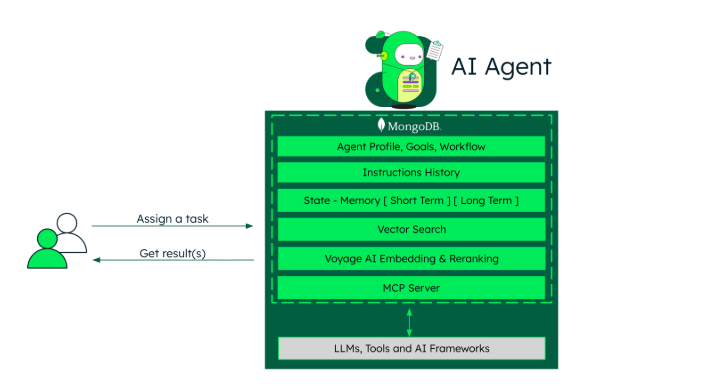
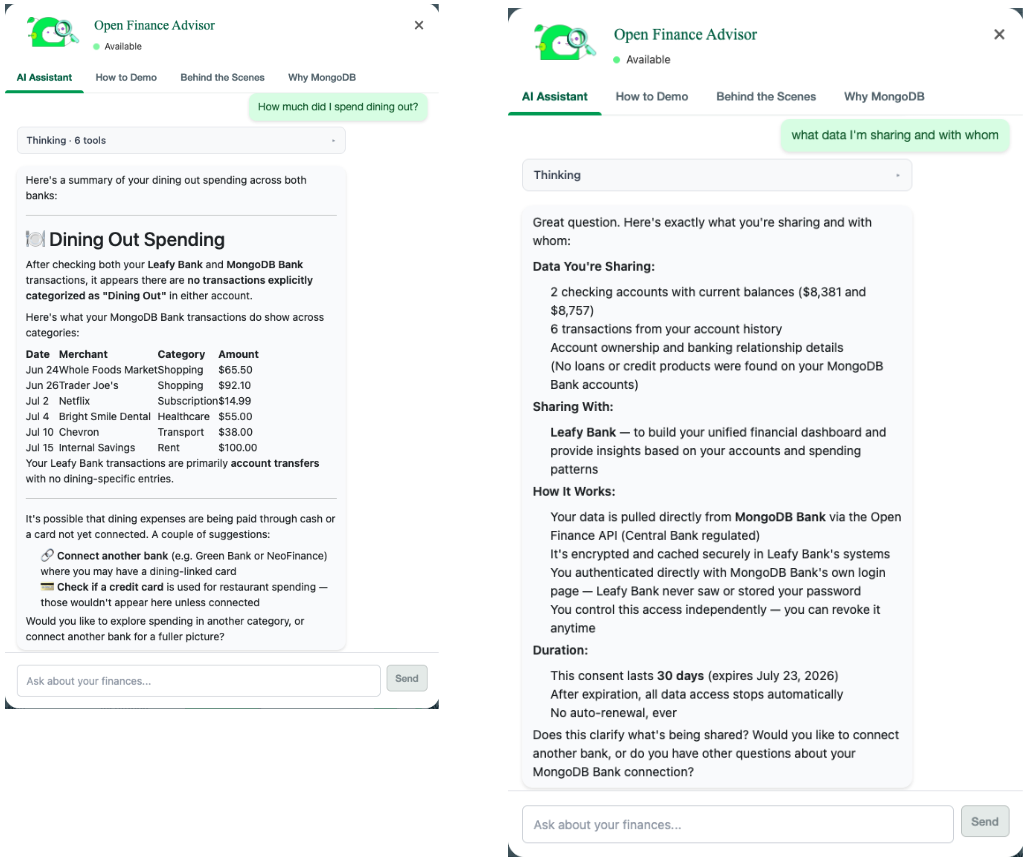
Figure 6. An open architecture approach allows the agentic chatbot to answer ad hoc questions about granted data access, customer accounts, transactions, and products by querying MongoDB directly through the MCP Server. This flexible design empowers financial institutions to integrate their enterprise Large Language or Short Language models and AI frameworks of choice.
Takeaways
By combining agentic AI with MongoDB, financial institutions can turn consent from a compliance bottleneck into a competitive advantage, improving customer satisfaction, lowering operational costs, and strengthening auditability across their Open Finance ecosystems.
- Higher Customer Satisfaction & NPS: Builds trust through plain-language transparency, frictionless onboarding, and reduced user churn.
- Lower Operational Costs: Automates complex T&C explanations and guidance, significantly reducing call center and human support overhead.
- Traceability and Auditability: Provides complete, verifiable audit logs for every consent grant, modification, and data-sharing event.
With MongoDB underpinning the memory, state, and vector capabilities of these AI agents, financial institutions have the unified developer platform required to deliver secure, scalable, and sophisticated OB&OF experiences without architectural complexity.
Next Steps
Discover how to unlock the monetization potential of open finance with MongoDB as the operational data layer: Next Generation Open Finance with MongoDB and Agentic AI.
Explore how six Latin American countries are shaping open finance and how MongoDB's modern data platform helps institutions turn regulation into opportunity. How Latin American Countries are Shaping the Open Finance Revolution.