You can engineer the fastest, most advanced vehicle in the world, but without a paved road, it is not going anywhere. In many ways, this reflects the current state of the automotive industry. Sophisticated, software-driven vehicles generate vast amounts of data. Yet the digital “roads” needed to move, structure, and use that data remain fragmented and, well, unpaved. Each automaker exposes vehicle signals differently. This makes it difficult to build services that scale across brands, platforms, and ecosystems.
Today, many organizations continue to build their own paths, but few connect with each other without friction. This is where COVESA, the Connected Vehicle Systems Alliance, plays a key role. By bringing together automakers, suppliers, and technology companies, COVESA helps the industry move toward shared approaches. Its mission is to unlock the full potential of connected vehicles through open collaboration and common standards. These shared foundations reduce fragmentation and make it easier to build connected services across the ecosystem.
One key initiative in this space is the Vehicle Information Service Specification (VISS) and its reference implementation, VISSR. To better understand how VISS-based architectures can extend to scalable cloud environments, this article takes a closer look at the initiative and the collaborative efforts behind it.
At the same time, cloud infrastructure has become essential. Connected vehicle services depend on the ability to collect, process, and scale data across entire fleets. This introduces new challenges around data structure, scalability, and long-term management. As part of this effort, MongoDB collaborates with COVESA to explore how modern data platforms can support these evolving needs.
The Vehicle Information Service Specification
In development for nearly a decade, which started at the World Wide Web Consortium (W3C), VISS, now hosted by COVESA, is nearing its fourth launch. VISS enables clients to read and write vehicle signals that are defined by the Vehicle Signal Specification (VSS), with message payloads being sent over any of the supported transport protocols.
Further, VISS specifies an access control model with role-based clients that can be used to restrict signal access according to client credentials. VISS also contains features that allow it to be an integrated part of a consent framework. With the new features in the coming version 3.1, VISS will be ready to enable an interoperable connected services solution for all kinds of vehicles, such as passenger cars, trucks, trailers, and vans.
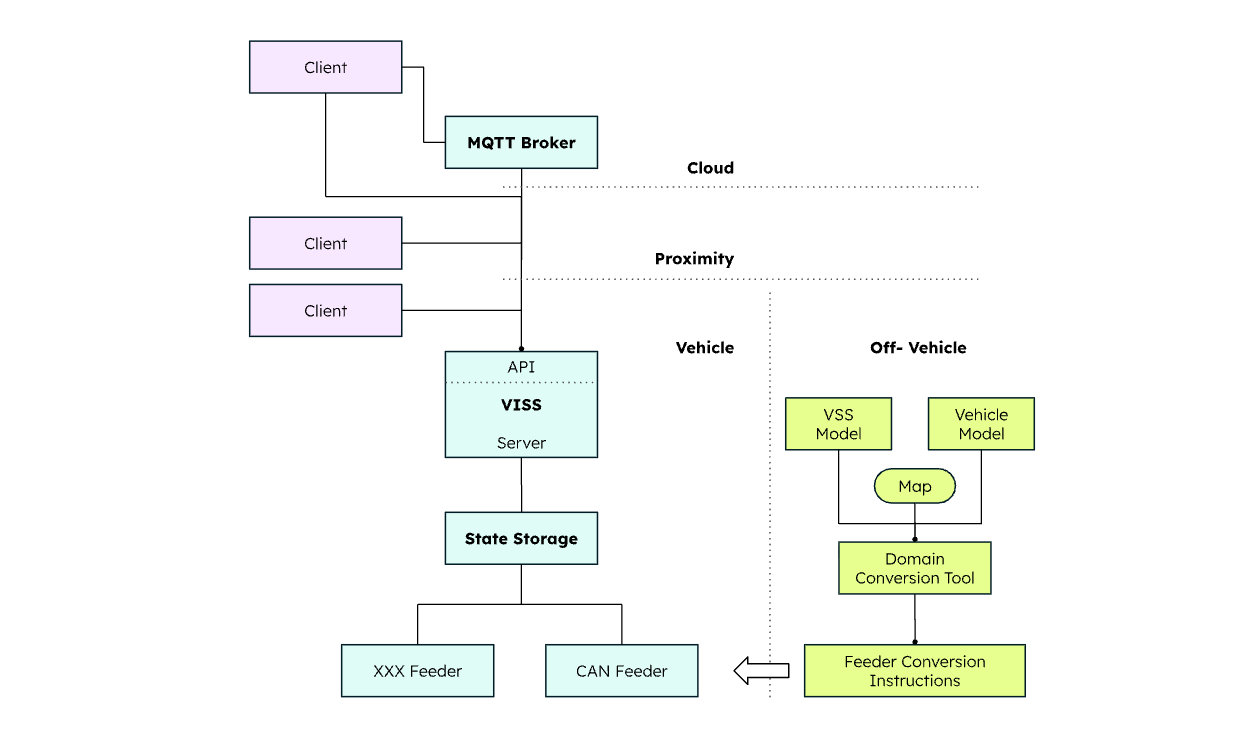
The VISS specification project is complemented by the VISS reference implementation project (VISSR). This project provides not only a server exposing the VISS interface to clients, but also other software components needed to integrate the server with the underlying vehicle system. This technology stack makes it possible to quickly test VISS with running code, both with simulated data and live data in a vehicle deployment.
The figure below shows the VISSR tech stack. For more information on the different software components, see the documentation.
Figure 1. VISSR technology stack.
Scaling vehicle data innovation to the cloud
As vehicle data moves beyond individual vehicles into fleet-scale operations, the challenges shift. Use cases such as managing a fleet of trucks, monitoring tire pressure, temperature, and performance require data to flow continuously from thousands of vehicles into centralized systems. Cloud data architectures become a central piece in enabling this. They provide the foundation to ingest, store, and process large volumes of vehicle data while supporting real-time operations and analysis.
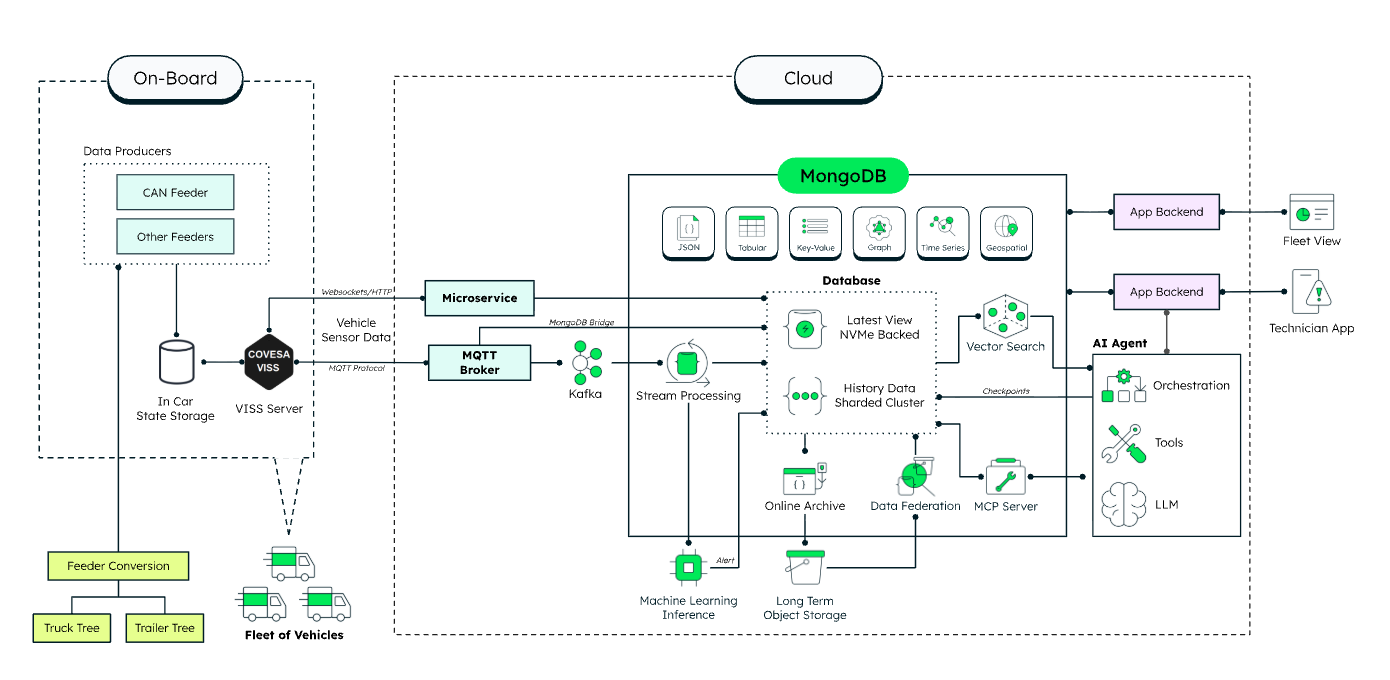
Within the COVESA community, we explore how vehicle signal data can be modeled and stored efficiently in the cloud. This work builds on earlier efforts to understand data storage patterns for VSS-based data and extends them into more complete architectures. Recent experimentation focuses on integrating VISSR with cloud backends, using messaging protocols such as MQTT to simulate real-world data flows, and evaluating how data from multiple vehicles can be synchronized and queried at scale. Rather than defining a fixed solution, these efforts help shape practical approaches that organizations can adapt to their own environments.
As these architectures evolve, the choice of data platform becomes increasingly important. Vehicle data is complex, time-based, and diverse in nature. It requires systems that can adapt, scale seamlessly, and support varied workloads, while maintaining high availability and strong security standards. In this context, MongoDB provides a flexible document model that aligns naturally with the structure of vehicle signals, a distributed architecture for scale and resilience, and capabilities to support real-time analytical processing. These capabilities help organizations manage vehicle data efficiently as it grows in volume and complexity.
Figure 2. VISSR cloud synchronization architecture with MongoDB.
Looking ahead, the demands on these architectures will continue to grow. Connected vehicle platforms must support not only human-driven applications, but also increasingly intelligent systems that rely on real-time data access and unified data access patterns. This drives the need for flexible, future-ready data foundations. This is why leading automotive organizations such as Volvo, Toyota, and Bosch trust MongoDB for mission-critical workloads as they continue to build the next generation of connected vehicle services.
The road ahead
The path forward is becoming clearer. Vehicles will continue to evolve, generating more data and supporting more advanced services. But their impact will depend on how well that data can move beyond the vehicle and into systems that can scale with it.
Efforts within COVESA show that progress does not come from isolated approaches. It comes from building shared foundations that connect vehicles, platforms, and partners more seamlessly. Work around VISS and cloud architectures is a step in that direction, helping bridge what happens inside the vehicle with what is needed across fleets and services.
If the industry wants to unlock the full value of connected vehicles, it must invest not only in the vehicles themselves, but also in the digital roads that connect them—data infrastructure, models, and platforms that allow information to move, scale, and create value. The better we build those roads, the further we can go.
Next Steps
Explore the reference implementation behind this work in the GitHub repository and discover more connected vehicle solutions in the MongoDB Solutions Library.