Digital-first commerce has fundamentally re-engineered the global money movement. While plastic cards remain the primary consumer gateway in many markets, the democratization of real-time transactions across high-growth ecosystems (such as APAC and LATAM) has occurred at the point of sale via QR Payment Codes (QRPC). As a low-cost, zero-hardware interface, QR Payment Codes let merchants accept digital payments using nothing more than a printed placard or a basic screen.
For IT Decision Makers (ITDMs) at banks, fintechs, and payment service providers (PSPs), the strategic value of a QRPC lies in its role as a flexible, data-rich presentation layer that effectively abstracts a fragmented financial infrastructure. A single scan allows a gateway to seamlessly orchestrate and route transactions across instant account-to-account (A2A) networks, card networks, or proprietary digital wallets behind a unified user experience.
The challenge: The architectural pressure points of QR ecosystems
The simplicity at the point of interaction comes at the cost of significant complexity inside the payment stack. While underlying QR specifications are frequently anchored by international bodies like EMVCo, actual implementations vary wildly by country, region, and network participant.
To maintain strict millisecond windows for end-to-end routing, fraud evaluation, and merchant notification, modern payment architectures must solve two core challenges: QR Payment Ingestion and Rail Execution Polymorphism.
The end-to-end transaction journey follows this baseline flow:
Figure 1. Payment payload and rail polymorphism behind a Unified QR Experience.
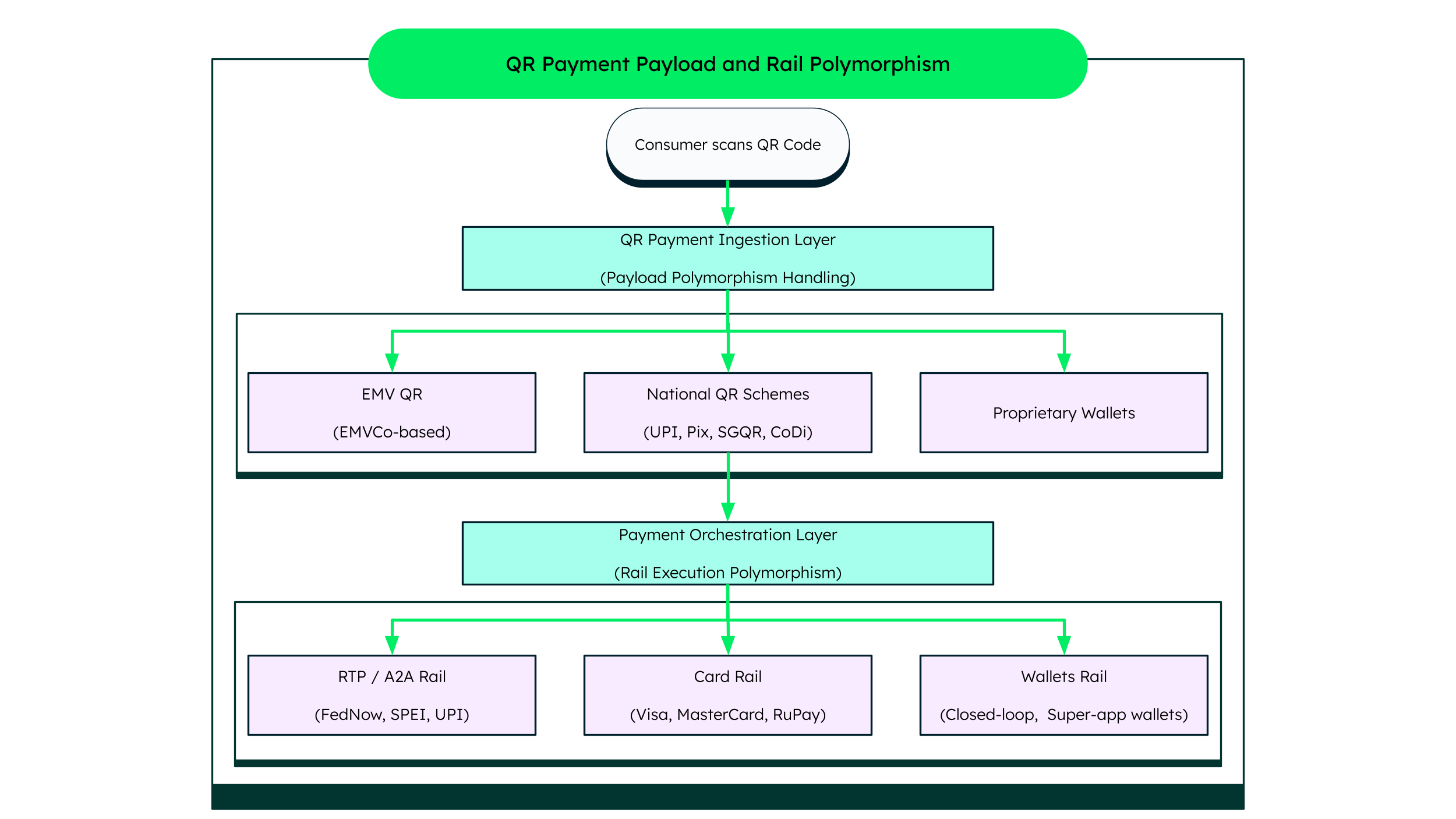
1. QR payment ingestion: The front-end presentation challenge
QR payment platforms face a fundamental ingestion problem: every payload differs. Unlike a card swipe, a QR scan arrives pre-shaped by its network, mutated by the scanning app, and defined by presentation direction. Three variables drive this complexity:
- Provider schema variance: Networks like India's UPI, Brazil's Pix, and Singapore's SGQR employ distinct field layouts, validation rules, and cryptographic envelopes. Providers further inject proprietary extensions into unallocated standard tags, and these evolve continuously. A fixed schema breaks under this; the storage layer must capture nested structures without migration overhead.
- Runtime enrichment: Every transaction participant appends its own data: payment apps add device telemetry, banks add KYC tokens, and aggregators add split-payment arrays. The data model must accommodate this natively without upfront field declarations.
- Conflicting access patterns: One ingestion pipeline must simultaneously satisfy three separate access paradigms across Merchant-Presented Mode (MPM) and Consumer-Presented Mode (CPM), placing radical demands on the database tier:
- Static MPM: A fixed printed placard that every customer scans. At peak times, large numbers of scans can converge on the same merchant context, creating a concentrated processing bottleneck that is difficult for legacy relational architectures that lack native sharding.
- Dynamic MPM: Generated fresh per transaction on a point-of-sale terminal or checkout screen. Because these QR payloads carry transient transaction information, the database must absorb large volumes of short-lived session state and support automated expiration with asynchronous background cleanup.
- Consumer-presented mode (CPM): Inverts the flow. The merchant scans a consumer-presented QR code from the customer’s device, requiring the platform to resolve the embedded payment credential or account reference with very low latency.
Addressing these challenges requires discarding the assumption that payload structure can be known in advance. The data tier must treat each incoming document as the source of truth, preserving its nested structure, absorbing new enrichment layers without schema changes, and supporting custom indexing per access pattern. Schema flexibility, native nesting, and granular index control are the architectural prerequisites for scaling QRPCs.
2. Rail execution polymorphism: The backend orchestration challenge
Multi-rail orchestration challenges every bank and paytech, but QR payments uniquely bring it to a head. Unlike card taps or bank wires that implicitly signal their delivery network, a QRPC scan is deliberately rail-agnostic.
Routing decisions fall entirely to the platform, dictated by merchant configurations, cost-optimization strategies, or regulatory requirements. A single scan can diverge into entirely different backend messaging ecosystems supporting competing data models:
- Account-to-account (A2A) real-time rails: The platform transforms the scan into complex, hierarchical ISO 20022 XML or JSON format for instant payment schemes like UPI, Pix, or SEPA Instant.
- Card network rails: If the QRPC acts as a card proxy, the payload maps into the traditional, bitmapped fields of an ISO 8583 message.
- Closed-loop digital wallets: The transaction bypasses traditional networks entirely, collapsing the data model into a streamlined, proprietary internal ledger.
Forcing these divergent data models into rigid relational tables requires expensive translation logic and extensive table joins, introducing unnecessary latency right at the checkout register.
The legacy relational constraint
In traditional relational systems, supporting new payment types often results in complex schemas, endless optional attributes, extensive table relationships, and significant application-layer transformation logic.
As payment types proliferate, schema evolution slows, and the mismatch between object models and relational structures becomes more pronounced. This object-relational mismatch increases development overhead, delays rail onboarding, and complicates orchestration across heterogeneous payment systems.
These challenges heavily impact environments requiring rapid product innovation, continuous integration of new payment rails, and near-real-time processing at scale.
Figure 2. The relational anti-pattern in dynamic QR payment processing.
.png)
Figure 2 illustrates the difficulty of handling payment polymorphism within a highly normalized relational architecture.
The proposed solution: Decoupling ingestion from execution
To achieve modern commerce agility, the recommended pattern is to completely decouple the ingestion layer from the downstream execution rails. This isolation protects the backend processing systems from volatile frontend data shapes and traffic surges.
The core mechanism enabling this is implementing a Canonical Payment Request. The ingestion layer accepts the polymorphic QRPC payload, validates it, and immediately normalizes it into a standardized internal data contract.
Figure 3. QR payment ingestion layer.
.png)
This architectural boundary isolates payment systems from continuous changes in QRPC specifications. Although incoming transactions contain varying identifiers, validation rules, and business semantics, the ingestion layer insulates downstream systems from this variability by translating each payload into a unified canonical representation using the Polymorphic Pattern.
Example: QR payload polymorphism.
.png)
Once normalized, the payload moves to the Payment Orchestration Layer, which evaluates routing logic, compliance rules, and risk profiles before transmitting the transaction to the final payment rail.
Figure 4. Payment orchestration layer.
.png)
Why MongoDB is the strategic enabler
For IT Decision Makers, choosing an underlying data tier that natively supports this decoupled architecture is critical. MongoDB serves as the ideal foundational technology for modern QR payment gateways, resolving the core operational challenges of both Ingestion and Rail Execution without requiring complex translation layers.
- Simplifying the canonical model via the document model: MongoDB’s flexible document model allows storing polymorphic incoming payloads and the resulting Canonical Payment Request side by side in a single, unified record. By natively handling hierarchical JSON, engineering teams can store complex ISO 20022 elements and ISO 8583 bitmap representations within nested sub-documents, eliminating expensive data-flattening code or multi-table relational joins, accelerating time-to-market.
- Sustaining scale-out performance via sharding: To resolve the "Static" MPM access challenges, where a printed QR placard experiences intense concurrent write pressure, MongoDB provides native Sharding. Using a Compound Shard Key (pairing the merchant ID with a high-cardinality unique transaction token) distributes parallel write workloads evenly across multiple database servers, ensuring consistent throughput and predictable scale-out during massive traffic spikes.
- Preventing performance degradation via memory-first processing: To manage the high-velocity lifecycle of the Dynamic MPM QRPC, MongoDB leverages its WiredTiger storage engine to process transient checkout sessions in memory. Instead of creating direct inline disk fragmentation, modifications are managed efficiently in memory before being flushed cleanly to disk during checkpoints. When combined with native TTL (Time-To-Live) Indexes that act as automated, asynchronous background timers, expired session data is automatically swept away without introducing the performance-degrading database bloat common in legacy systems.
- Accelerating ingress routing with deeply nested indexes: When decoding ephemeral consumer-presented tokens, time is of the essence. MongoDB’s optimized Secondary Indexes target deeply nested fields and array elements directly. This allows the payment gateway to query tokens hidden inside mutated payloads, executing reverse-routing account lookups in single-digit milliseconds right at the register.
The business value: Building for continuous change
The ultimate metric of success for a modern payment platform isn't just its support of a specific payment rail or QRPC format today; it is the readiness to absorb continuous change tomorrow. New payment networks, evolving QRPC specifications, shifting mandates, and fraud patterns will constantly emerge. Market leaders will be those that establish clean architectural boundaries that handle this variability without requiring ongoing, expensive core redesigns.
Decoupling the architecture, combining a QRPC Ingestion Layer, Canonical Payment Model, and Multi-Rail Orchestration on top of MongoDB's data platform, secures an adaptive operational foundation driving distinct architectural and business advantages:
Accelerated time-to-market: MongoDB’s document-native design allows teams to map new regional QR specifications and payload mutations directly into the system as they arrive. This simplifies the data-handling pipeline, launching in days rather than months.
Architectural resilience: MongoDB allows isolating the frontend ingestion from downstream execution rails. Volatile data shapes or traffic spikes at the checkout are absorbed smoothly, completely insulating backend settlement systems from operational strain.
Friction-free customer experience: Native sharding and memory-first data handling ensure the platform scales out automatically. Gateways maintain predictable, low-latency execution and high-concurrency, ensuring seamless checkouts at the register during major shopping events.
Ultimately, leveraging MongoDB at the core of a decoupled transaction strategy transforms the data layer from a maintenance burden into a strategic accelerator, empowering financial institutions to build resilient payment architectures that evolve as quickly as the global payment ecosystem.
Next Steps
See how MongoDB supports payments orchestration with canonical model Agentic AI-Powered Payments Orchestration.
Explore how MongoDB helps modernize payment systems at a global scale.
Ready to start building? Register for a free Atlas account today.