Who says that winter is when things slow down? MongoDB has had a busy start to the year, with a steady stream of announcements and product features—all against the backdrop of an industry moving at warp speed. It's been a lot, and it's been a blast!
For example, the energy at January’s MongoDB.local San Francisco—where we announced capabilities to help teams ship production AI faster—was infectious. MongoDB isn’t just starting a new chapter in AI; we’re rewriting the book in real time.
The next generation of AI companies isn't just looking for a temporary place to store data; they’re looking to build on a generational modern data platform. Indeed, the most innovative founders are moving away from rigid, legacy systems and embracing a single, fluid foundation that can grow with them.
At MongoDB.local SF, our message was clear: Choose your data platform strategically in order to ship faster. From our new Voyage 4 models to the general availability of our Intelligent Assistant, we are obsessed with anticipating what developers need next. This assistant is particularly impactful because it embeds MongoDB-specific expertise directly into Compass and MongoDB Atlas, allowing developers to troubleshoot performance without the "context-switching" that traditionally slows them down.
In this issue, I’m thrilled to spotlight four startups who are building the future on the right foundation. You’ll see how Modelence and Thesys are using our flexible document model to eliminate 'operational drag,' allowing them to iterate on AI-native workflows in real time. And then there’s Heidi and Emergent Labs, who both are proving that when you simplify your codebase with a unified platform, you can turn a plan into shipped code at record speeds.
I’ve highlighted their journeys below so you can see exactly how these leaders are setting a new pace and changing their trajectory with MongoDB.
Modelence
Modelence aims to modernize backend infrastructure for the era of AI-assisted development. Traditional relational databases and manual systems create significant operational drag, as their rigid schemas and heavy migrations cannot keep pace with agent-native workflows. These legacy systems struggle with the high-velocity requirements of intelligent coding agents, which must iterate on data structures in real time without causing system downtime.
To build a stable foundation for automation, Modelence integrated MongoDB Atlas as its core data layer. The platform utilizes the flexible document model to align with how intelligent systems think, allowing specifications and runtime events to coexist. This "fit" enables per-tenant isolation and managed credentials, ensuring automated changes remain safe and traceable without the tangle of relational joins.
Standardizing on MongoDB Atlas helped Modelence raise $3 million dollars in its Seed round. The company now moves from planning to running features in minutes, achieving faster iteration loops and fewer regressions.
Thesys
Thesys aims to empower developers by making generative user interfaces—adaptive, real-time components—accessible to everyone. Previously, developers faced the friction of static chat bubbles and hardcoded dashboards that failed to visually represent complex AI outputs. These traditional interfaces forced teams to rebuild UI layers for every use case, which kills user engagement.
To solve these orchestration challenges, Thesys integrated MongoDB Atlas as the operational backbone for its C1 API middleware. The platform utilizes the document model to manage complex entities within a single, high-performance data layer. By removing the friction of mapping unstructured LLM outputs to rigid schemas, engineering teams can now ship updates weekly.
Through the MongoDB for Startups program, Thesys successfully accelerated its go-to-market timeline. By offloading operational management to MongoDB Atlas, Thesys now maintains the agility to evolve its data layer alongside emerging AI trends, ensuring its intelligent interfaces remain high-performing as they scale globally.
Emergent Labs
Emergent Labs sought to democratize software development through “vibe coding,” a platform where AI agents build applications from natural language prompts. The company’s initial use of PostgreSQL caused significant friction, as AI agents frequently failed during schema migrations when non-technical users iteratively changed their application requirements.
By switching to MongoDB Atlas, Emergent Labs provided its agents with a flexible, document-based architecture that matches the JSON data they naturally produce. This eliminated the PostgreSQL migration loops, allowing agents to modify data structures on the fly and deploy isolated, production-ready databases in minutes.
The transition has powered the creation of nearly 2 million applications across 180 countries in just four months. With MongoDB Atlas, the platform now supports complex builds of up to 300,000 lines of code, doubling deployment rates and allowing non-technical entrepreneurs to launch sophisticated tools without traditional engineering resources.
Heidi
Heidi aims to reclaim clinician time by automating administrative tasks. Previously, clinicians spent 40% of their shifts on paperwork, reducing time for patient care. To manage this at scale, Heidi initially used Amazon DocumentDB, but faced critical limitations including mandatory downtime for scaling, high latency, and a lack of native search functionalities essential for complex AI workloads.
To eliminate these bottlenecks, Heidi migrated to MongoDB Atlas for its flexible schema and built-in AI capabilities. Integrating MongoDB Vector Search enables Heidi to perform RAG without "bolt-on" databases, streamlining vector and semantic search under a single API. This technical fit enables developers to unify diverse medical data while meeting stringent healthcare security and regulatory requirements.
Since migrating, Heidi has supported 81 million consultations, returning 18 million hours to the frontline. By offloading management to MongoDB Atlas, Heidi ensures its platform remains high-performing while empowering practitioners to focus on their primary mission: providing compassionate patient care.
Video Spotlight
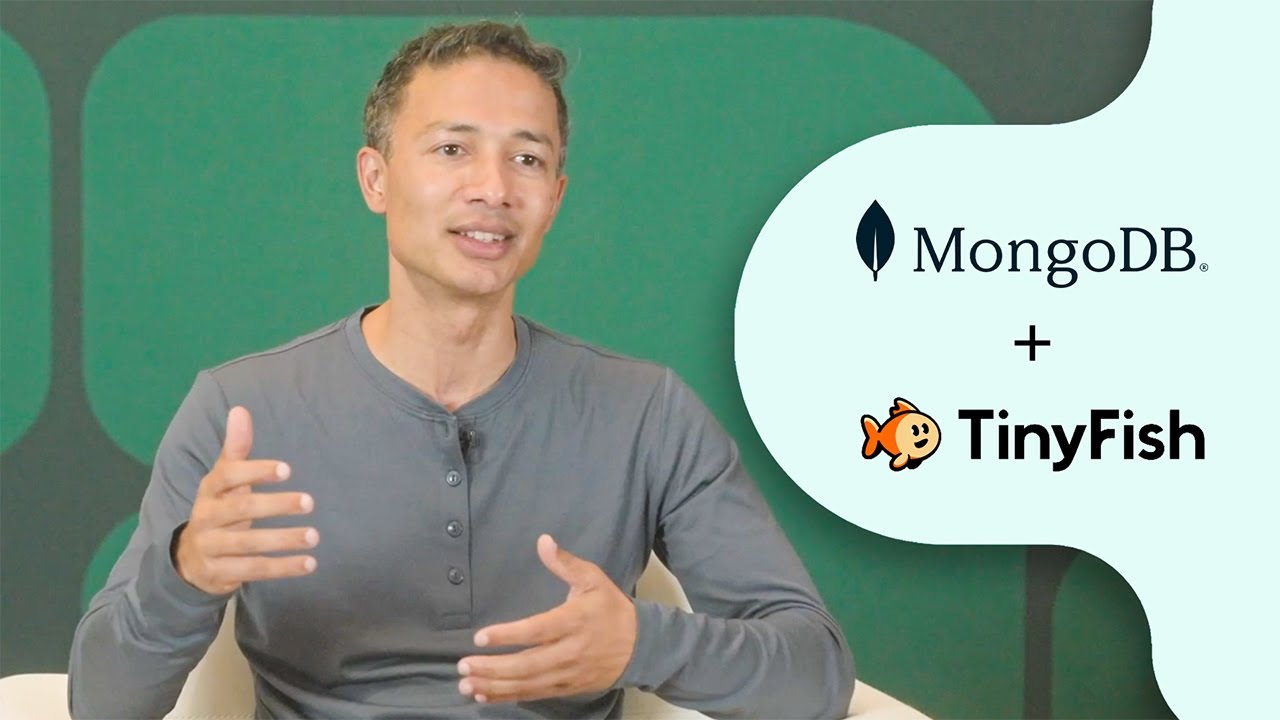
Before you go, watch TinyFish Co-founder and CEO, Sudheesh Nair, explain how “nano agents” are transforming web-based research.
Next Steps
Want to get inspired by your peers and discover all the ways we empower businesses to innovate for the future? Visit MongoDB’s Customer Success Stories hub to see why these customers, and so many more, build modern applications with MongoDB.