Retail is entering a new phase where products are no longer sold once and forgotten. Instead, retailers are increasingly seeking to participate in the second, or even third, transaction of a product's lifecycle through trade-in, refurbishment, resale, or recycling. This shift is being driven by the rapid growth of recommerce platforms that are capturing significant portions of the secondary market. To remain competitive, retailers are increasingly investing in their own circular commerce capabilities, extending customer relationships far beyond the initial sale.
Consumers are moving with this shift. Shoppers are increasingly comfortable purchasing certified refurbished goods, participating in trade-in programs, and purchasing second-life products through dedicated recommerce platforms. A record 58% of U.S. consumers shopped secondhand apparel in 2024, up 6 percentage points from 2023, while 94% of U.S. retail executives confirmed their customers are already participating in resale(1). Among younger consumers, 46% say that if they can find an item secondhand, they won't buy it new(2). For many retailers, this trend presents both an opportunity and a threat. Circular commerce is becoming a strategic growth opportunity that enables retailers to recover value from returned inventory, create new revenue streams, and compete more effectively in a rapidly expanding recommerce market. In fact, 75% of U.S. resale activity today happens outside of apparel, spanning electronics, furniture, home goods, sports gear, and more, helping fuel a market on track to reach $306.5 billion by 2030 and nearly 8% of total retail spending(3).
But circular commerce introduces a new class of operational complexity. Products no longer have a single lifecycle or a single identity. A single item may be sold, returned, inspected, refurbished, relisted under a new SKU, sold again, and eventually recycled. Supporting these processes requires retailers to manage rapidly evolving product data, synchronize information across multiple systems, power AI-driven decision making, and make inventory decisions in real time. Most legacy retail architectures were built for linear commerce, making circular commerce as much a technology transformation challenge as a business opportunity. MongoDB’s flexible document model and real-time data platform give retailers the operational foundation to meet that challenge, from reverse logistics and dynamic pricing to AI-driven lifecycle decisions and sustainability reporting.
The technology challenge behind circular commerce
Most retail systems were designed for a world that no longer exists. Traditional ERP, POS, OMS, and inventory platforms were built around static product catalogs and forward-moving supply chains. Once a product was sold, its operational journey was over.
Circular commerce breaks that assumption entirely.
Returned products must be inspected, graded, repriced, and relisted across channels, but circular commerce breaks traditional retail assumptions where products are identical at the SKU level. Instead, each returned unit becomes an item-level entity with its own condition, history, and lifecycle attributes that must remain flexible as it evolves. This shifts pricing from static product rules to dynamic, item-specific valuation, since identical products may have different commercial value depending on condition, refurbishment status, or resale channel.
For retailers still running on legacy architectures, this creates compounding problems. Product data fragments across systems, SKU definitions become inconsistent, Reverse logistics workflows become difficult to orchestrate, and when retailers attempt to introduce AI into circular commerce operations, they quickly discover that AI needs to make real-time decisions such as determining whether a returned product should be refurbished, resold, discounted, or recycled, predicting resale demand, and dynamically pricing second-life inventory. These use cases require immediate access to unified, operationally current data, something that batch-driven ETL pipelines and disconnected databases simply cannot provide.
A data foundation built for evolving product identities
Circular commerce requires an operational data model flexible enough to manage products that continuously change their identity throughout their lifecycle. MongoDB's document model aligns naturally with this requirement.
Figure 1. Lifecycle inputs flow into and out of a single, unified MongoDB document.
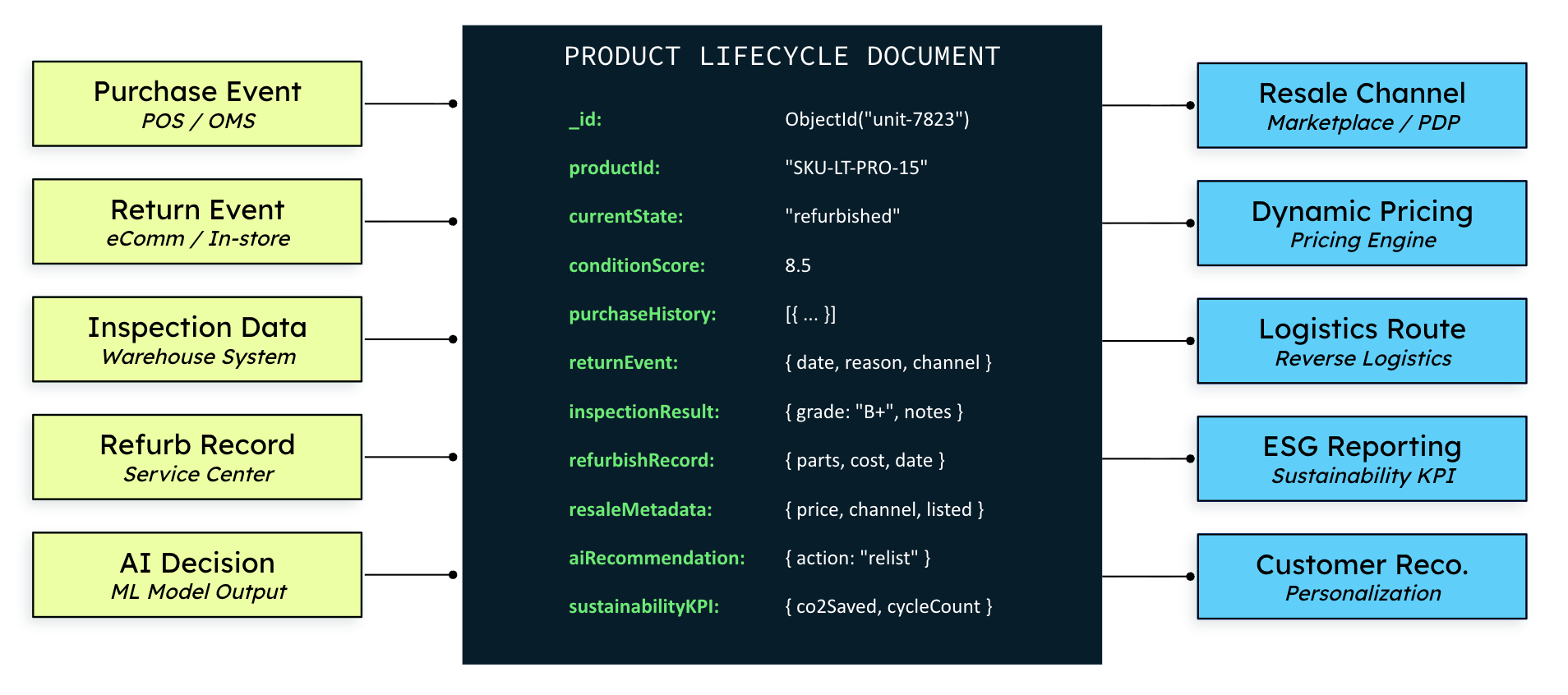
Rather than distributing lifecycle data across rigid relational schemas, MongoDB allows retailers to store purchase history, return events, inspection results, refurbishment records, condition scores, resale metadata, AI-generated recommendations, and sustainability metrics together within a single, unified structure that evolves in real time. As new lifecycle states emerge, retailers can extend the data model dynamically without costly schema migrations or large-scale system redesigns.
This flexibility is critical because, in circular commerce, a product's meaning changes continuously. A returned laptop begins as new inventory, transitions to a certified refurbished device, moves into outlet stock, and eventually becomes a recycled component. Each stage requires different metadata, pricing logic, customer-facing descriptions, and operational workflows. MongoDB enables retailers to manage all of these evolving identities within a single living document, avoiding the data fragmentation that cripples legacy systems at scale.
Real-time event processing for reverse logistics
Circular commerce extends traditional reverse logistics by introducing continuous product transformation rather than a single return event. While retailers already process returns today, those workflows are typically fragmented across multiple systems that treat each step, return, inspection, refurbishment, and resale as isolated processes.
The key shift in circular commerce is the introduction of a unified product lifecycle view, where every physical unit is represented as a continuously evolving product document. This lifecycle document is updated in real time as the product moves through return, inspection, grading, refurbishment, repricing, and resale stages.
When a customer initiates a return, the event is captured and immediately appended to the product’s lifecycle record. When a warehouse completes an inspection, condition attributes are written directly into the same document. When AI systems evaluate refurbishment viability or determine resale potential, their outputs are stored as part of the same evolving lifecycle context.
Figure 2. Return events from every channel are ingested in real time into a single product lifecycle document, enabling AI models to determine the optimal next action.
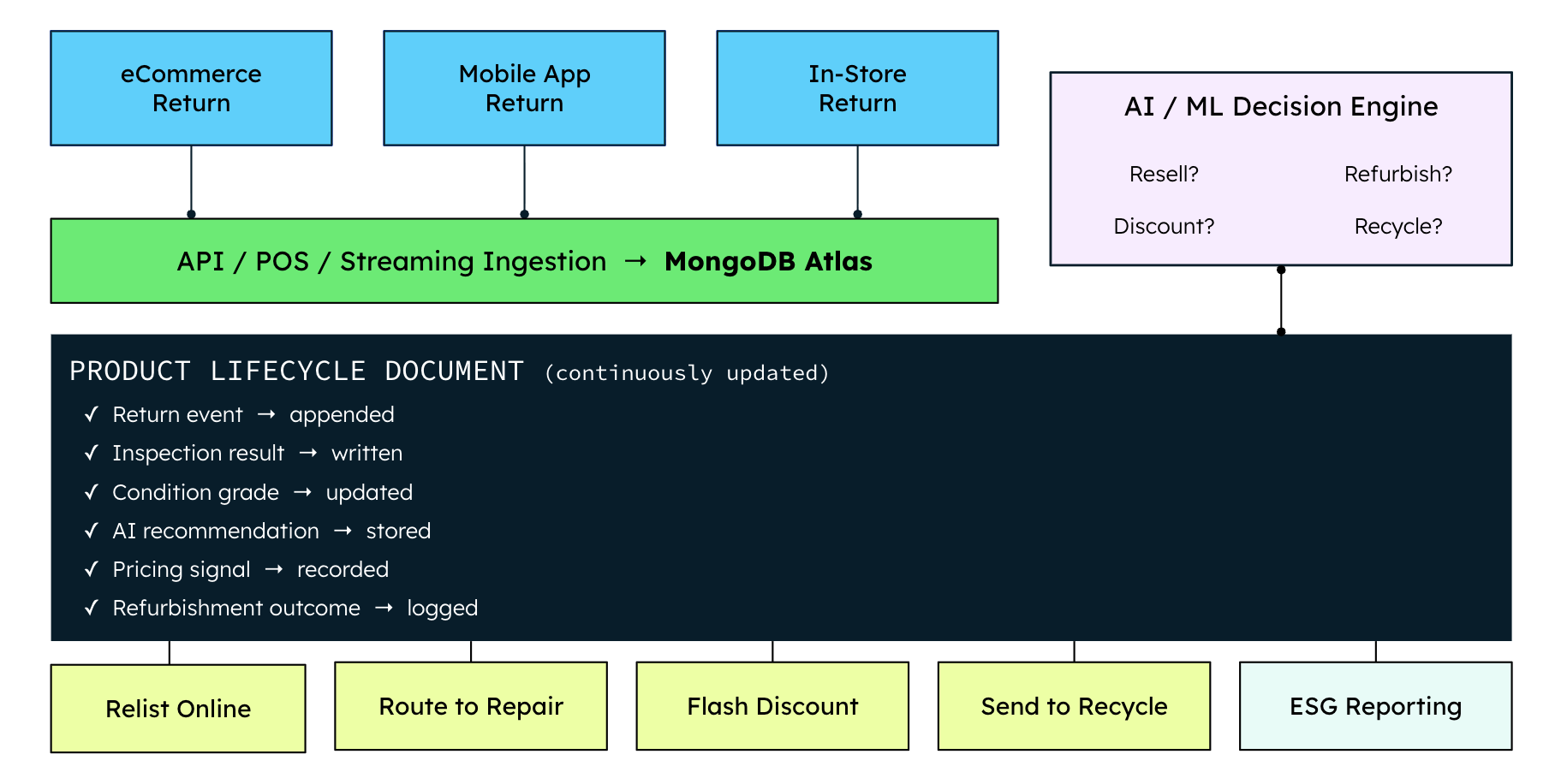
As shown in Figure 2, a product transitions from purchase to return, where events are ingested into MongoDB through APIs, POS systems, or streaming integrations. Instead of triggering isolated workflows across disconnected systems, each event continuously enriches a single product lifecycle document with inspection results, condition grading, pricing signals, and refurbishment outcomes. AI models then operate directly on this unified lifecycle context to determine the next-best action, resale, repair, restocking, or recycling, and update downstream commerce systems in real time.
AI as the orchestration layer for circular commerce
AI is becoming the operational brain of circular retail. Retailers are using AI to optimize reverse logistics, predict return likelihood, personalize resale offers, identify profitable refurbishment opportunities, and dynamically price second-life inventory. But every one of these use cases depends entirely on having immediate access to unified, operationally current data.
MongoDB provides the operational data layer that makes this possible. By unifying transactional, behavioral, inventory, and lifecycle data within a single platform, retailers can create continuously updated AI feedback loops that improve decision-making across the entire circular commerce ecosystem.
MongoDB's Atlas Vector Search capabilities further strengthen these workflows by enabling semantic matching between related products, resale listings, and customer preferences. Retailers can use AI models to identify similar items across fragmented SKU structures, improve discovery for refurbished inventory, and generate more accurate recommendations for second-life goods. For retailers adopting generative AI, MongoDB also enables retrieval-augmented generation (RAG) architectures that ground large language models with real operational lifecycle data, supporting accurate resale descriptions, refurbishment summaries, and sustainability reporting narratives.
Operational and analytical convergence at scale
One of the biggest architectural challenges in circular commerce is balancing live operational workloads with analytics and AI-driven decision-making. Retailers must simultaneously support customer-facing applications, reverse logistics systems, resale marketplaces, sustainability reporting, and AI workloads such as dynamic pricing, demand forecasting, and refurbishment decisioning, all without introducing latency or bottlenecks.
MongoDB addresses this through workload isolation, distributed architecture, analytical nodes, and aggregation pipelines that allow retailers to process operational transactions and AI-driven analytics simultaneously without relying on complex ETL pipelines or fragmented infrastructure.
Figure 3. Operational systems continuously stream data into MongoDB Atlas, while AI services, analytics tools, and customer applications consume and enrich that data simultaneously.
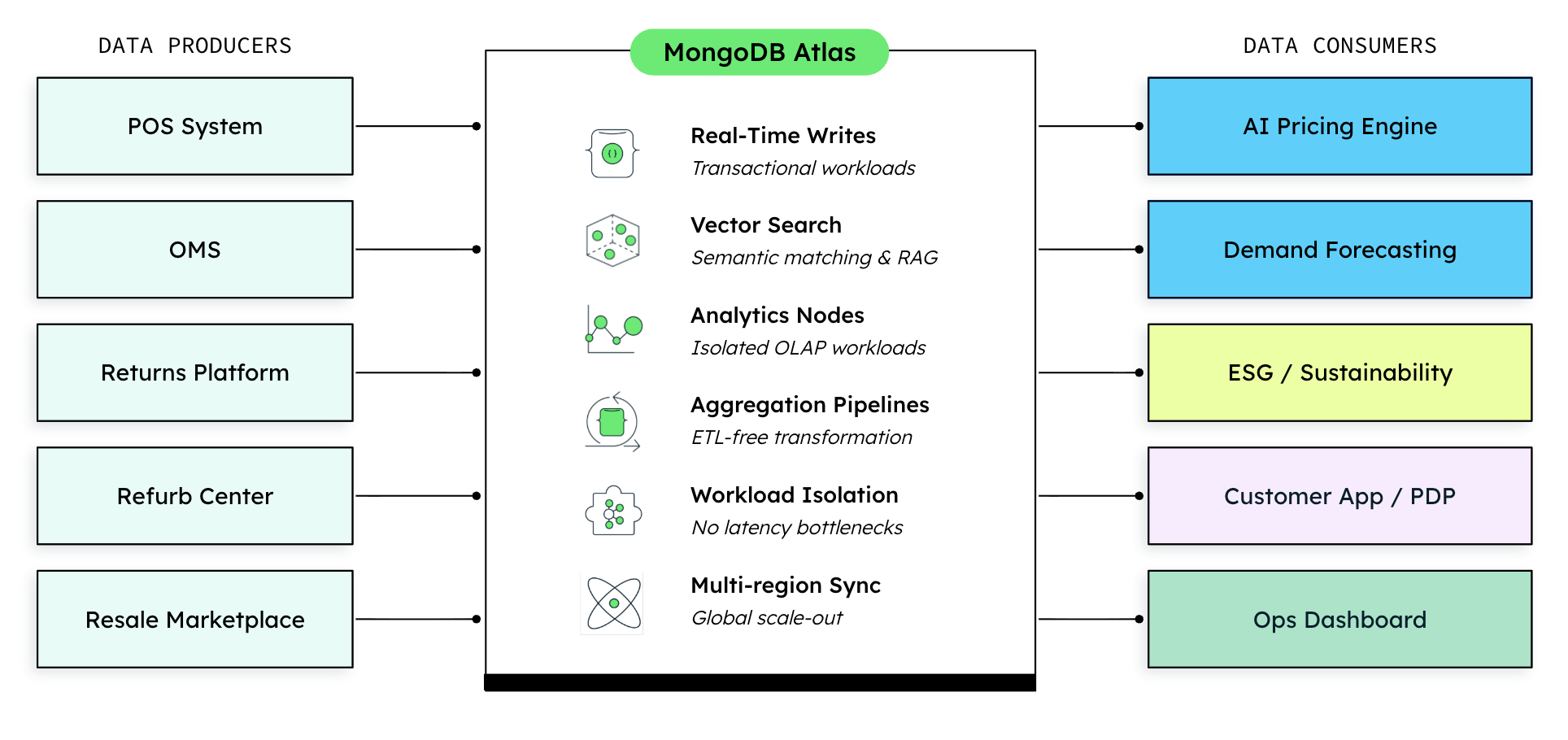
As shown in Figure 3, operational systems continuously stream data into MongoDB, while AI pricing engines, analytics systems, ESG reporting tools, and customer applications consume and enrich that data in real time. Operational teams gain live visibility into reverse supply chains, AI models continuously optimize pricing and lifecycle decisions based on fresh data, sustainability teams gain accurate reporting, and customers receive faster, more personalized resale and trade-in experiences.
Building the future of circular retail
The benefits of circular commerce extend well beyond sustainability metrics. Retailers that operationalize circular ecosystems effectively can recover significant product value, reduce waste, strengthen customer loyalty, and unlock entirely new revenue streams from second-life inventory. Customers benefit equally, through faster resale cycles, better trade-in experiences, more accurate refurbished product recommendations, and greater transparency into product history.
But capturing these benefits demands more than ambition. It requires an operational data foundation capable of managing products that continuously change identity, processing lifecycle events in real time, and giving AI models the unified, current data they need to make intelligent decisions at speed.
Next Steps
Discover how MongoDB can help you deliver seamless customer experiences across all channels through our solutions page.
As recommerce evolves into a core retail operating model, the retailers who move first to modernize their data architecture will hold a decisive advantage. MongoDB gives IT leaders the platform to make that move today, scaling with them as circular commerce becomes the new standard.
References
ThredUp 2025 Resale Report (via Retail Dive) URL: https://www.retaildive.com/news/thredup-2025-resale-report-tariffs-fast-fashion/743095/
ThredUp 2025 Resale Report (GlobalData survey of 3,034 U.S. adults) URL: https://ir.thredup.com/news-releases/news-release-details/thredups-13th-resale-report-shows-online-resale-saw-accelerated/
OfferUp Recommerce Report 2025 URL: https://recommercereport.com/