Every customer relationship is an investment, and like any investment, its value grows over time—when relationships are properly nurtured. Industry research has shown that retaining existing customers is far more cost-effective than acquiring new ones. For example, a 2025 article by Startup Guru Lab states that “businesses spend 5 to 7 times more to acquire new customers compared to keeping existing ones.”
New customers require significant marketing spend, extensive onboarding efforts, and a sustained period of trust-building before they can reach the level of loyalty and profitability of an existing customer. In contrast, customers who have already purchased from a brand have overcome those initial barriers. They know the products, the service standards, and the overall brand promise. What’s more, return customers tend to purchase more frequently, spend more per transaction, and are far more likely to recommend the brand to others.
Despite this well-documented return on investment, many retailers still focus the majority of their resources on acquisition rather than retention. A 2024 report by The CMO Survey notes how marketers spend “19.6% more on acquiring customers than retaining them.” Marketing campaigns often prioritize bringing in fresh traffic over protecting the relationships that already exist. The simple truth is that preventing a customer from leaving is almost always faster, cheaper, and more impactful than replacing them. When retailers proactively address signs of dissatisfaction, they not only keep revenue in-house but often strengthen the relationship through well-timed interventions.
The challenge of retention in a hyper-competitive market
Modern shoppers have an unprecedented amount of choice at their fingertips. With a few clicks, they can move from one site to another, compare prices, or abandon a cart if the experience feels too slow, too generic, or untrustworthy. Retention is not simply about having a loyalty program or sending follow-up emails after a cart has been abandoned. Customers expect retailers to anticipate their needs in the moment—not after the fact.
This challenge is compounded by the complexity of online shopping behavior. Customers hesitate for multiple reasons: indecision between similar products, uncertainty about delivery costs, skepticism about product quality, or simple distraction. Traditional analytics, which rely on batch data processing, fail to capture the immediacy of these moments. By the time an abandoned cart email is sent, the customer has likely already purchased the same product elsewhere.
Real-time behavioral understanding is now critical, seeing that IT decision makers in retail must evaluate technologies that can ingest, process, and act on behavioral data within milliseconds. This is not a trivial requirement. It demands a platform that unifies structured customer data with unstructured behavioral signals, processes vast volumes of event streams in real time, and executes interventions directly from the data layer without additional latency.
MongoDB: A foundation for AI-powered retention
MongoDB is uniquely positioned to support next-generation customer retention strategies by serving as the operational data layer for real-time behavioral triggers. Its flexible document model, real-time event handling, and integration with AI pipelines allow retailers to detect hesitation and respond instantly, keeping customers engaged before they abandon their journey.
Imagine a shopper browsing sneakers. With MongoDB, hesitation can be detected immediately through captured session data, time on page, navigation loops, and mouse movement patterns. MongoDB Triggers and change streams monitor these signals in real time and launch targeted actions the moment thresholds are exceeded.
For example, if the system identifies indecision, it can surface a recommendation widget highlighting products similar to those previously purchased by the same customer. If exit intent is detected, a social proof message can appear, noting that “25 people bought this item today” or that “only a few items remain in stock.” If delivery costs are a barrier, an instant free shipping offer can be triggered. In every case, MongoDB ensures that interventions are executed in milliseconds, before the shopper clicks away.
Crucially, MongoDB is not only about speed—it also ensures intelligent intervention. An embedded AI pipeline enriches raw behavioral events with contextual insights, distinguishing genuine hesitation from casual browsing and preventing system abuse. For instance, as shown in Figure 1, if a customer repeatedly triggers discounts by abandoning carts, MongoDB’s memory-driven session model can detect the pattern and adjust offers accordingly, ensuring retention efforts are sustainable and not exploited.
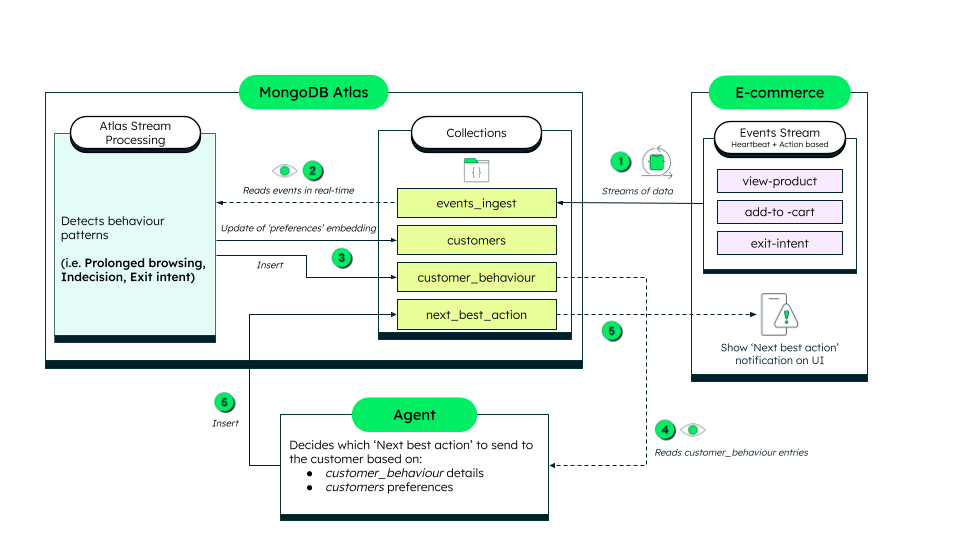
Description: A shopper browses the site, generating events captured in the events collection (1) and processed in real time by the Atlas Stream Processor (2). The system detects patterns such as prolonged browsing, indecision, or exit intent, then updates the customer's collection and logs activity in customer_behaviour (3). This enriched data is sent to the AI Agent (4), which determines the next-best action and stores it in the strategies collection for delivery to the customer via the e-commerce/app interface (5).
The technology’s ability to unify data is central to its effectiveness. MongoDB stores structured data like transactions and purchase history alongside unstructured behavioral metadata like clickstream logs, session timers, and device fingerprints. This holistic view allows interventions to be precise, contextual, and aligned with the customer’s unique behavior. Atlas Search further enhances this by enabling lightning-fast retrieval of relevant product recommendations the instant they are needed.
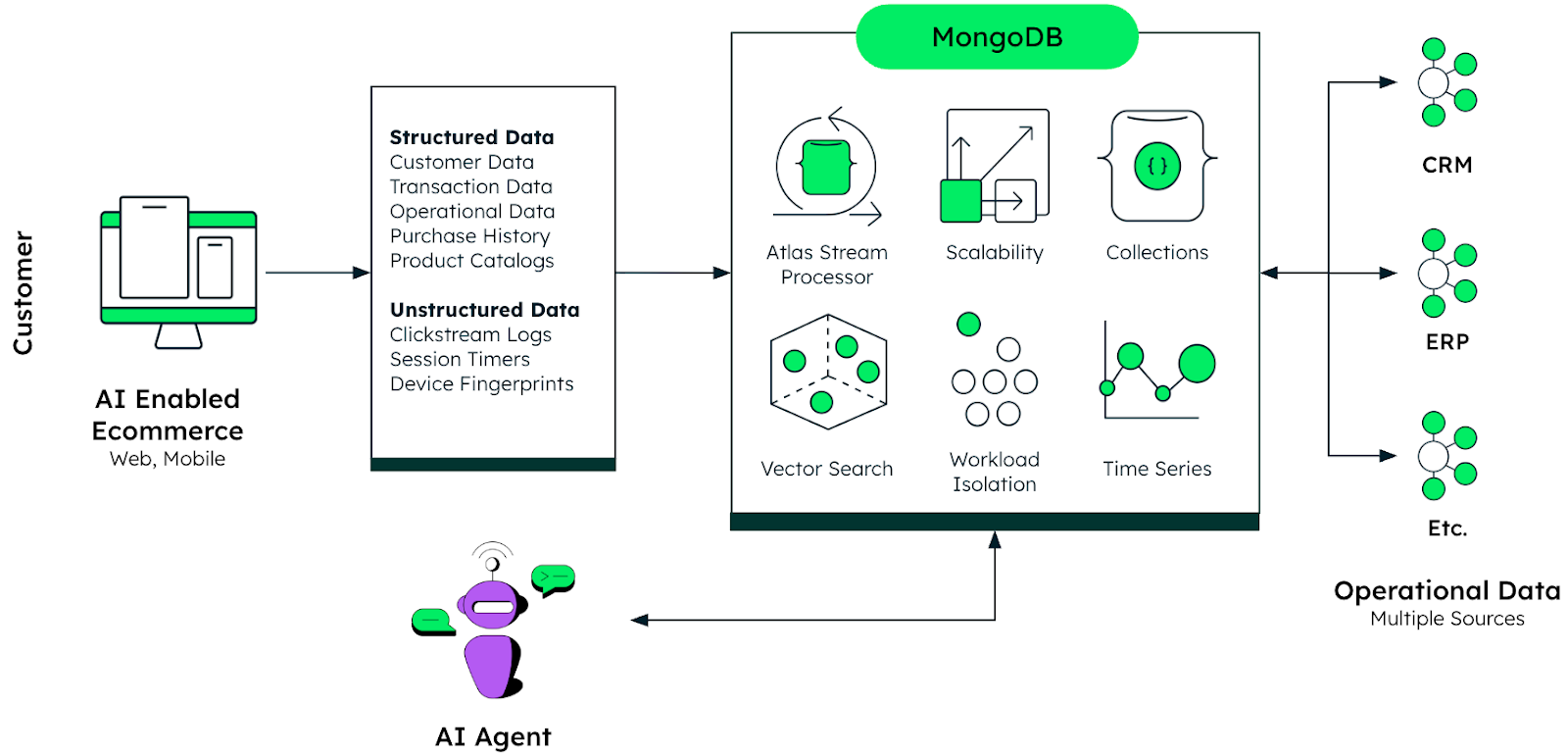
MongoDB eliminates the need for fragmented architectures that combine separate databases, ETL jobs, and analytics engines. Instead, it provides a single, scalable solution that handles behavioral event capture, enrichment, storage, and real-time query execution. Its sharding and distributed architecture ensure the platform can support millions of concurrent sessions without latency, making it suitable for large-scale global retailers.
The benefits are clear. Abandonment rates are reduced because customers are intercepted before they leave. Conversion rates increase as hesitation is turned into a decision through contextual nudges. Personalization improves because actions are tied to live behavior, not static profiles updated once a week. And all of this is made transparent to operations teams through real-time dashboards powered by MongoDB’s aggregation framework, enabling leaders to monitor, measure effectiveness, and continuously optimize.
Real-world examples show the power of timely intervention. For example, Carrefour has implemented real-time push notifications for cart abandonment that delivered a 350% uplift in conversion rates. This case underlines what is possible with proactive, behavior-based retention strategies. By leveraging MongoDB’s operational data layer, AI integration, and real-time triggers, ITDMs can implement these strategies at scale while ensuring flexibility and cost efficiency.
How MongoDB sets retail teams up for success
The promise of customer retention solutions is often balanced against technical feasibility, cost, and scalability. MongoDB addresses these concerns directly. Its document model offers flexibility to accommodate evolving data structures without requiring schema redesigns, reducing development friction and accelerating time to market. Its ability to unify operational and analytical workloads removes the overhead of complex data pipelines, lowering infrastructure costs and simplifying system maintenance.
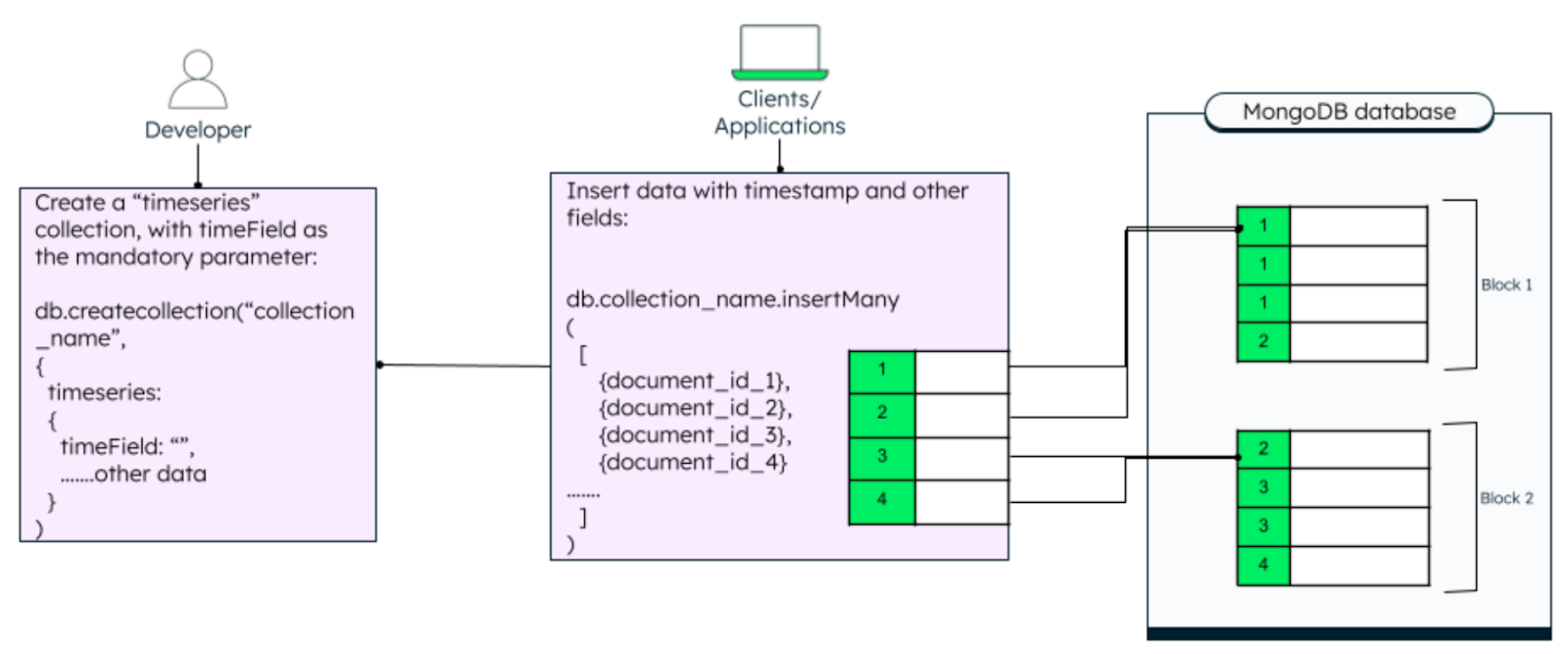
MongoDB’s built-in capabilities—such as time-series collections, TTL indexes, and change streams—allow IT teams to model and execute timer-based events directly within the database layer. This reduces reliance on external schedulers or ETL frameworks, cutting down latency and simplifying architecture. MongoDB Atlas Search provides near real-time retrieval of contextual recommendations without needing an additional search engine. These features make MongoDB a comprehensive platform for real-time engagement.
Security, governance, and scalability are equally addressed. MongoDB’s distributed architecture supports high performance at scale, ensuring consistent low-latency responses even during peak shopping seasons. Fine-grained access controls, encryption, and auditing capabilities align with enterprise security standards. And with MongoDB Atlas, IT teams benefit from a fully managed cloud platform that automates scaling, patching, and monitoring, freeing resources to focus on delivering value to the business rather than maintaining infrastructure.
From a strategic perspective, MongoDB allows stakeholders to align technical capabilities with business outcomes. Instead of reacting to churn after it happens, IT leaders can equip their organizations with proactive, AI-driven retention workflows that directly impact revenue and customer loyalty.
Winning the moments that matter
Customer retention is no longer about broad loyalty programs or after-the-fact marketing campaigns. It is about winning the critical moments of hesitation before a customer leaves. The retailers who succeed are those who can detect indecision instantly, act on it with contextual relevance, and do so at scale across millions of sessions.
MongoDB provides the operational data layer required to make this possible. Its flexible document model, real-time triggers, AI enrichment, and Atlas Search integration enable interventions that fire in milliseconds, ensuring customers receive timely nudges that transform hesitation into conversion. For IT decision-makers, MongoDB offers not only the technical foundation to deliver these capabilities but also the assurance of scalability, security, and operational simplicity at enterprise scale.
Retention is the true driver of sustainable growth. By harnessing MongoDB to power AI-driven behavioral triggers, ITDMs can ensure their organizations are not just competing for attention but winning loyalty at the exact moments that matter most.
Next Steps
Discover how MongoDB can help you deliver seamless customer experiences across all channels through our solutions page.
References
- 2025 article by Startup Guru Lab
The CMO Survey (2024 report)