Welcome back to our series on Building a Financial Crime Mitigation Platform, in which we show how MongoDB ideally supports the demands from modern digital financial operations as a unified data platform. In case you missed it, be sure to check out the series overview.
As part of onboarding new entities, financial institutions are required to run a comprehensive analysis in order to comply with KYC (Know-Your-Customer) regulations. In our previous blog post, we covered building a unified single view of the customer. The next step is to go through different checks to make sure the prospect is legally entitled to become a customer.
Complying with financial crime regulations
Whenever a financial institution is onboarding a new prospective customer, it needs to comply with the so-called FATC (Financial Action Task Force) Recommendations. Among all the guidelines, the most important ones are:
- Customer due diligence (CDD): Identifying and verifying the customer and “beneficial owners” (who really own the money).
- Sanctions screening: “Enhanced” scrutiny beyond the basic one, applicable for high-risk customers with higher exposure (e.g., offshore account holders), clients listed in OFAC (The Office of Foreign Assets Control) lists, or those considered Politically Exposed Persons (PEPs).
- Record keeping & perpetual monitoring: Maintaining transaction records for at least five years. Making sure it is constantly updated in an “event-driven” mode (updating customer information based on events).
Each country or region is responsible for implementing these recommendations in line with its local regulations. Around the world, many jurisdictions have established anti-money laundering and counter-terrorist financing (AML/CFT) frameworks aligned with international standards. These include the United States, the European Union, the United Kingdom, Singapore, Hong Kong, Japan, South Korea, and several Latin American countries.
Throughout the years, these screening and compliance checks have become a bottleneck, preventing financial institutions from providing a fast and efficient onboarding process that would improve the overall customer experience. Mainly due to its lengthy, manual checks. Furthermore, having human risk analysts not only includes the human-error factor but also limits their ability to foresee potential risk beyond the visible ones.
Agentic AI to the rescue
Here is the transformational power of AI in the financial crime mitigation space:
- Enhanced fraud detection: AI Agents can use similarity search of known patterns for minimizing false positives.
- Advanced transaction monitoring: AI models can use synthetic data for evaluating the likelihood of potential different scenarios.
- Behavioral risk scoring: Smart agents can use graph neural networks for analyzing a complex web of relations and unnoticeable events.
- Real-time responses & automation: LLM models can be used for generating due diligence case reports, serving as a copilot/assistant to human risk analysts.
MongoDB as the agentic AI enabler
For each of the described capabilities, AI Agents would require a unified, traceable single-source of truth database that can serve as the contextual data store, but also as the memory/semantic cache for executing each specific action:
Figure 1. MongoDB as an Agentic AI Enabler through an onboarding process.
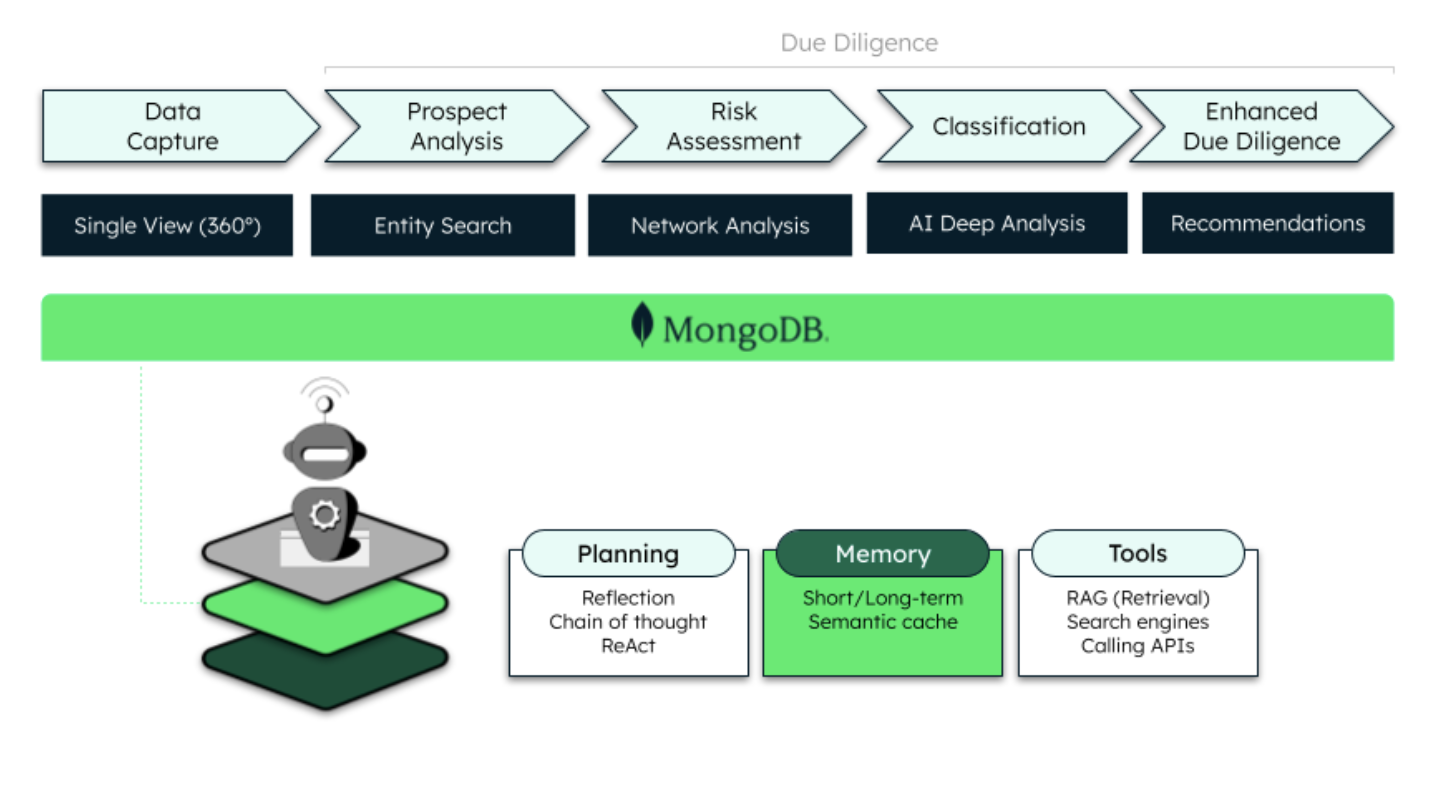
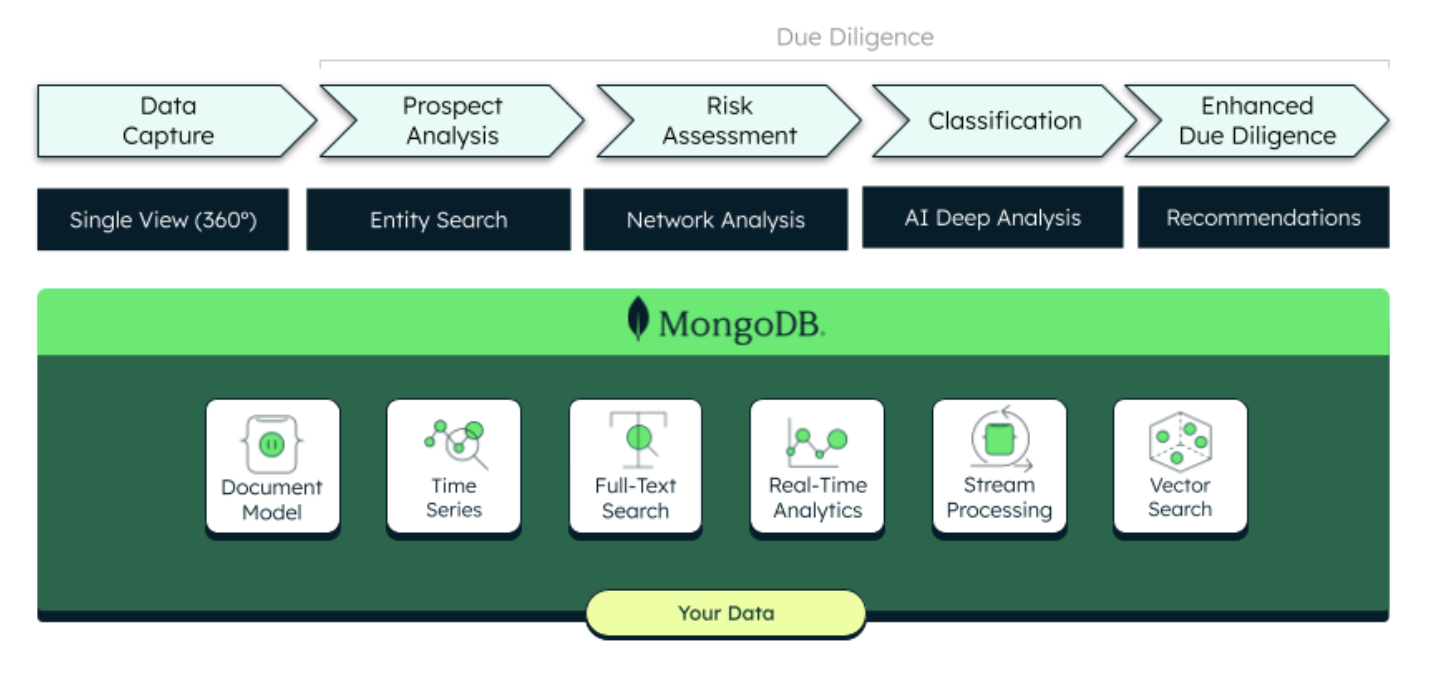
Besides providing the contextual data store and the memory semantic cache, MongoDB is an enterprise-grade data platform enabling query and search capabilities as tools to be invoked by agents to fulfill the corresponding business operations.
Figure 2. MongoDB platform services available as tools for Agentic workflows.
Use Case: Applying agentic AI powered by MongoDB for enhanced due diligence (EDD)
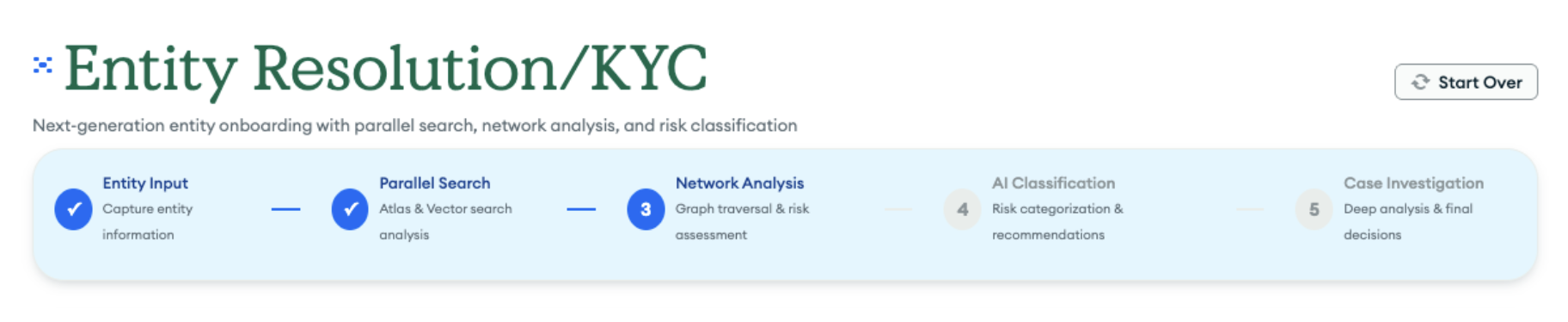
With the regulatory and architectural foundations in place, financial institutions can combine agentic AI with MongoDB to streamline enhanced due diligence (EDD) and case management. In this section, we focus on three core stages of the EDD process: network analysis, AI‑powered classification, and case investigation and reporting.
Figure 3. Demo workflow process for Entity Resolution/KYC as part of the onboarding process.
1. Network analysis
EDD starts by understanding how a prospective customer connects to existing entities and transactions. Using MongoDB Atlas Vector Search, risk teams can retrieve the most similar profiles and construct an ‘on‑the‑fly’ relationship graph directly from the operational data store.
Rather than relying on precomputed graph tables or separate graph databases, MongoDB’s aggregation framework builds this network view at query time, combining similarity scores, shared attributes, and historical interactions into a dynamic picture of the entity’s risk context.
Figure 4. Top entity analysis brought by similarity search using MongoDB Vector Search.
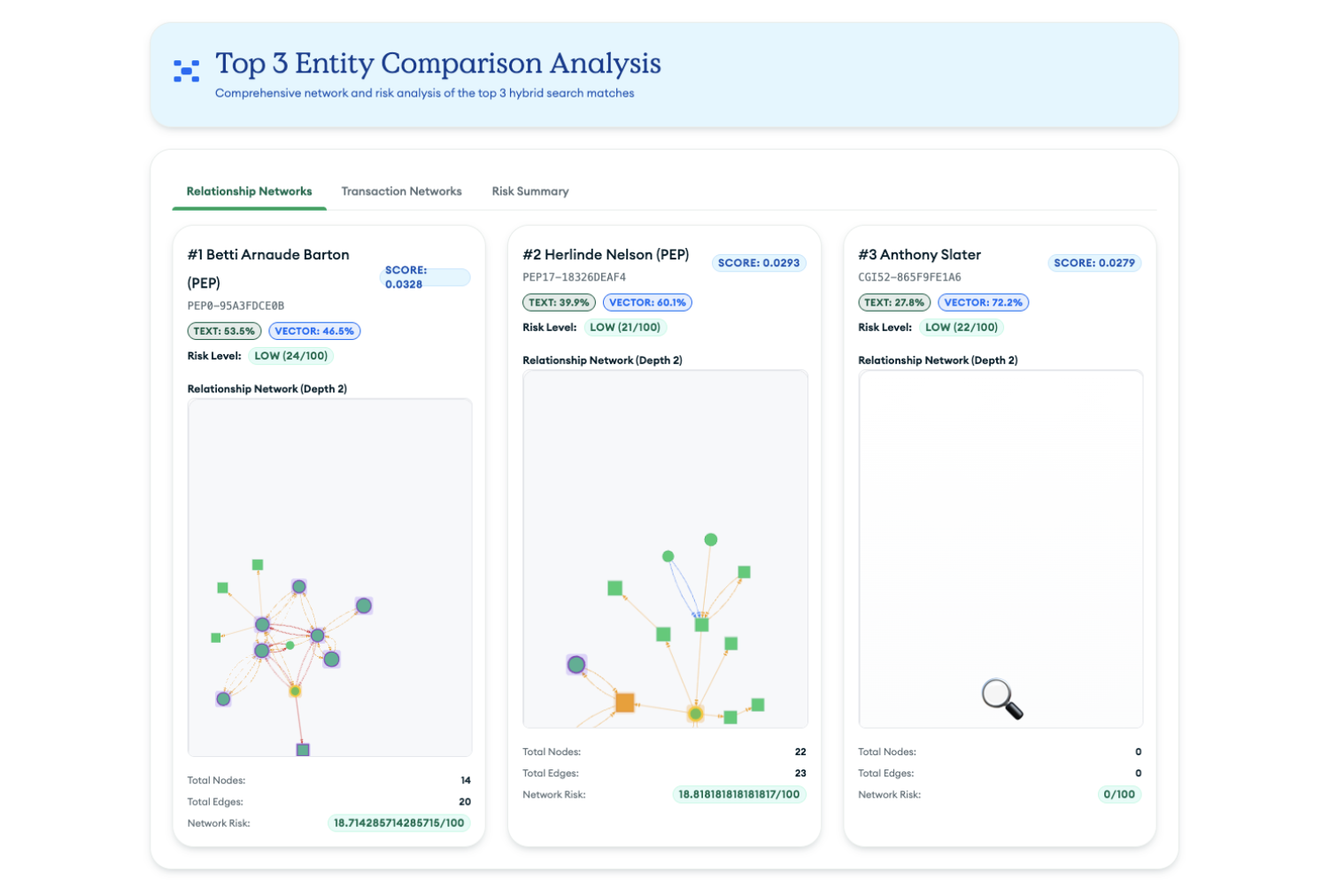
Image taken from our demo prototype. Disclosure: The look and feel is from a custom UI developed for demo purposes. It is not part of MongoDB’s offering.
2. AI-powered classification
Once the closest entities and their relationships are identified, their attributes and behavioral patterns can flow into an LLM‑based classification workflow(in this case: Claude Sonnet 4 running on Amazon Bedrock) to classify the prospective customer, and determine what should the best course of action:
Figure 5. Prompt Engineering for AI entity classification.
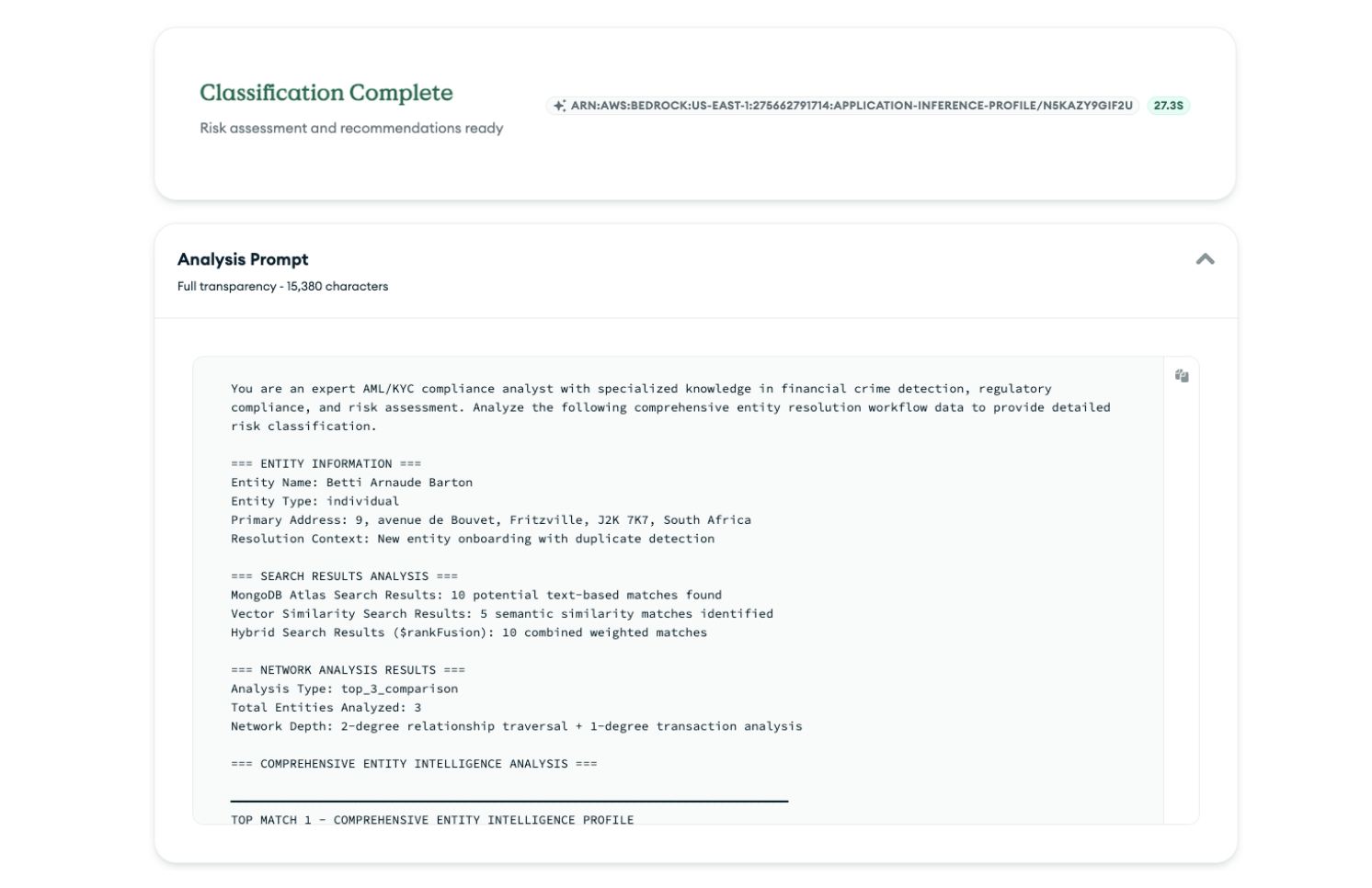
Image taken from our demo prototype. Disclosure: The look and feel is from a custom UI developed for demo purposes. It is not part of MongoDB’s offering.
Because this workflow runs on top of MongoDB as the unified data store, the model works with full context: network relationships, historical transactions, sanctions hits, and prior alerts reside in one place, instead of being scattered across disconnected systems.
3. Case investigation
When the model flags an entity as higher risk—for example, by categorizing them as a Politically Exposed Person (PEP) or surfacing high‑risk behavioral patterns—the workflow can automatically open a case investigation with clear, explainable next steps. Furthermore, investigators can systematically review identity information across all connected entities, re‑run targeted checks, and enrich the case with additional context, all from a single, entity‑centric view (go beyond the visible).
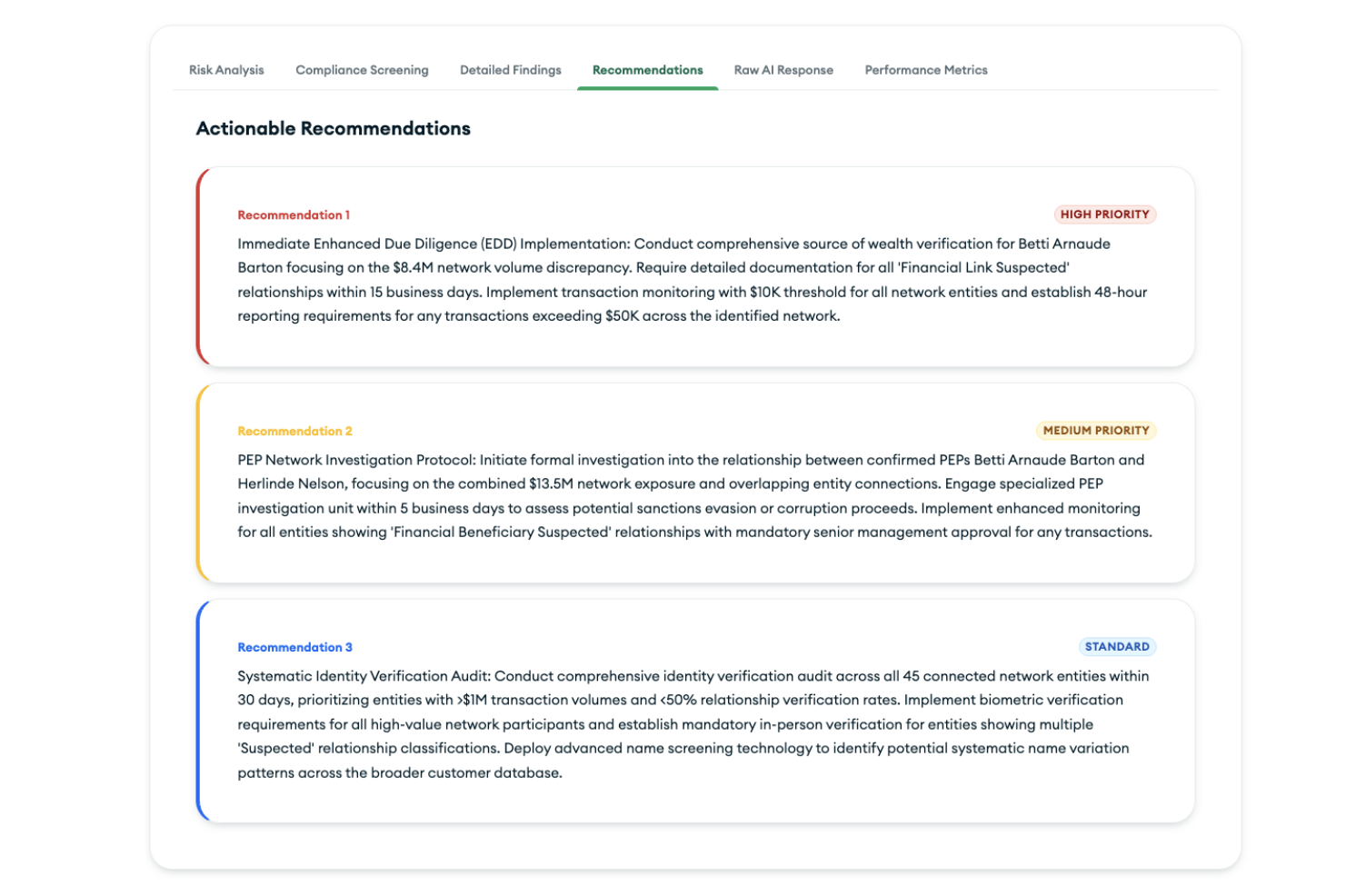
Figure 6. Example of next best recommendation provided by the AI model.
Image taken from our demo prototype. Disclosure: The look and feel is from a custom UI developed for demo purposes. It is not part of MongoDB’s offering.
Backed by MongoDB as the data platform, investigators can systematically review identity information across all connected entities, re‑run targeted checks, and enrich the case with additional context, all from a single, entity‑centric view. In parallel, LLMs can generate human-readable case summaries that bring together network analysis, classification results, and recommended actions into a structured report ready for review and filing.
Figure 7. Example of a case report generated by the LLM model.
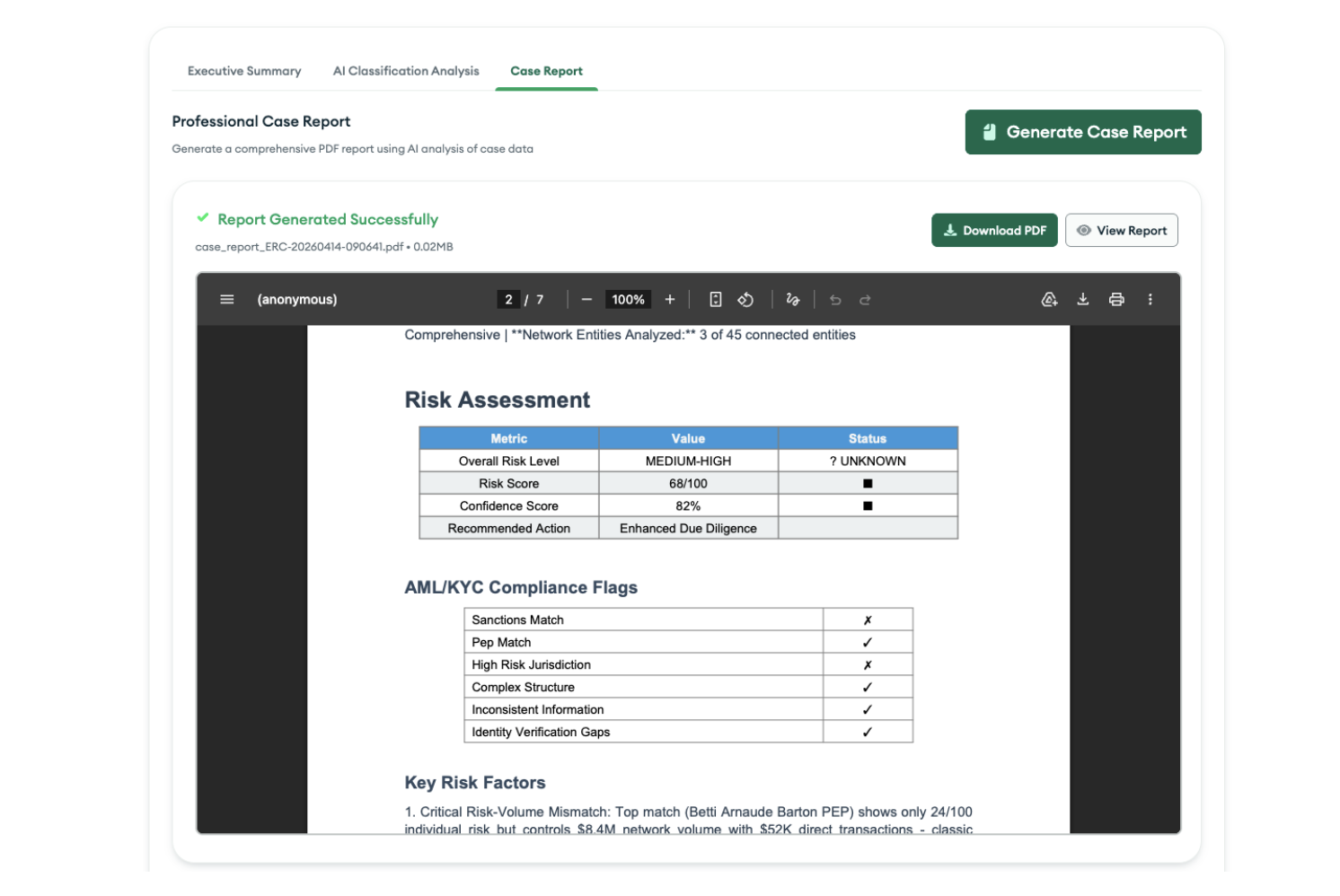
Image taken from our demo prototype. Disclosure: The look and feel is from a custom UI developed for demo purposes. It is not part of MongoDB’s offering.
Takeaways
AI is a transformative technology that can significantly improve due diligence and case investigation processes. It can reduce false positives by identifying known patterns, uncovering hidden relationships, simulating what-if scenarios with synthetic data, and using LLMs to generate case reports and assist risk analysts.
According to McKinsey & Company, banks often dedicate 10–20% of their workforce to KYC and AML activities, while still struggling with low automation rates, fragmented data sources, and unstandardized datasets. These challenges create inefficient manual processes and slow, frustrating onboarding experiences for customers.
By introducing AI-driven automation and intelligent analysis, financial institutions can streamline traditionally lengthy and error-prone workflows, improve analyst productivity, strengthen financial crime controls, and reduce operational costs.
In the next article in this series, we dive deeper into how MongoDB’s platform capabilities can improve fraud detection, transaction monitoring, and behavioral risk assessment. Read the third part of the series here.
Next Steps
Read our series overview on Financial Crime Mitigation with MongoDB / Series Overview.
Check out these guided step-by-step tutorials on building a Financial Crime Mitigation with MongoDB / Part I: Dynamic Customer Profile and AML Network Analysis with $graphLookup.
1 Alexander Verhagen, Angela Luget, Olivia Conjeaud, and Vasiliki Stergiou, “How Agentic AI Can Change the Way Banks Fight Financial Crime,” McKinsey & Company, August 7, 2025.