

INTRODUCTION
Building for the enterprise: An AI startup’s defining moment
For AI startups, the architectural decisions made in the earliest days can define their trajectory for years to come. The choice of a database, the design of a security model, and the commitment to a particular tech stack are the pillars that determine a company’s ability to scale, pivot, and, ultimately, deliver on its promises. Super AI, founded by Saurabh Moody and Preksha Kaparwan to disrupt the traditional analytics landscape, faced this exact crossroads. Its journey began with a broad vision for business intelligence, but a single, pivotal meeting with a Fortune 500 pharmaceutical company changed everything.
The challenge was massive. As a global leader in pharmaceuticals, the client needed to empower a 15,000-person sales team with intelligent, real-time guidance. This wasn’t a request for another dashboard; it was a demand for a sophisticated AI-driven system capable of navigating a complex, highly regulated industry.. The meeting forced Super AI to pivot from a general-purpose platform to a specialized, high-stakes solution—one that required an architecture purpose-built for flexibility, enterprise-grade security, and uncompromising speed. It pushed the company to re-evaluate the core of the modern AI stack. Their decision to build on MongoDB Atlas became the defining factor in their success.
THEIR CHALLENGE
Navigating security and complexity in pharmaceutical AI
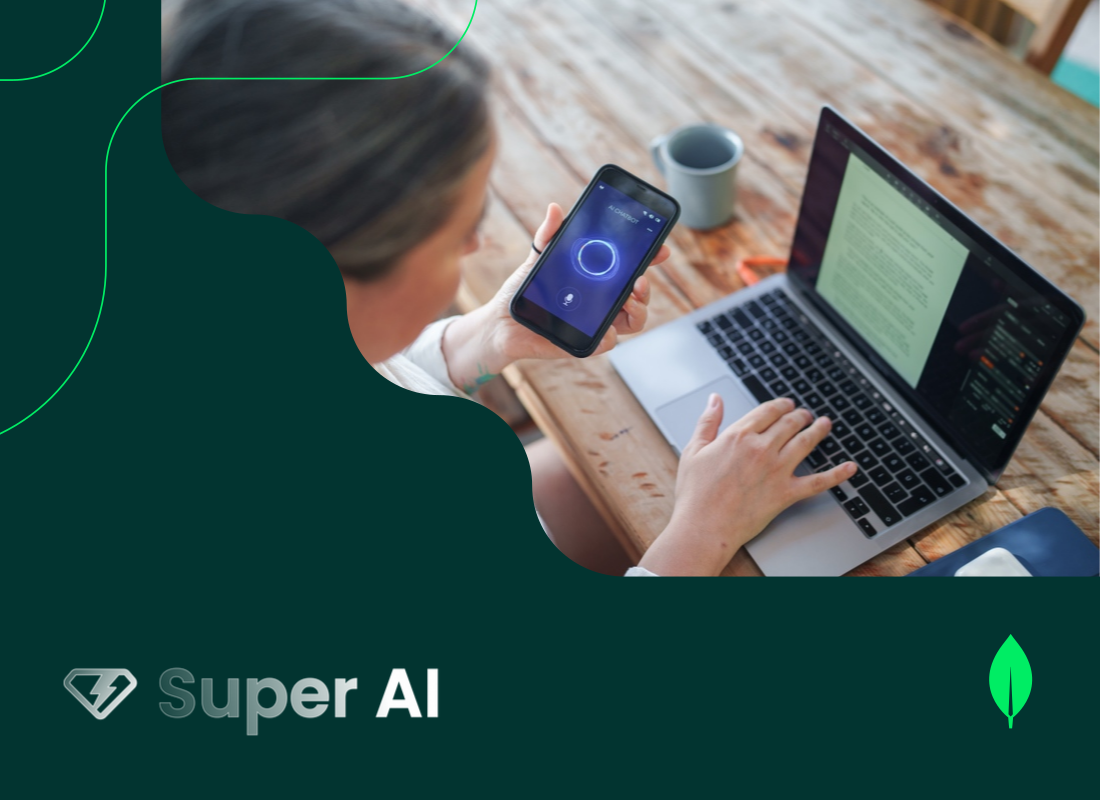
The client’s vision was clear: Its sales representatives, who are constantly in the field, needed a conversational AI companion. This tool had to provide immediate, data-driven insights to help them plan and execute effective calls with doctors and healthcare providers. Super AI’s initial approach, using standard MongoDB queries to answer simple, structured questions such as “What were my sales last quarter?” was a starting point, but it barely scratched the surface of the client’s needs. The true value lay in unlocking the vast stores of unstructured data, such as doctors’ private notes, clinical trial results, and market feedback to provide nuanced, contextual guidance.
This ambition, however, came with a formidable set of constraints. First, the client had a zero-tolerance policy for using public Large Language Models (LLMs). The sensitivity of its data, which included proprietary drug information and confidential physician feedback, made the risk of leaks or privacy breaches unacceptable. The solution had to meet rigorous security standards. Second, the system had to be immune to model hallucination. In the high-stakes pharmaceutical world, providing a sales representative with inaccurate or fabricated information is not just a technical error; it’s a critical business risk that could damage relationships with healthcare providers and have profound compliance implications.
The core challenge for Super AI was twofold. It needed to build a sophisticated, proprietary AI system capable of performing retrieval-augmented generation (RAG), grounding its responses in the client’s private data to ensure accuracy. At the same time, it had to architect a data backend that could handle complex queries across both structured and unstructured data while enforcing stringent, user-specific security rules. The platform had to be not only intelligent but also trustworthy, delivering a seamless and instantaneous user experience to a sales force that measures success in seconds, not minutes.
OUR SOLUTION
A unified data platform for a new generation of AI
To meet this complex challenge, Super AI developed the proprietary, patent-pending Pharma Operating System. The success of this ambitious platform hinged on the choice of its data backend. The team began by evaluating the emerging landscape of AI data technologies, including specialized vector databases such as Pinecone, which were gaining popularity for their ability to handle the vector embeddings that power semantic search. After careful consideration and an initial phase using MongoDB Community Edition, Super AI chose to build its entire database platform on MongoDB Atlas.
The choice was driven by a core technical principle: the power of a unified data platform. “We tried Pinecone,” noted Moody, Co-founder and CEO of Super AI, “but we wanted the JSON capabilities. Our entire app stack is built on JSON.” Opting for a specialized vector database would have meant creating a fragmented architecture with one system for core application data and another for vector embeddings. This approach would have introduced complexity, created data silos, and made it significantly harder to implement the granular security model Super AI’s client required.
By choosing MongoDB Atlas with native MongoDB Atlas Vector Search, Super AI avoided these pitfalls and built a cohesive, elegant solution on a single, unified database platform:
Application data: The core of the Pharma Operating System, including user profiles, sales territories, product information, and call logs, lives in MongoDB as flexible JSON documents. This enables rapid development and easy adaptation to changing business requirements.
Vector embeddings: Embeddings generated from powerful models such as Gemini and Claude are stored and indexed directly within MongoDB Atlas, right alongside the structured application data they relate to. This colocation of data and embeddings is the key to unlocking powerful, context-aware queries.
Unified memory: The database serves as a“unified memory database for the AI agents. It stores conversation histories, user preferences, and other metadata that provide critical context for every user query, enabling the AI to have stateful, intelligent conversations rather than treating each request as a one-off transaction.

_Spot.svg)

_1.svg)