Transform supply chain disruption management with Agentic AI to overcome data readiness hurdles and automate mitigation in minutes.
Casos de uso: Inteligência artificial, pesquisa inteligente
Setores: Manufatura e Mobilidade
Produtos: MongoDB Atlas, MongoDB Atlas Search, MongoDB Atlas Vector Search, Voyage AI
Visão Geral da Solução
Supply chain disruptions cost businesses $184 billion annually as of 2026. Agentic AI can help reduce the impact of these disruptions. Gartner identified data readiness as one of the make-or-break hurdles for supply chains.
For AI agents to move from chatbots to autonomous collaborators, they require a foundation of high-quality, real-time data currently stored in silos. Agentic AI bridges this gap by:
Solving the unstructured data problem: Agentic AI uses reasoning to extract information from thousands of PDFs, emails, and images, converting them into a UNS that the entire business can use.
Reducing response times: Agents can diagnose a disruption and trigger corrective actions in minutes rather than days.
Enabling autonomous mitigation: Context-aware agents can simultaneously reason across multiple data streams. They can autonomously reroute shipments, negotiate with alternative suppliers, and adjust production schedules within set limits. These capabilities turn data readiness into a competitive advantage.
The Architecture of Action: Agentic AI on MongoDB Atlas
The proposed solution demonstrates how multiple AI agents can collaborate within a single, AI-ready data foundation. The application uses MongoDB Atlas to transform the data readiness hurdle into a competitive advantage across the following operational moments.
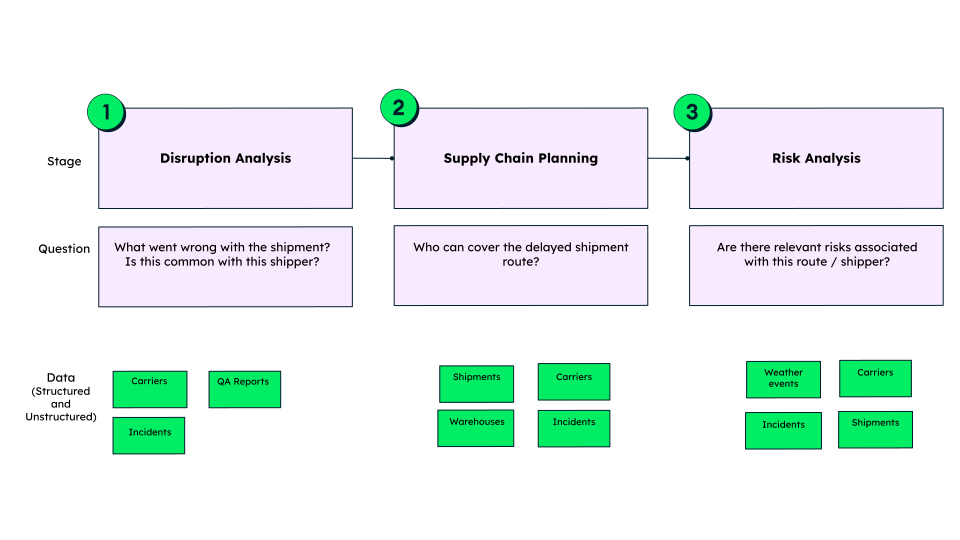
Figure 1. Solution agents overview
Disruption Analysis: Extract Logic from the Chaos
Long email chains, PDF invoices, QA reports or delivery notes often hide the reason for a shipment failure. Traditional databases struggle to parse this information because they look for exact words. For example, if a report says mechanical delay but a user searches for truck breakdown, the system misses the connection. This solution uses Voyage AI to turn this text into embeddings.
Consider an embedding as a mathematical representation of meaning. Instead of just storing text, Atlas Vector Search maps data meaning in a high-dimensional space. This allows the agent to recognize that terms like severe weather, blizzard, and impassable roads share a similar meaning.
With this information, the agent can reason through different documents and explain why a carrier failed. It understands the situation and transforms a stack of PDFs into a clear, actionable analysis of the disruption.
Supply Chain Planning: Execute the Recovery
When the agent discovers the cause of a failure, it scores a diagnostic win, but it might still need considerable time to find alternatives. At this point, the agent shifts from analyst to coordinator and uses Atlas Search with MongoDB geospatial queries to identify alternative carriers that can step in immediately.
Instead of manually cross-referencing spreadsheets with a map, the agent treats geography as a live, queryable data point. The agent uses a geoWithin query to quickly find available fleet hubs within a specific radius of the disruption.
Risk Analysis: Mitigate Vulnerabilities
The final agent acts as a predictive engine, calculating the VAR for each shipment by aggregating data from sources such as weather events and historical incident logs. MongoDB Atlas uses a flexible document model, allowing the agent to ingest these disparate sources without the friction of a rigid schema.
This agent effectively suggests updates to risk weights based on current conditions. For example, if severe weather is expected, the agent can recommend increasing the priority weight for weather patterns to give a more accurate, real-time risk assessment.
Arquiteturas de referência
Presents a multi-agent supply chain application built with:
MongoDB Atlas for data storage, retrieval and vector search.
LangGraph for agentic orchestration.
AWS Bedrock for LLM reasoning.
Voyage AI for generating embeddings.
These technologies create an intelligent system where autonomous agents use logistics data to handle disruption analysis, route planning, and risk assessment.
The Benefits of this Architecture
MongoDB Atlas serves as the unified data platform, handling structured logistics data, geospatial queries, and vector search in a single database, eliminating the need for multiple specialized systems.
LangGraph orchestrates specialized agents, each with its own tools and prompts, to handle complex workflows. It can store the conversation memory and state management in MongoDB.
AWS Bedrock acts as the central decision-making hub. By leveraging models like Claude 3.5 Haiku, Bedrock functions as a reasoning agent that doesn't just match keywords but understands intent.
Voyage AI generates the high-quality vector representations necessary for precise retrieval. Embedding models convert unstructured and complex data, such as documents, images, audios, into dense numerical vectors (i.e. embeddings) that capture their semantic meanings.
Each agent has a unique set of tools tailored to its domain. For example, one tool can query historical shipment patterns and weather disruptions, another can find nearby carriers using geospatial proximity, and another can perform semantic search across quality assurance reports. The next section explores the agent tools in detail.
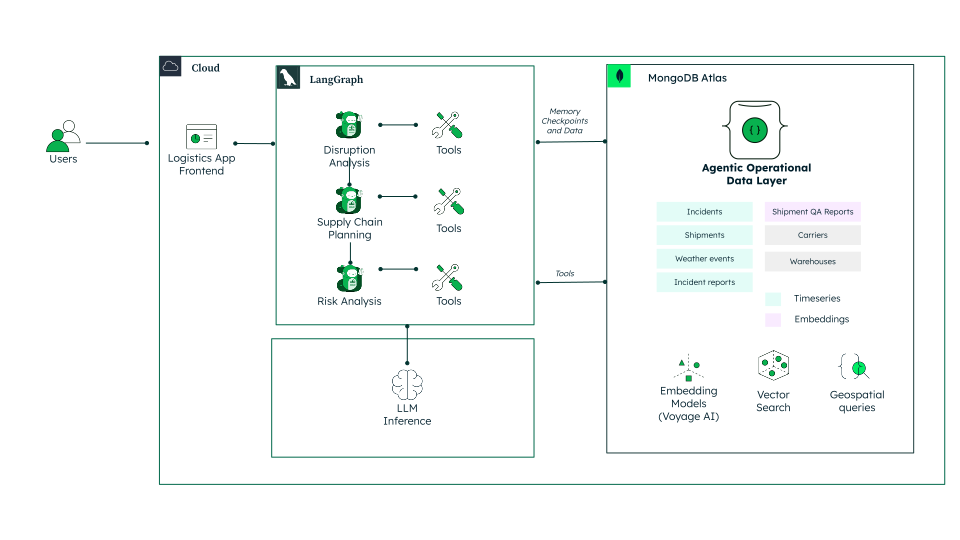
Figure 2. Solution architecture diagram
Disruption Analysis Tools
Acesses to tools that enable it to uncover the underlying causes of disruptions using structured shipment data and unstructured QA reports.
Retrieve Carrier History
Uses the stored carrier history to detect trends in performance. With this data, the agent has intelligence to determine if the delay is an isolated event or part of an ongoing pattern.
Retrieve QA Reports
Uses Atlas Vector Search to let the agent analyze vectorized QA reports stored in the database and find similar issues related to the carrier.
Generate Shipment Incident Reports
Generates a comprehensive report on the cause of the delay. It stores this report in the database, so it can be used later to identify recurring problems.
Supply Chain Planning Tools
Finds alternative carriers and routes. It combines geographic data with carrier capabilities to suggest alternatives that can complete the delivery. The agent uses the following tools.
Find Nearest Carriers
Searches for carriers near the shipment's current location. It identifies which carriers can quickly take over a delayed shipment, minimizing recovery time.
Validate Service Coverage and Origin
Checks which carriers operate in the origin region. This tool considers only carriers with active operations inside the pickup location’s area.
Validate Service Coverage and Destination
Identifies the carriers that covered the origin, and reached their destination.
Format Alternatives
Retrieves detailed carrier information from the database and presents alternative routes and carriers. It highlights key decision factors such as cost, estimated delivery time, reliability ratings, and environmental impact.
Using MongoDB's geospatial capabilities, the agent ensures feasible alternatives, and provides valuable insights to make data-driven decisions.
Risk Analysis Tools
Analyzes potential risks for a set route by reviewing weather conditions, border crossing disruptions, and the carrier's historical reliability. With this context, the agent then generates a VAR metric that estimates potential financial risk. The agent has available the following tools.
Retrieve Weather Events
Looks up historical weather patterns along the route, such as hurricanes, snowstorms, floods, and other conditions that could cause delays. The agent can then warn about unexpected weather risks when scheduling a shipment.
Retrieve Border Incidents
Fetches and analyzes historical disruptions at border crossings, such as inspection delays and unexpected border crossing closures.
Retrieve Carrier Performance
Reviews the selected carrier’s recent shipments to identify patterns such as delays, compliance issues, or reliable performance. The agent uses this history to assess if switching carriers reduces risk.
Calculate VAR to Estimate Financial Exposure
Collects contextual information from the previous tools to generate an estimated VAR. The calculation combines the base route cost with risk-adjusted values, which are weighted according to user preferences for each risk factor.
Together, these tools provide a risk analysis that help teams make decisions based on operational intelligence stored in MongoDB Atlas.
Construir a solução
To replicate this solution, follow the README in the GitHub repository, which guides you through the following steps.
Configure the environment
Copy the template and create your local environment file:
cp .env.example .env
Open the .env file and update your credentials:
MONGODB_URI="mongodb+srv://<user>:<password>@<cluster>.mongodb.net/" DATABASE_NAME="supply_chain_demo" AWS_REGION="us-east-1" AWS_PROFILE="default" COMPLETION_MODEL="your_completion_model" EMBEDDING_MODEL="your_embedding_model" VOYAGE_API_KEY="your_voyage_key_here"
For example, you can choose us.anthropic.claude-4-5-haiku-20251001-v1:0 as your completion model and voyage-large-2-instruct as your embedding model.
Access the application
Once the app is running, navigate to your browser and go to http://localhost:8080 to use the solution.
Principais Aprendizados
Orchestrate supply chain operations with agentic AI: Agentic AI can mitigate supply chain disruptions-estimated to cost $184 billion annually-by transforming data readiness into a competitive advantage.
Unlock insights from unstructured data: Use Agentic AI to analyze unstructured data, such as PDFs and emails, reducing response times from days to minutes.
Consolidate your data foundation: Adopt MongoDB Atlas as your single data platform. Unify structured logistics data, geospatial data for route optimization, and vector search for semantic retrieval of QA reports in a single database, eliminating the need for multiple specialized databases.
Deploy specialized multi-agents: Deploy LangGraph-managed agents to handle critical operational disruptions. Build a system that uses Voyage AI and Atlas Vector Search to identify disruption intent, utilizes MongoDB geospatial queries to find alternative carriers, and aggregates fragmented data streams into a flexible document model to estimate potential VAR during volatile events.
Build a modular AI stack: Combine MongoDB Atlas, LangGraph, AWS Bedrock, and Voyage AI to create a high-performance reasoning engine for your supply chain data.
Autores
Javier Guajardo, MongoDB
Dr. Humza Akhtar, MongoDB