Use cases: Intelligent Search
Industries: Healthcare
Products: MongoDB Atlas, MongoDB Community Server Edition, MongoDB Enterprise Advanced
Partners: Tapdata
Solution Overview
This project develops a FHIR hybrid ODL pattern for healthcare. The primary goal is to create a single, highly performant operational store that powers customer web services. Additionally, the design exposes FHIR-compatible endpoints for the resources in scope, so future features can be built using the FHIR REST API instead of new custom services.
At its core, the ODL uses MongoDB Atlas as a flexible and scalable
database that stores resources, such as Patient or Encounter, in
a structured three-block format. This includes:
The canonical FHIR representation when a mapping exists.
Additional application-specific fields.
Pre-indexed search fields optimized for query performance.
Because mappings are defined FHIR-first, fields aligned with FHIR are stored using the standard structure, while remaining attributes are held in separated application blocks. This hybrid structure preserves interoperability without forcing the solution to behave as a full FHIR server.
The backend uses FastAPI and exposes two families of APIs:
Application API: Implements the customer’s operational endpoints, for example patient search, case search, or local identifier services, using the ODL as a shared backend.
FHIR API: Provides FHIR-compatible search for a defined subset of resources, such as
PatientandEncounter, reusing the same envelope model and indexes. It is designed as a pragmatic FHIR facade, not as a complete, profile-driven FHIR server.
The frontend uses Next.js, and it includes an interactive API demonstrator, so teams can try application endpoints and FHIR-style queries together.
For demonstrations and development, the ODL can generate synthetic clinical datasets, allowing realistic tests without exposing real patient data.
Reference Architectures
The architecture focuses on the FHIR Hybrid ODL, a reference data model approach that supports custom operational access patterns and FHIR-compatible access over the same dataset. Rather than duplicating data, this approach indexes valuable information for operational queries and maintains the complete FHIR resource.
The use case originates from a real-world customer challenge involving a large healthcare institution operating multiple EHR platforms. Each system offered patient access services independently, leading to fragmented data access, duplicated logic, and absence of semantic interoperability.
To simplify this, this institution introduced an ODL to centralize clinical data access and provide shared MDM services, without disrupting existing applications.
This situation created an opportunity to shift toward industry best practices by adopting FHIR as the common language, instead of redefining data structures and semantics from nothing. By designing the ODL data model as FHIR-first, the organization avoided “reinventing the wheel” for core concepts such as patients and encounters. It also aligned with standard resource definitions, making it a potential model for others in the field.
The reference architecture shows how healthcare companies can unify different data sources, support custom processes and deliver highly performant APIs using MongoDB Atlas. The interface is divided into tabs, with each tab displaying a specific capability of the architecture.
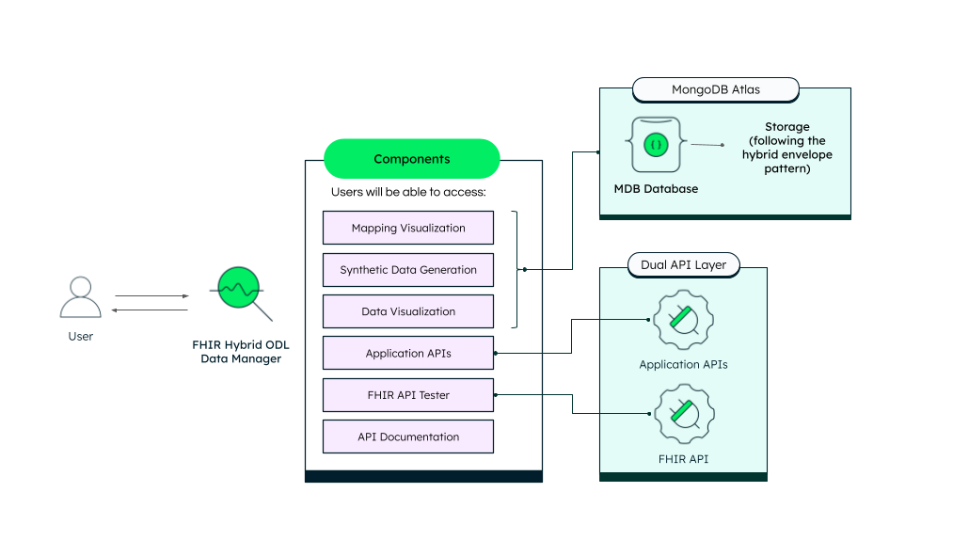
Figure 1. FHIR Hybrid ODL reference architecture
Initially, the mappings section shows how legacy healthcare data fields map into the ODL data model, which is designed around a FHIR-centric schema. Each document stores:
A canonical FHIR resource (when a FHIR mapping exists)
Application-specific fields required by current workflows
Search-optimized fields used by the APIs
Users can browse a full set of field mappings across entities such as
Patient and Encounter in an interactive table. This helps them
understand which fields come from the FHIR specification and which ones
are modeled as application or search fields. This mapping strategy makes
it easier to trace data lineage and assess alignment with standards.
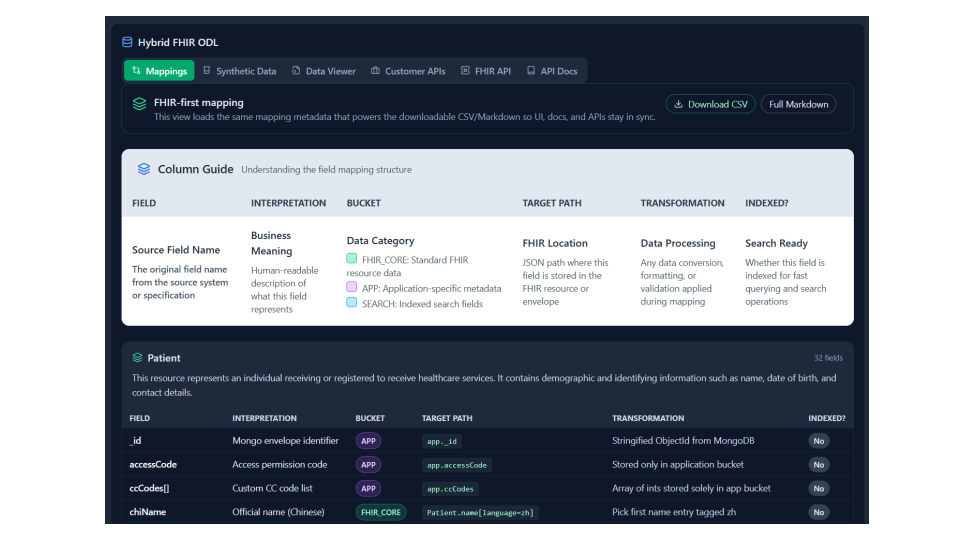
Figure 2. Mappings tab in the Hybrid FHIR ODL demo
The platform includes a built-in generator that creates synthetic clinical data for storage and retrieval tests, allowing teams to test functionality. Users can customize synthetic content, including the number of patients, encounters per patient, practitioners, and care teams.
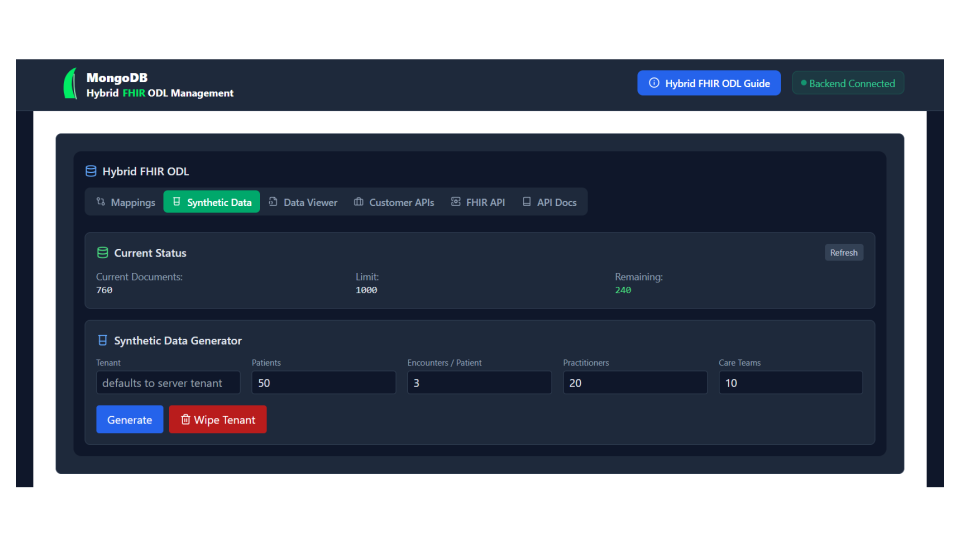
Figure 3: Synthetic clinical data creator
After data is populated, the Data Viewer section allows users to explore the FHIR resources stored in MongoDB. It shows the canonical FHIR content and the additional ODL fields in one place, clarifying how standard and operational data live together.
The Customer API section integrates legacy healthcare systems with the platform. An API tester allows users to call customer-specific MDM and operational endpoints. By selecting an endpoint and entering the required parameters users can execute the query and view the formatted response as the custom systems expect it.
Finally, the FHIR API Tester section allows users to perform FHIR standard searches on the underlying dataset. The results display the MongoDB query pipeline and the FHIR response. This view highlights how the platform maintains FHIR standard-compliant output, delivers performance insights, and provides debugging details.
Dual API Layer (Core Pattern)
The dual API layer is central to the architecture. The platform exposes two types of endpoints from the FHIR-centric data model:
Application APIs: Custom endpoints that match existing integration services.
FHIR API: FHIR-style queries over the same dataset for standards-based access.
Both APIs include a set of predefined example queries, so users can trigger typical queries with a single click.
By exercising these ready-made scenarios, teams quickly see how one ODL schema can simultaneously serve legacy-compatible and FHIR-compatible APIs without extra ETL pipelines or separate databases. Discover how MongoDB partner TapData uses the dual API layer pattern in its platform. Learn more about this integration here.
Data Model Approach
The architecture is built around a FHIR-centric ODL schema stored in MongoDB. Instead of scattering patient and encounter data across many tables, each record is kept as a single document with three sections. Each section serves a specific purpose within the ODL:
resourcefor the canonical FHIR content: Contains a valid R4 FHIR object, such asPatientorEncounter. This block can be returned directly by FHIR-style endpoints without additional transformation.appfor the application metadata: Holds fields that are required by the workflows, but are part of the base FHIR resource. It includes fields such as internal codes, classification flags, or other customer-specific attributes.searchfor the denormalized query surface: Flattens the attributes most frequently used in queries, including identifiers such as names, key dates, organization or location references. It also turns relationship keys into fields that are easy to index and use for the API layer.
Below, you can find a commented JSON example for the Encounter
resource:
{ "_id": "ObjectId", "tenant": "tenant-1", "resourceType": "Encounter", // 1 Canonical FHIR block "resource": { "resourceType": "Encounter", "id": "036fcfcd-797c-4ae2-a30f-49226357deb2", ..., "status": "onhold", "class": { "code": "EMER" }, "serviceType": { ... }, "period": { "start": "2025-10-31T17:43:00", "end": "2025-11-02T17:43:00" }, "serviceProvider": {}, "hospitalization": {}, "participant": [], "location": [], "type": [ { ... } ] }, // 2 Application block "app": { "caseNum": "QH-1761928980-83", "doctorCode": "DR100", "specialistCode": "DR100", ..., "sourceIndicator": "SELF", "patientGroup": "G2" }, // 3 Search block "search": { "start": "2025-10-31T17:43:00", "end": "2025-11-02T17:43:00", "local_id": "A108548(0)", ..., "caseNum": "QH-1761928980-83", "statusCode": "onhold", "caseType": "E" } }
Build the Solution
For detailed setup instructions, follow the steps outlined in the
README of this GitHub repository. This
repository hosts the backend and frontend for this demo.
To reproduce this demo in your own environment, follow these steps:
Configure your environment variables
Go to the /backend directory and create a .env file with
the connection details below. Use your MONGODB_URI connection
string saved in Step 1.
MONGODB_URI=mongodb+srv://<user>:<password>@<cluster-url>/?retryWrites=true&w=majority MONGODB_DB=fhir_demo MONGODB_COLLECTION=fhir MONGODB_TENANT=tenant-1
Then, browse to the /frontend directory and create a .env
file with the following information:
NEXT_PUBLIC_ENABLE_FHIR = true BACKEND_URL=http://localhost:3100
Deploy both services using Makefile
Open two separate terminals and start each service independently with the following commands:
Terminal 1: Backend
make backend
Terminal 2: Frontend
make frontend
After completing these steps, you’ll have a working Hybrid FHIR ODL demo. You can access the resources at the following URLs:
Frontend: http://localhost:3101
API documentation: http://localhost:3100/docs
Health check: http://localhost:3100/health
Key Learnings
Modernize legacy healthcare systems: This solution shows how hospitals can update their clinical data infrastructure without having to abandon their operational workflows. Rather than requiring institutions to maintain their fully-custom services or switch entirely to FHIR, this approach enables integrating these systems incrementally. Data remains available as FHIR resources, and custom application endpoints and existing query patterns continue to work through the application API layer. Hospitals using this solution can progressively modernize their infrastructure, moving clinical teams and partner systems at their own speed.
Optimize clinical data performance: This approach allows FHIR data to stay unaltered in the resource block for standards compliance, while the application information resides in high-usage attributes, indexed for faster search performance. The system is appropriate for real-time clinical dashboards, operational analytics, and quick lookups during registration, triage, and bed management.
Accelerate interoperability and developer productivity: The dual API architecture, built-in synthetic data generation, and interactive API testing tools help teams quickly prototype, validate, and deploy FHIR-compliant solutions without disrupting existing hospital processes.
Authors
Patricia Renart Carnicero, MongoDB
Francesc Mateu Amengual, MongoDB