Modernize payments with Agentic AI, a JSON-based canonical model, and MongoDB Atlas to bridge ISO 20022, ISO 8583, and Stablecoins.
Use cases: Artificial Intelligence, Payments
Industries: Financial Services
Products and tools: MongoDB Atlas, MongoDB Atlas Vector Search, MongoDB Atlas Search
Partners: Amazon Bedrock, LangChain, LangGraph
Solution Overview
Payment processors today face an interoperability problem. They must handle legacy card messages (ISO 8583), modern rich data standards (ISO 20022), and evolving crypto payment rails. Traditional systems rely on rigid extract, transform, and load (ETL) pipelines that break when a new field appears or a local regulation changes.
To connect legacy infrastructure and the future of finance, a JSON-native canonical payment model acts as the essential foundation for modern orchestration. In a post-ISO 20022 landscape, it solves the semantic dialect fragmentation seen in varying implementations, such as CBPR+ and FedNow. It prevents data truncation risks identified by SWIFT, where legacy internal systems strip away rich ISO 20022 data because they lack the capacity to store expanded fields. Because the model captures the full message depth in a flexible JSON format, the system loses no data during translation.
Coupled with a universal API abstraction, the platform enables IT teams to move away from opaque binary bitmaps and fragmented standards to a developer-friendly environment. This environment allows for accelerated development and reuse, as new payment rails—from India’s UPI to stablecoins—can be integrated as modular extensions rather than core code rewrites.
Beyond development speed, this model establishes centralized payment scheme and data governance, enabling single-point updates where a new regulatory field is defined once and inherited across all transformation logic. This shift from rigid SQL schemas to a flexible document model eliminates the technical debt and maintenance burden typical of legacy hubs. By normalizing data into a truly standardized and consistent data model early in the life cycle, the model facilitates early compliance engagement and proactive in-flight repair. Ultimately, it provides the defined stewardship and operational agility needed to navigate a multirail world that is constantly evolving under new regulations such as the Markets in Crypto-Assets (MiCA).
The following video gives an example of a cross-border DE to JP payment with agent-driven Japanese Katakana transliteration of the creditor name:
This solution demonstrates how a canonical payment model with Agentic AI can redefine payments processing. By moving away from rigid SQL schemas to a flexible, JSON-based canonical model, financial institutions can empower AI agents to autonomously ingest, normalize, route, and repair transactions across any payment rail, such as a SWIFT wire or USDC transfer on a public blockchain.
JSON Foundation
A JSON-based data model is the critical foundation for such a multipayment rail processing system because of the following properties:
API Native: Modern payments, especially in crypto and fintech, use API-driven communication (REST/GraphQL/RPC), which is inherently JSON-based. A native format reduces translation latency and complexity.
Schema Flexibility: JSON handles common fields (amount, sender) while accommodating rail-specific fields (for example, gas limits for crypto, zengin codes for Japan, remittance information for ISO 20022) without breaking the core schema.
AI Readiness: LLMs train on code and JSON. Agents can analyze the data structure directly, detecting anomalies and performing complex mappings more effectively than with opaque binary bitmaps or rigid SQL tables.
Reference Architectures
This payments processing demo includes a Payment Processing Platform that handles the complete transaction lifecycle from format onboarding to execution and repair. The architecture delegates specific responsibilities to specialized components:
Build
Config Builder: Accelerates format onboarding during development. Aggregation pipelines extract field mappings from existing configurations, while an LLM suggests mappings for unknown fields. New formats that once took months to integrate can be configured in weeks. Once configurations are in place, the platform handles live transaction processing.
Execute
Message Translation Service: Incoming messages pass through a configuration-driven processing system. Most fields follow deterministic rules stored in MongoDB that are constructed in the build process described previously. Complex unstructured fields such as remittance information route to an AI lane powered by Claude.
Agentic Resolution Service: A multiagent system that repairs transactions failing validation. A supervisor routes tasks to specialized agents: the Resolution Agent finds correct values for missing or invalid fields (using database lookups, Atlas Search, or AI inference), and the Execution Agent applies approved changes and logs an audit trail.
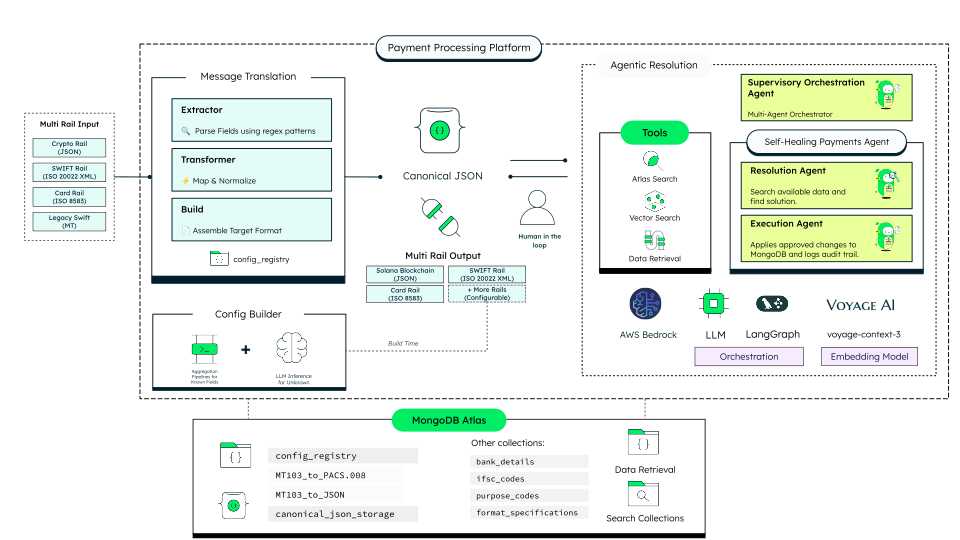
Figure 1. Payment Processing Platform architecture showing message translation, canonical JSON routing, and agentic resolution with MongoDB Atlas
As shown in the architecture diagram, MongoDB serves as the Operational Data Layer (ODL). The system stores each transaction as a single document containing normalized canonical JSON, and a complete audit trail of agent decisions. Conversion configurations live in a separate collection, making format changes data-driven. This structure provides the auditability required for regulatory compliance.
Core Capabilities
This demo showcases four core capabilities where the MongoDB flexible schema and agentic AI transform payment operations.
Data-Driven Message Translation
Legacy systems often hard-code translation logic (for example, "field 4 maps to field 32A"). This solution stores translation rules and metadata in MongoDB alongside the data, making the translation logic data-driven.
Instead of recompiling code to change a mapping, you update a configuration document in MongoDB. The converter service reads these rules dynamically—extract patterns, field mappings, and output paths—to normalize incoming ISO 8583 or SWIFT MT messages into the canonical JSON format.
Config-Driven Transformation:
# Load config from MongoDB config = db.conversion_configs.find_one({"_id": "MT103_to_JSON"}) # Extract fields using patterns from config["extract"] for field_id, pattern in config["extract"].items(): extracted[field_id] = re.search(pattern, message).group(1) # Transform using rules from config["map"] for mapping in config["map"]: value = extracted[mapping["from"]] if "ai" not in mapping: # RULES lane output[mapping["to"]] = value else: # AI lane ai_fields.append({"value": value, "field_type": mapping["ai"]})
Some fields resist regex patterns such as SWIFT Field 70 (remittance information) can contain free-text payment purposes, invoice references, and instructions across multiple lines. The configuration marks these fields for AI processing ("ai": "remittance"), and the LLM extracts structured data from the unstructured text. This approach keeps deterministic rules for most fields but handles the complex remainder through inference.
New message formats are enabled through document inserts—the converter code stays unchanged, keeping translation logic out of the deployment cycle.
Gen AI-Powered Adaptive Conversion
With rules and historical metadata stored in the database, you can use Generative AI (LLMs) to accelerate onboarding of new payment formats.
To add support for a new message type, provide a sample message. The Adaptive Learning Service loads all existing conversion configurations from MongoDB and extracts fields using format-specific parsing. It matches detected field IDs against mappings from existing configurations. For example, if field "32A" exists in MT103_to_JSON, that exact mapping is reused.
For fields not found in any existing config, an LLM suggests mappings that you review and refine. This generates a draft configuration ready for human review and deployment. Payment rails that once took months to integrate can now be onboarded faster.
Adaptive Learning with Aggregation and LLM:
# Aggregation pipeline: extract field mappings from ALL existing configs pipeline = [ {"$addFields": {"extract_array": {"$objectToArray": "$extract"}}}, {"$unwind": "$map"}, {"$project": {"field_id": "$map.from", "mapping": "$map", "source_config": "$_id"}}, {"$group": {"_id": "$field_id", "mapping": {"$first": "$mapping"}}} ] field_lookup = {doc["_id"]: doc for doc in db.conversion_configs.aggregate(pipeline)} # Match detected fields against learned patterns for field_id in detected_fields: if field_id in field_lookup: matched[field_id] = field_lookup[field_id]["mapping"] else: unknown.append(field_id) # For unknown fields: LLM suggests mappings constrained by format spec suggestions = bedrock.invoke_claude(f"Map {unknown} to {target_format} fields")
The aggregation pipeline builds a field-to-mapping lookup from all configs in one query. Known fields get instant matches. Unknown fields get LLM suggestions constrained by the target format's supported fields.
Agentic Payment Repair
Cross-border payments frequently fail because of local clearing requirements, such as missing codes, incorrect scripts, or incomplete institution data. Traditional systems queue these exceptions for manual review, often taking days to resolve.
The Resolution Agent handles these exceptions by using tools that the LLM autonomously selects based on docstrings and system prompts. The pattern guides the LLM toward cheaper, faster options first.
Resolution Agent Tool Selection:
from langchain_core.tools import tool from langgraph.prebuilt import create_react_agent def atlas_search(collection: str, query: str, search_fields: list, fuzzy: bool = True) -> dict: """Search MongoDB using Atlas Search. Use fuzzy=False for exact match first.""" pipeline = [{"$search": { "index": f"{collection}_search", "text": {"query": query, "path": search_fields, "fuzzy": {"maxEdits": 2} if fuzzy else {}} }}] results = list(db[collection].aggregate(pipeline)) return {"found": bool(results), "top_result": results[0] if results else None} def vector_search(collection: str, query: str) -> dict: """Semantic search using Atlas Vector Search - matches by meaning, not keywords.""" embedding = voyage_client.embed([query], model="voyage-3").embeddings[0] pipeline = [{"$vectorSearch": { "index": f"{collection}_vector", "path": "embedding", "queryVector": embedding, "numCandidates": 100, "limit": 3 }}] results = list(db[collection].aggregate(pipeline)) return {"found": bool(results), "top_result": results[0] if results else None} agent = create_react_agent(model=llm, tools=[atlas_search, vector_search])
The LLM reads tool docstrings and system prompts to determine which tool to call. Atlas Search handles exact lookups and typo-tolerant matching. Vector Search handles semantic classification where keywords don't match but meaning does. To illustrate these capabilities in practice, consider the following payment scenarios:
Japan (Katakana Transliteration): A payment to Tokyo requires the beneficiary name in Katakana script, but the incoming message contains Latin characters (for example, Heinrich Mueller). The agent first checks the
bank_detailscollection for a known translation. If not found, it uses Atlas Search for fuzzy matching. As a fallback, it calls an LLM to transliterate the name into Katakana (" ハインリッヒ・ミュラー").India (IFSC Code Lookup): A payment to India requires an IFSC code to route to the correct branch, but the sender provides only a bank name and city. The agent queries the
ifsc_codescollection for an exact match. If the input contains typos (for example, "HDFC Connaught" instead of "Connaught Place"), Atlas Search handles the fuzzy matching to find the correct code.
Human-in-the-Loop Review
Banks operate in a high-risk environment where autonomous changes
require oversight. Before any repair is applied, the LangGraph workflow
pauses by using an interrupt() mechanism, presenting the proposed
change for human approval.
The user sees:
Original Value: The field as it arrived (for example, "Heinrich Mueller").
Proposed Value: What the agent found (for example, "ハイン リッヒ・ミュラー").
Reasoning: Which tool was used and why.
The user can then:
Approve: The Execution Agent applies the change and logs it to the audit trail.
Reject: The workflow ends, and the original value is preserved.
Modify: The user provides a corrected value, which the system then applies.
This process ensures full auditability—users review every agent decision before execution, and the system logs every change with before and after values and timestamps.
LangGraph HITL Implementation:
from langgraph.types import interrupt def human_review_node(state: dict) -> dict: """Pause workflow for human approval.""" # interrupt() halts execution, returns data to caller, waits for resume review_decision = interrupt({ "original_value": state.get("original_value"), "proposed_value": state.get("solution", {}).get("proposed_value"), "confidence": state.get("solution", {}).get("confidence") }) # When resumed: {"approved": True/False, "modified_value": "..."} return {"approved": review_decision.get("approved"), "human_review": review_decision} # Workflow: resolution → human_review → execution workflow.add_edge("resolution", "human_review") # Always review before execution app = workflow.compile(checkpointer=MemorySaver()) # Checkpointer persists state
The interrupt() function is the key mechanism. When the workflow
reaches this node, it serializes the current state, returns the review
data to the API caller, and waits. The frontend displays this data to
the user. When the user submits the decision, the API resumes the
workflow with the decision injected as the return value of
interrupt().
Multi-Rail Extensibility: Blockchain Settlement Example
The canonical JSON model provides a stable internal abstraction for integrating multiple payment rails by normalizing core payment intent—such as parties, assets, amounts, and instructions—into a single, consistent structure. Using the MongoDB polymorphic document model, rail-specific execution details and metadata are stored alongside canonical fields without requiring separate schemas or data models. This keeps protocol complexity out of upstream and downstream systems while enabling different rails to consume the same payment representation.
The demo shows this pattern in action with a Solana integration: payments containing crypto settlement fields are routed to a Solana service that executes real transfers on devnet.
Solana Service Integration:
# Step 1: Convert incoming message to canonical JSON hop1_result = await converter.convert( source_format="pacs.008", # or MT103, ISO8583, etc. target_format="JSON", message=raw_message ) # Step 2: Parse the canonical JSON from conversion result canonical_json = json.loads(hop1_result['converted_message']) # Step 3: Check canonical JSON for crypto settlement fields if canonical_json.get('crypto_blockchain') and canonical_json.get('crypto_receiver_wallet'): # Route to Solana solana_service.transfer( to_pubkey=canonical_json['crypto_receiver_wallet'], amount_sol=50000 ) # step 4: Solana Service Class class SolanaService: def transfer(self, to_pubkey: str, amount_sol: float) -> dict: response = self.client.send_raw_transaction(bytes(tx)) self.client.confirm_transaction(response.value) return { "signature": str(response.value), "explorer_url": f"https://explorer.solana.com/tx/{response.value}?cluster=devnet" }
Unlike traditional payment rails, blockchain provides built-in proof of settlement. Every transfer returns a Solana Explorer URL where users verify the transaction on-chain sender, receiver, amount, timestamp, and confirmation status. This transparency isn't available with SWIFT or card networks, where settlement proof requires back-office reconciliation.
The demo runs on Solana devnet, which uses the same protocol as mainnet: Transactions are cryptographically signed, propagated to validators, and permanently recorded.
Why MongoDB
MongoDB provides the unified data platform for the entire Payment Processing Platform—supporting both development (format configuration) and runtime (transaction processing, agent decisions, audit trails) in a single system.
The platform uses several core MongoDB capabilities to streamline these complex financial workflows:
Schema Flexibility: The MongoDB document model aligns naturally with canonical payment formats. Developers can evolve data models without migrations, store related data (canonical JSON, metadata, audit trail) in a single document, and handle diverse message structures without schema conflicts.
Atlas Search for Typo-Tolerant Resolution: The Resolution Agent uses Atlas Search when exact lookups fail—typo tolerance up to 2 edit distance, compound queries across multiple fields, no external search infrastructure required.
Atlas Vector Search for Semantic Matching: For classification beyond exact text—semantic similarity to categorize payment descriptions (for example, "paying wages" maps to purpose code SALA), built into Atlas without a separate vector database.
Aggregation Pipelines for Adaptive Learning: The Adaptive Learning Service uses
$objectToArrayand$unwindto build field-to-mapping lookups from all configurations in one query—database-level processing for instant pattern reuse.Automatic Document Updates: Single-document atomicity ensures the Execution Agent updates payment fields and logs the audit trail in one operation—critical for regulatory compliance in high-risk financial services.
Together, these capabilities make MongoDB the ODL for AI-driven payment processing—supporting the demands of modern multirail finance.
Data Model Approach
MongoDB stores two types of documents that power the payment processing pipeline.
Canonical JSON (Payment Document)
{ "transaction_ref": "MED-CH-ZA-2024-001", "value_date": "2024-12-15", "amount": "180000.00", "currency": "CHF", "debtor_name": "SWISS PHARMA INTERNATIONAL AG", "debtor_account": "CH9300762011623852957", "debtor_bank": "UBSWCHZH80A", "creditor_name": "SOUTH AFRICAN HEALTH SUPPLIES PTY LTD", "creditor_account": "ZA123456789012345678901", "creditor_bank": "ABSAZAJJXXX", "remittance_info": "INVOICE MED-ZA-2024-5678", "charge_bearer": "SHA" "metadata": {...} }
This flat structure acts as a universal bridge with the following mappings:
MT103 maps to JSON, which maps to pacs.008.
MT202 maps to JSON, which maps to pacs.009.
One semantic concept equals one field name and the same
mapping across all formats. Each document also includes a
metadata object containing processing details and an
audit_trail that logs every agent decision (old value, new
value, tool used, timestamp).
Conversion Configuration
The system supports both multihop conversions through JSON and direct conversions for common paths. The following example shows a direct conversion config:
{ "_id": "MT103_to_pacs.008", "extract": { "20": ":20:([^\\n:]+)", "32A": ":32A:([^\\n:]+)", "50K": ":50K:([\\s\\S]*?)(?=:[0-9])" }, "map": [ {"from": "20", "to": ["transaction_ref"]}, {"from": "32A", "to": ["value_date", "currency", "amount"], "split": [6, 9]}, {"from": "50K", "to": ["debtor_account", "debtor_name"], "multiline": true}, {"from": "70", "to": "remittance_info", "ai": "remittance"} ], "output": { "transaction_ref": "Document.FIToFICstmrCdtTrf.CdtTrfTxInf.PmtId.InstrId", "amount": "Document.FIToFICstmrCdtTrf.CdtTrfTxInf.IntrBkSttlmAmt.#text" } }
Three sections define the conversion:
extract: Pulls fields by using regex.map: Transforms them (splitting composites, formatting dates, routing to AI).output: Places values in the target format.
Document inserts enable new message formats, removing translation logic from the deployment cycle. For new payment rails, the canonical model accelerates connectivity by serving as a universal JSON integration point, ensuring that core business logic remains untouched as you scale.
Build the Solution
For the complete implementation, follow the instructions in the GitHub repository.
The Payment Processing Platform consists of two microservices: a Message Translation Service that handles format conversion through a three-lane pipeline—including a Configuration Builder for development-time format onboarding—and a Payment Agent that repairs invalid transactions by using a LangGraph multiagent workflow. Both services share MongoDB Atlas as their ODL.
Implement the Payment Converter Service
The converter transforms messages between formats (MT103, ISO 20022, ISO 8583) by using configuration stored in MongoDB rather than hard-coded logic.
Set up the Translation Pipeline: Configure the extractor to route fields based on complexity: deterministic regex patterns for structured fields such as transaction references and amounts, and LLM calls through AWS Bedrock for unstructured fields such as remittance information.
Store conversion configurations in MongoDB: Each configuration document contains three sections:
extract(regex patterns),map(field transformations), andoutput(target format paths). The converter reads these at runtime—no code changes needed for new formats.Build the output generator: The builder takes transformed fields and constructs the target format. For ISO 20022, the builder generates valid XML with proper namespaces. For JSON targets, it outputs the flat canonical structure.
Implement the Payment Agent with LangGraph
The agent repairs transactions that fail validation—missing IFSC codes, incorrect scripts, incomplete beneficiary data—using a multiagent workflow.
Create the Supervisor Agent: This agent receives a repair task (for example, "creditor_name needs Katakana for Japan") and determines whether to route to the Resolution Agent for research or directly to Execution if the fix is known.
Build the Resolution Agent with tools: quip it with three tools:
atlas_search(database lookup with exact or fuzzy matching),vector_search(semantic similarity for classification), andtransliterate_text(LLM-based script conversion). The agent determines which tool to use based on the problem context.Add the Human Review checkpoint: Use LangGraph's
interrupt()function to pause the workflow before applying changes. The user views the original value, proposed fix, confidence score, and reasoning. They can approve, reject, or modify before the workflow resumes.Implement the Execution Agent: On approval, this agent writes the corrected value to the canonical JSON and appends an entry to the audit trail with old value, new value, tool used, and timestamp.
Enable Adaptive Learning for New Formats
When onboarding a new payment format, the system auto-generates configuration by learning from existing patterns.
Load existing configurations: The Adaptive Learning Service queries MongoDB for all conversion configurations and builds a map of field IDs to their canonical mappings (for example, field "32A" maps to
value_date,currency, andamount).Parse the sample message: By using format-specific extractors—such as SWIFT tag patterns, ISO 8583 field positions, and XML paths—the service identifies all fields present in the new format.
Match known patterns and infer unknown fields: For fields that exist in other configurations, the system reuses the exact mapping. For fields not found anywhere, the service calls an LLM with context about the format type to suggest a mapping.
Generate and review the configuration: The service outputs a draft configuration document with all mappings. The system flags fields below the confidence threshold for human review. Once approved, it inserts the document into MongoDB—the converter processes it up immediately.
Key Learnings
Aggregation pipelines for adaptive learning: Build field-to-mapping lookups from all existing configurations in a single query by using
$objectToArrayand$unwind. Known fields receive automatic mappings; unknown fields receive LLM suggestions constrained by format specifications.Atlas Search for typo tolerance: When exact database lookups fail, fuzzy search with edit distance handles misspellings (for example "HDFC Connaught" maps to "HDFC Connaught Place") without falling back to slower AI inference.
Configuration-driven conversion: Store extraction patterns, field mappings, and output paths in MongoDB documents rather than application code. Adding a new payment format becomes a database insert, not a deployment.
Human-in-the-loop compliance: Use the LangGraph
interrupt()mechanism to pause agent workflows before applying changes, present proposed fixes to users, and resume only after explicit approval.Supervisor multi-agent pattern: Route research tasks—such as IFSC lookup and transliteration—to a Resolution Agent with database tools, and execution tasks—such as field updates—to an Execution Agent. This separation ensures focused expertise and cleaner audit trails.
Unified operational data layer: Store canonical JSON, conversion configurations, and audit trails in MongoDB Atlas. This centralization eliminates data silos between payment rails and provides the complete transaction context agents need.
Authors
Wei You Pan, MongoDB
Kiran Tulsulkar, MongoDB
Ainhoa Múgica, MongoDB
Daniel Jamir, MongoDB