Imagine this. The World Cup is taking place. The weather in a customer’s location will be pleasant during the big match. We know the same customer has a strong affinity for outdoor living and is physically close to one of our stores right now. We also have a sharp, real-time understanding of BBQ products in stock in that specific store location. Instead of sending a generic promotion to a broad segment, we deliver a timely, useful mobile app notification that reflects the customer’s moment, their location, their interests, and what the store can actually fulfill.
That is not just personalization. It is contextual merchandising.
A 2026 Capgemini report argues that the retail industry is trending from a purely product-led mindset to an experience-led one, with “moments over merchandise” becoming a lasting consumer shift. By utilizing data-driven insights, retailers can elevate existing personalization through real-time contextual offers that align with a consumer's current intent and surroundings.
To successfully implement contextual merchandising, retailers need a solution that avoids over-complicating the existing data architecture, while also providing effective tools for market-leading experiences. Acting as an operational data layer with native geospatial support and real-time data processing capabilities, MongoDB is the ideal data platform to quickly deliver on the promise of real-time contextual engagement.
Driving business outcomes with context-aware merchandising
The goal for retailers adopting contextual merchandising is to ask, “What is the most useful and commercially relevant interaction for this customer right now?” Done well, underpinned by MongoDB’s foundational data platform, that customer interaction can improve several business outcomes at once.
First, it can improve conversion. An offer tied to the customer’s current situation is simply more compelling than one based only on historical preference. Second, it can strengthen loyalty because the interaction feels helpful rather than noisy. Third, it can make better use of local inventory by connecting demand generation directly to what is available in a store at a specific moment. And finally, it helps retailers upgrade physical locations from endpoints for fulfillment and sales to intelligent nodes in an experiential customer journey.
Five contexts required for effective customer moments
To make that BBQ product example work in real time, a retailer needs to combine several different forms of context in one operational flow:
Customer context, such as loyalty status, preferences, and purchase history.
Location context, such as whether the customer is near a store, entering a store or in a particular zone.
External context, such as weather, local events, and time of day.
Operational context, such as current inventory, assortment, and fulfillment options.
Interaction context, such as recent app activity or engagement history.
Figure 1. Combining disparate contexts to deliver contextual experiences.
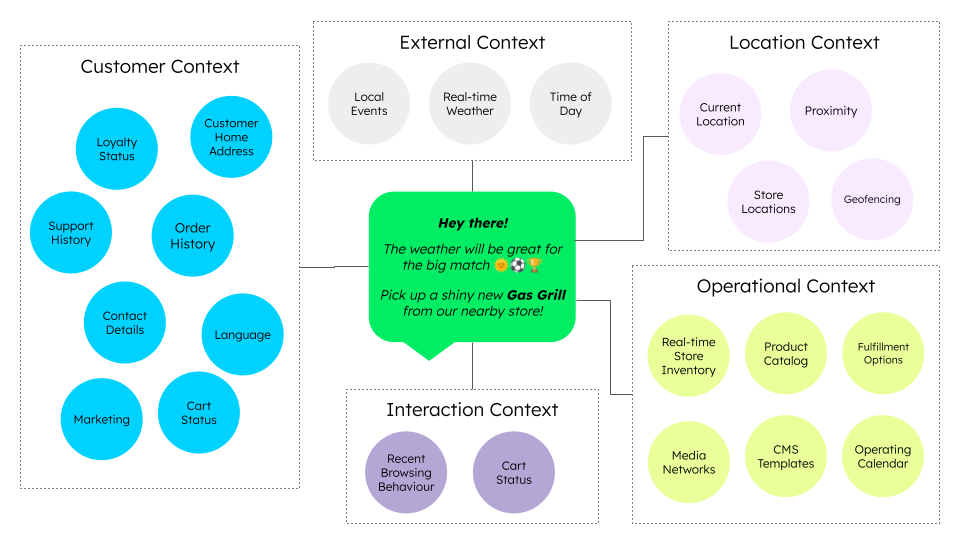
In most enterprises, those signals live in different internal and external systems, move at different speeds, and are owned by different teams. Legacy, batch-oriented estates make execution even more difficult because they were not designed for sub-second contextual decisions across digital and physical channels.
The technical goal for retailers is to make data operational quickly enough to act in the moment, which is why delivering a real-time contextual experience is fundamentally a data architecture challenge.
Building the foundation for contextual solutions
A practical reference architecture for contextual merchandising will typically include:
A unified operational data layer for customer, inventory, product, and store data.
Ingestion of mobile location signals and external feeds such as weather and events.
Geospatial store and zone geofencing models that can determine proximity, entry, exit, and in-store context.
Event-driven workflows and database triggers that drive actions in real time.
Real-time analytics and feedback loops.
Figure 2. High-level reference architecture for contextual merchandising.
.png)
MongoDB’s document model gives retailers the flexibility to bring together operational data that is naturally varied in structure, including customer profiles, inventory records, store metadata, contextual signals, and event payloads.
Geofencing is the ability to detect when a customer or device enters, leaves, or is near a real-world location. It is supported by MongoDB through GeoJSON-based modeling and geospatial queries. Geofencing tactics include defining center coordinates with a set radius for broad proximity, or an irregularly shaped polygon with multiple coordinates for defined zones. MongoDB’s native proximity, boundary, and near-location logic operators, such as $geoWithin, $geoIntersects, $near, and $nearSphere, allow engineers to quickly deliver effective geo-centric experiences.
For event-driven execution, Atlas Triggers support workflows that respond to live data changes rather than waiting for a batch campaign cycle. When the appropriate conditions are met, retailers can meet the customer in the exact moment with a timely, useful app notification.
Navigating the experience economy
Market-leading retailers have a desire to compete on more than assortment, price, and convenience. They are competing on timing, relevance, and the quality of the moment they create.
Contextual merchandising moves the conversation from static personalization to real-time contextualization, combining who the customer is with where they are, what is happening around them, and what the business can deliver right now. “Moments over merchandise” frames the commercial imperative well, but delivering on it requires a modern technical foundation.
MongoDB helps retailers build that foundation by bringing together a flexible operational data layer, geospatial intelligence, and event-driven execution in one platform. The result is a simpler path to creating localized, inventory-aware, context-sensitive experiences delivered directly to the consumer in a helpful way.
That is where the real opportunity sits: not just personalizing retail, but making it meaningfully contextual.
Next Steps
Ready to turn customer moments into real-time retail experiences? Explore how MongoDB helps retailers unify customer, product, inventory, and location data to build AI-ready, context-aware applications that can personalize engagement when it matters most.
References:
- Capgemini (2026), Top retail trends 2026 - Capgemini