In 35 years in this business, I have never seen so many industries move at once. Banks, automotive, insurance, and manufacturing—all betting, as one customer put it to me, on the whole racetrack.
The outlook is more sobering in practice. Gartner expects 40% of agentic AI projects to be canceled by 2027.* Deloitte finds just 11% of enterprises running agentic systems in production, meaning 89% are still stuck short of it.* Earlier this year, I watched a smart team realize, mid-meeting, that their proof of concept utilizing an elaborate architecture of 14 components from different vendors could not be turned into a business deployment. The room went quiet.
Moments like that one are why we publish Database Digest.
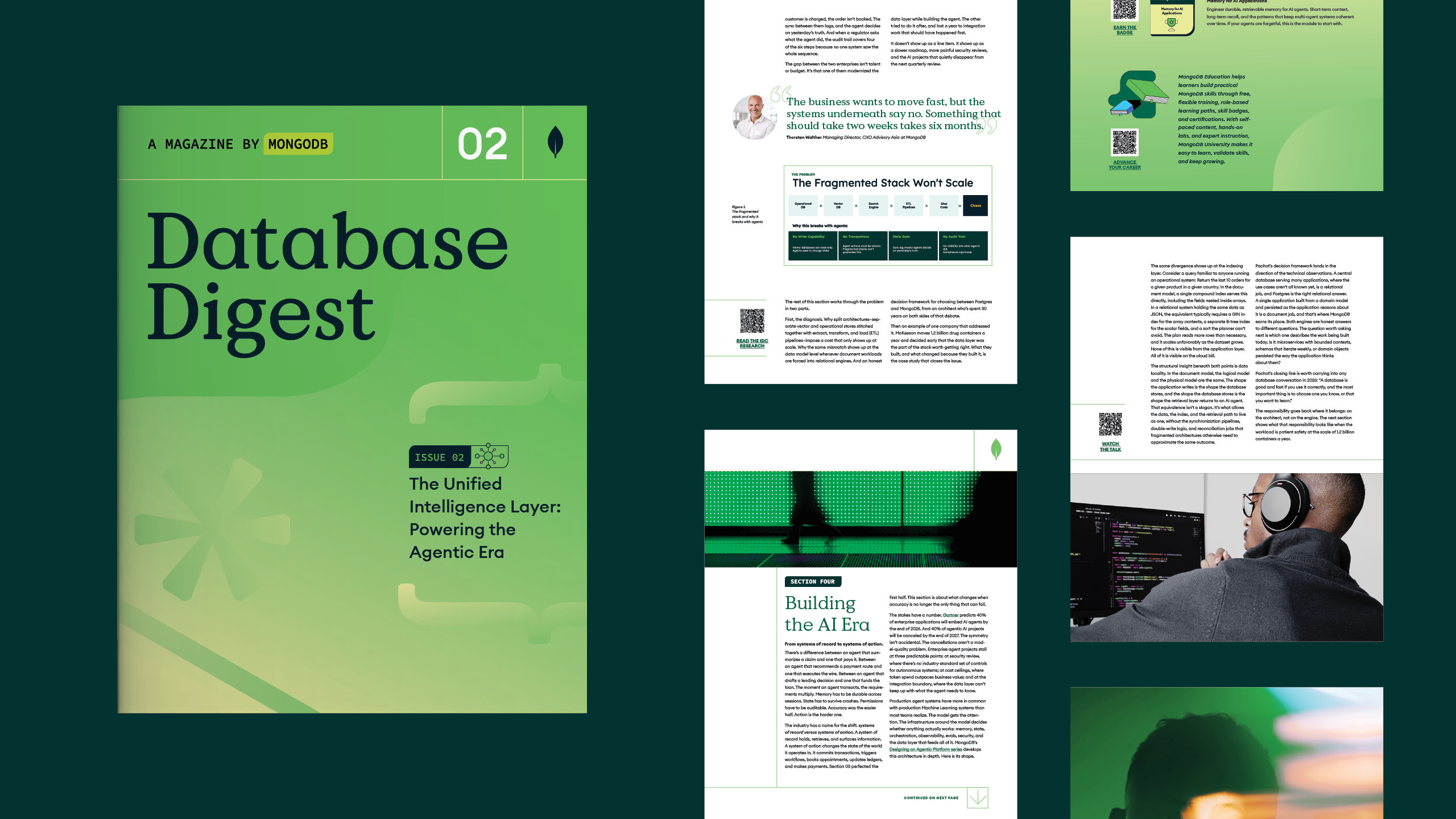
Database Digest is MongoDB's magazine on the role of data in modern applications. Really, it’s a field report, written by people who spend their weeks in those rooms. The first issue argued that the right data foundation changes what companies can build. This second issue applies that argument to the agentic era, and to the layer that determines whether agents ever make it out of the demo.
When AI outruns the stack
The reason projects stall, almost without exception, isn't the model. As MongoDB's President and CEO, CJ Desai put it at MongoDB.local London: “The hardest part of running agents in production isn't the model. It's the data layer underneath it.”
New research from IDC, looking at 1,400 organizations across Asia-Pacific, quantifies this. Forty-three percent say their existing architecture is a major obstacle to building new applications without extensive modernization, and organizations that fail to address that technical debt face a 50% higher AI failure rate by 2027.
We have a name for that cumulative weight: architectural drag. It's what happens when a stack assembled to retrieve information is suddenly asked to let an agent read, decide, write, transact, and remember—all at once.
The unified intelligence layer
The antidote to fragmentation and sprawl is consolidation and simplification. This issue is built around a single architectural pattern we call a converged datastore for agentic AI: The entities a business operates on, the embeddings its agents reason over, and the state those agents accumulate, in one place—under one API, one query language, and one security model. Operational data, vector search, full-text search, embeddings, agent memory, and stream processing stop being six integration problems and become one unified platform.
This issue shows what’s generating real returns across four industries—manufacturing, retail, financial services, and automotive—and the thread through all of them is the same. Consolidation generates returns in places that look unrelated until you look at the architecture diagram. A weld line predicting its own maintenance. A retail storefront and a support agent are grounded in one source of truth. A financial-crime platform reasoning over structured and unstructured signals in the same query. An automotive technician matches a corroded connector to a fault tree. Different vocabularies. Same foundation underneath.
Accuracy at scale
A unified layer is only as good as the retrievals it serves. Most hallucinations aren't a model problem. They're a retrieval problem—the answer that fed the prompt was stale, incomplete, or out of sync with the operational truth. Accuracy at scale is the discipline of closing that gap: Keeping operational data, embeddings, search indexes, and agent state consistent automatically, rather than reconciled after the fact. When those things live in the same record on the same query path, there's no synchronization step for accuracy to leak through.
The building blocks shipped at the last two MongoDB.local events. The Voyage 4 series raised the retrieval-accuracy ceiling, and MongoDB 8.3 went generally available with up to 45% more reads and 35% more writes over MongoDB 8.0.
LG U+, the leading Korean telecom, shows what this looks like under real load. Their Agent Assist tool runs on MongoDB Atlas across a call center handling 3.5 million calls a month, with processing time per call down 7% and resource efficiency up 30%. The trust gap is designed into the architecture rather than managed as a process.
Building the AI era
There's a fundamental difference between an agent that summarizes a claim for validation through a physical person and one that pays the claim directly. The moment an agent transacts, the requirements multiply: Durable memory, state that survives crashes, and permissions that are auditable. Our industry calls this the shift from systems of record to systems of action.
McKesson's work with MongoDB shows what that shift demands. Facing the U.S. Drug Supply Chain Security Act, McKesson—the largest drug distributor in the United States—had to trace more than 1.2 billion containers a year, authenticating each one back to the manufacturer. It retired a monolithic legacy stack, ran on a unified data platform, and scaled operations 300x. The principal architect's description of go-live is the line I keep coming back to: “There was no blip on the map.” They modernized for compliance, and the foundation they built is the same one they now use to explore generative AI. The architectural choice that made compliance achievable is the one that makes the next workload achievable at all.
The reward for getting it right: non-deterministic models turned into predictable, trustworthy digital assets.
What will outlast the agent?
Models will be replaced. Frameworks will be renamed. Protocols will mature. The winning architectures will be the ones that absorb all of that change without asking the business to start again. One CTO told me his project was obsolete the day it went live. “But the data was MongoDB,” he said. “That is my foundation. I can replace the LLM anytime. The data is mine.”
Next Steps
The full issue of Database Digest is available now. Read it online or download your copy.
That, in the end, is why the data layer is the decision worth getting right. The agentic era won't be powered by agents alone. It will be powered by the data layer that makes them safe to trust.
References
* Gartner, Gartner Predicts Over 40% of Agentic AI Projects Will Be Canceled by End of 2027 (June 25, 2025). https://www.gartner.com/en/newsroom/press-releases/2025-06-25-gartner-predicts-over-40-percent-of-agentic-ai-projects-will-be-canceled-by-end-of-2027
** Deloitte, Agentic AI Strategy, Tech Trends 2026. https://www.deloitte.com/us/en/insights/topics/technology-management/tech-trends/2026/agentic-ai-strategy.html