Retail supply chains are not a back-office logistics function; they are a high-stakes, board-level concern. Imagine learning suddenly that shipment rerouting surcharges have doubled due to new regional escalations; the impact on competitive differentiation and consumer trust is immediate. As a result, a long-standing focus on linear efficiency and lean inventory is being disrupted by a mandate for resilience and AI-driven responsiveness. To survive, retailers must move beyond the rigidity of legacy systems and embrace an AI-ready data platform that can pivot as fast as headlines change.
Indeed, a 2026 study by KPMG reported that businesses are establishing new performance metrics, centered around post-disruption recovery time, supplier diversification, sourcing agility, revenue growth from improved experiences, cost savings, and employee engagement.
Now, retailers are modernizing their supplier management capabilities. An effective supplier management application that boosts visibility, builds resilience, and delivers material business benefits must be underpinned by unified supplier data and AI copilots. To unlock these next-generation capabilities, retail leaders use MongoDB as a unified data foundation, enabling the high-velocity intelligence and material results required in today’s volatile landscape.
However, the business agility of many organizations remains restricted by their enterprise resource planning (ERP) systems, which were designed for an era when stability was assumed, laborious data access was the norm, and delays due to batch processing were acceptable. These legacy foundations have become an operational bottleneck and a strategic threat that prevents real-time responsiveness to external shocks.
The speed of supply chain decision-making is hard-capped by the difficulty of getting fast, accurate answers from supplier information buried in legacy systems, PDFs, spreadsheets, and email chains. These systems fail because they are not able to force incompatible data profiles into a one-size-fits-all table structure. Any multi-modal data, such as images and PDFs, is not queryable. By the time a supplier manager has gathered the data required to make a decision, hours, if not days, have passed.
Benefits of supplier management modernization
The opportunity for retailers that move decisively to modernize is measured in both profitability and market share. IDC predicts that 70% of large retailers will invest in data modernization to unlock better insights and resilience by 2027.
To achieve true resilience, retailers must decouple supplier management from the ERP core and deliver a high-impact capability for the business. MongoDB facilitates low-latency data access, geospatial data, and multi-modal AI-assisted discovery that can deliver a world-class supplier management capability. By creating a dedicated application with MongoDB as its consolidated operational data layer, retailers gain the flexibility to handle modern complexities without the legacy overhead.
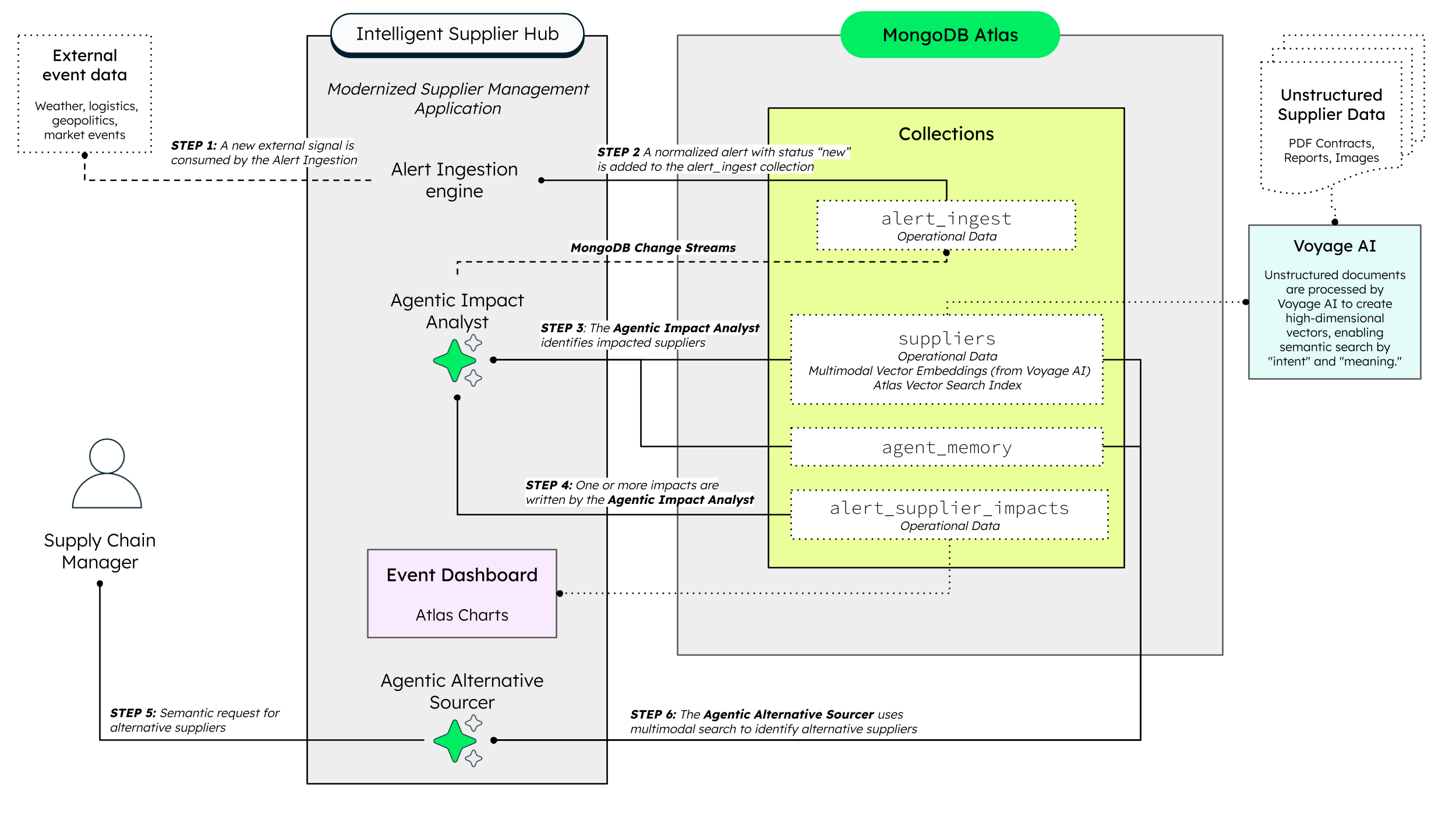
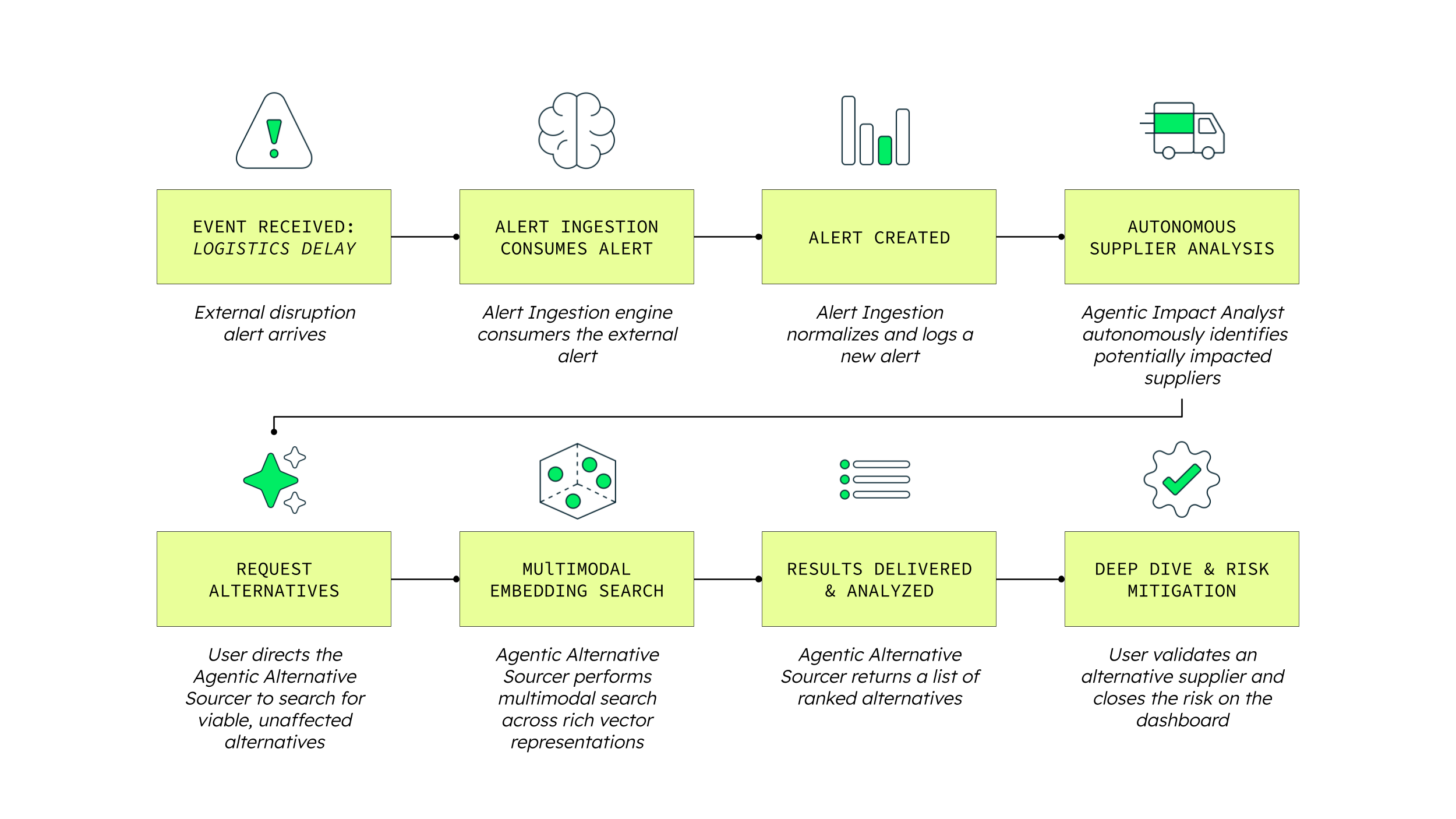
Imagine a geopolitical escalation has triggered a 50% tariff on aluminium imports from South Korea from midnight tonight. The external event propagates its way into your modernized system, triggering a real-time identification of your impacted suppliers. The business assesses this impact and decides whether to seek alternatives. Instead of typing in a specific supplier attribute, they describe the need: "Alternative dairy partner in a tariff-neutral zone." The system scans thousands of supplier profiles and digitized contracts stored as high-dimensional vectors. Within seconds, it identifies a mid-sized supplier that hasn't been used in two years. The business delves deeper into the supplier details and decides they are a suitable alternative. The risk has been mitigated; the disruption avoided. Breaking free from the pitfalls inherent within legacy systems has ensured the business remains operationally agile in the face of external change.
Figure 1. An Agentic Supplier Management solution, with multi-modal search, powered by MongoDB.
Operational flexibility for supplier attributes
Suppliers are complex entities with varied and evolving attributes. A textile supplier in Vietnam will have very specific data requirements when compared with a packaging partner in Poland. New requirements will emerge over time, like the need to track a custom "Tariff Exposure Rating" or "Sustainability Score" for 500 suppliers in a specific region. Business users will expect a modern application to add those fields instantly to the relevant supplier profiles without taking the system offline or rewriting the schema.
MongoDB’s flexible data model allows different supplier data attributes to be stored inside a single collection of suppliers. This polymorphic capability allows data to evolve at the same pace as global trade policy, without impacting core operations.
Sourcing agility with semantic discovery
When a primary supplier is sidelined by a localized lockdown or a shipping bottleneck, the clock starts ticking. Traditionally, finding an alternative meant a manual, frantic search through spreadsheets. In a modern system, business users will expect semantic search capabilities, low-latency experiences, and intelligent, AI-powered assistance.
MongoDB provides multi-modal intelligence with Voyage AI, a specialized retrieval layer for AI applications that provides API-based embedding models and re-rankers. It enables unstructured data like documents and images to be defined as high-dimensional vectors, all stored right beside standard operational data in the same MongoDB platform.
When a supplier in a disrupted region fails, MongoDB Vector Search can instantly identify alternative suppliers across your global network who have the most similar attributes. Think product attributes, lead times, and sustainability credentials. Because semantic search is based on mathematical "closeness" rather than exact keyword matches, it can surface a high-potential partner in a different region that your team might have otherwise overlooked. This transforms searching from a reactive, manual scramble into a proactive, intelligent capability
Real-time, low-latency visibility
In 2026, visibility is no longer a luxury; it is the heartbeat of operational survival. Most retailers are paralyzed by disconnected systems that trap critical data points in isolated silos, leaving decision-makers to act on data that is difficult to access or out-of-date. In a disruption scenario, this disconnect is fatal. Unifying supply chain data into a single, coherent layer is the only way to ensure that customer promises are grounded in current reality.
Through MongoDB Change Streams, the data platform acts as a high-speed nervous system, propagating updates from legacy cores to a modernized supplier application with near-zero latency. Because MongoDB does not require a rigid, pre-defined structure for every incoming piece of data, you can instantly ingest a flow of data directly into your supplier profiles.
This immediacy fundamentally changes the dynamic of an impending crisis: instead of managing the aftermath of an external issue over an extended period, the business can address the impact in minutes. Decision-making shifts from reactive guesswork to high-confidence execution, allowing businesses to reroute shipments or trigger alternative sourcing before the disruption reaches the bottom line.
The foundation of resilience
By leveraging MongoDB’s AI-ready data platform to modernize supplier management, retailers will achieve business outcomes that were previously impossible. When supply chain disruption inevitably occurs, the business can be empowered with AI-driven impact assessment, semantic discovery of alternative supplier options, and multi-modal data access, combining to mitigate risk and maintain consumer confidence.
Figure 2. An AI-driven Supplier Management workflow with MongoDB.
Market data from Congruence shows that 72% of leading retailers are investing in AI-integrated platforms, including supply chain. While the 2026 macroenvironment generates supply chain issues that result in manual struggles and customer frustration, competitors will use MongoDB to treat their supplier management agility as a dynamic engine for resilience and value.
Our recommendation is simple: start your migration to a flexible, AI-ready data platform now, or prepare to be outmaneuvered by competitors that are already moving on.
Next Steps
To learn more about MongoDB’s solutions within the Retail industry, please check out the MongoDB for Retail Innovation section of our website.
Explore our extensive library of Retail articles, tutorials, analyst reports, white papers, and more here.
Learn more about AI use cases for top industries in our whitepaper: Enhancing Retail Operations with AI and Vector Search: The Business Case for Adoption.
References
KPMG (2026), Key trends impacting supply chains in 2026
IDC (2025), IDC FutureScape: Worldwide Retail 2026 Predictions
Congruence Market Insights (2025), Next-Gen Retail Technology Market Report: Growth Drivers, Market Dynamics & Future Potential (2026–2033)