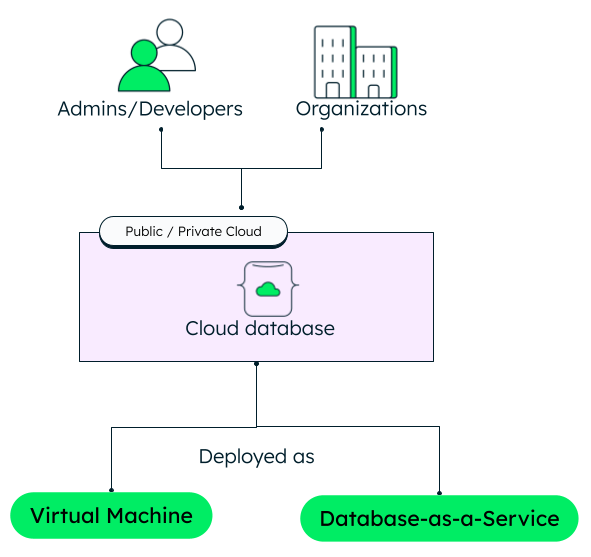
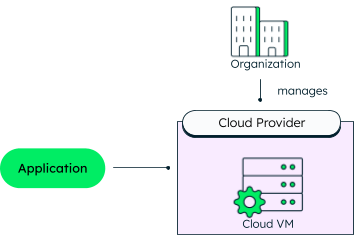
Private cloud: Unlike a public cloud environment, private clouds are considered single tenant, meaning only one organization has access to the cloud. This is often the choice of large organizations with sensitive data and larger budgets. With that said, a private cloud environment can support the same types of cloud databases as those supported via the public cloud (e.g., NoSQL database, SQL database, in-memory database) — these cloud services are simply tailored to the specific needs of the organization owning the private cloud. However, unlike in a public cloud, in a private cloud, software maintenance, scaling, data security, database management tasks, and backups fall on the user group's organization rather than a cloud vendor, requiring additional labor and skill sets.
Hybrid cloud: A hybrid cloud combines on-premises resources, third-party cloud provider services, and possibly private cloud access as well. With a hybrid cloud environment, there is a greater level of access management required due to the variety of disparate data assets in play. However, this type of cloud offers the ability to utilize existing on-premises resources while migrating databases to the cloud or to enhance the functionality and mobile access to existing data warehouses. As with both public and private clouds, virtually any type of database can be used, with database services and the database management system being agreed upon between the organization and cloud providers.
Multi-cloud: It is also possible to deploy databases across multiple clouds (e.g., more than one public cloud or more than one private cloud). This option allows organizations to avoid being locked into one cloud services provider, can increase data security through redundancy, and can help meet unique operational requirements an organization may have. And, as with other cloud types, virtually any type of database can be deployed.