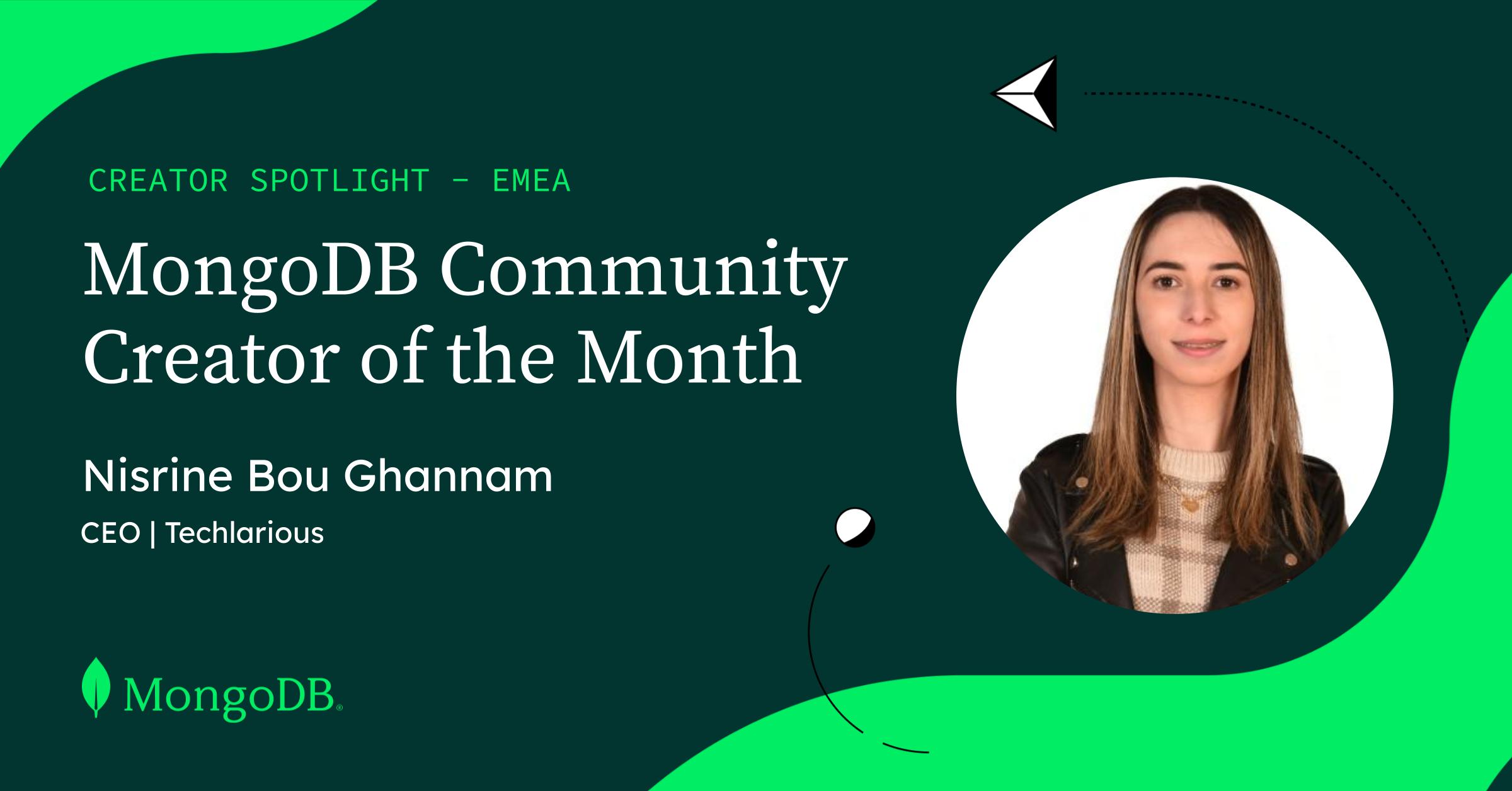
Introducing @Nisrine_bg, our MongoDB Creator of the Month !! She is the CEO of Techlarious and a passionate educator who has made MongoDB concepts accessible to developers throughout Lebanon.
We did a Q&A with Nisrine about their journey, so keep reading to learn more about her👇
Why did you start creating and sharing technical content?
I started creating and sharing technical content because I’ve always believed that knowledge grows when it’s shared. As an Educator Enabler, my goal has always been to empower teachers, students, and professionals to integrate technology and innovation into their work. Working in tech and education, I noticed how many people, especially students, tech enthusiasts, and women in STEM, struggle to find clear, practical guidance when starting out. That inspired me to create content that breaks complex topics into something accessible, real, and inspiring, always backed by real examples and scenarios from my own work and experiences. I’ve found that when people can relate to real-world situations, they learn faster and feel more confident applying what they’ve learned.
Take us behind the scenes of your creative workflow
My content creation workflow starts by focusing on topics tech enthusiasts want to learn, gaps in the tech market, universities, and the challenges tech learners face. I brainstorm ideas, outline key points, and turn them into engaging, story-based posts. I also conduct hands-on workshops, tech talks, and events to help learners apply the content in real projects and scenarios. For planning and creation, I use Canva for visuals, Notion for organizing ideas, and Draw.io for sketching. My tip for creators: start small, stay consistent, and focus on adding real value, addressing real challenges, and providing practical examples. These are the things that make the biggest impact.
What is your favorite content that you’ve created so far?
One of my favorite pieces of content I’ve shared so far is my tech talk “Modern Data Thinking: Why the Next Decade Belongs to MongoDB”, which I presented at Google DevFest 2025 in Lebanon.This session was unique because it simplified complex database concepts by comparing how schemas, relationships, and APIs are structured in SQL vs. NoSQL. I walked the audience through embedding relationships instead of nesting queries, demonstrated migrating from SQL to NoSQL using MongoDB Relational Migrator, and showed how to sketch efficient data models while reducing data fat, merging tables with similar attributes into a single BSON file for optimized performance. I also highlighted how MongoDB is more than just a database, it’s an entire ecosystem for building scalable, modern applications.The talk received great feedback because it bridged the gap between theory and real-world use, helping developers understand not only how to use MongoDB but why it matters for the future of data-driven applications. Personally, it was a rewarding experience that deepened my passion for turning technical topics into relatable, practical learning moments.
If you could share one piece of advice to someone who wanted to start creating technical content, what would that be?
If I could share one piece of advice for someone starting to share technical content, it would be to focus on solving real problems and filling knowledge gaps. When I began exploring MongoDB, I noticed that many universities in Lebanon still focus heavily on SQL databases, teaching nested, relational structures, and leaving little room for NoSQL technologies. That’s what pushed me to start introducing MongoDB in universities through university workshops and orientation sessions, where I compared MongoDB with traditional databases and showcased its features, highlighting that MongoDB is not just a database, but an ecosystem for building modern, scalable applications, including capabilities for flexible data modeling, performance optimization, and integrating with APIs. Through these sessions, I also encouraged students to sketch real data models, reduce data redundancy, and apply their learning in practical projects, helping them see how MongoDB can solve real-world problems and bridge gaps left by traditional database education.
Where can developers connect with or learn more about you?
Want to catch Nisrine at an upcoming event or connect with her? Reach her via LinkedIn or GitHub.
Thank you very much, Nisrine, for sharing your story with us today and for all the incredible content you’ve created about MongoDB. We can’t wait to see the next content you publish.
