Hello folks, happy to join the #100DaysofCode inspired by @henna.s 

In this amazing journey, I’ll be sharing with you my daily progress learning Golang (moving from Node JS, Python). Starting from a hello world program at day-01 till finishing the adventure at day-100 with a complete API integrated with MongoDB. 

Day 01
What is Golang? 
Golang, an open-source, compiled, and statically typed programming language designed by Google. Built to be simple, high-performing, readable, efficient, and concurrent nature. Used for server-side programming, game development, cloud-based programming, command line tools and more.
Why Golang? 
- Simple and easy to understand by design
- Built in dependency management (package registry)
- First class concurrency primitives
- Type safety enforced by the compiler
- Compiles to machine code for high speed
- Garbage collected (Memory Safe)
Hello World in Golang
- 1st : Open your Golang new project and run the following command
  go mod init yourModuleName or go mod init example.com/moduleName
  Example: go mod init hello
The above command creates a go.mod file to track your code’s dependencies. So far, the file includes only the name of your module and the Go version your code supports. But as you add dependencies, the go. mod file will list the versions your code depends on.
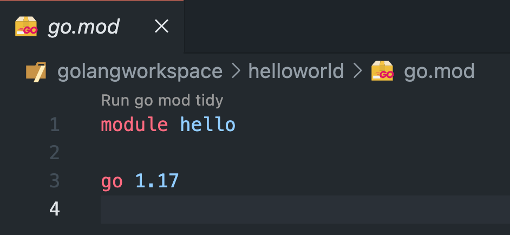
- 2nd: Create a main.go file
package main

import "fmt"

func main() {
	fmt.Println("Hello folks, Happy to Join the 100daysofcode!")
}
Let’s quickly analyze our simple first hello world go program 

-
package main: tells the Go compiler that the package should compile as an executable program instead of a shared library. The main function in the package “main” will be the entry point of our executable program -
import “fmt”: here we are importing the fmt package, that allows us to format basic strings, values, or anything and print them or collect user input from the console or write into a file using a writer or even print customized fancy error messages. -
Finally we are defining our main function using the func keyword, that print for us a normal String using the
fmt.Printlnfunction.
And now let’s run our main.go file using the following command to see the function result on the console 
go run main.go

That was everything for our Day-01 Hello world in Golang. Stay tuned in the coming days for some amazing and advanced topics, going from zero To hero in GO
 and happy that I played a part in inspiring you.




 use brackets around the condition itself
 , so we need to write a full if else statement to achieve the same result.
 Does it exist in Golang? And how can we replace it


 .
.
 compose types to build multi-dimensional data structures.
 and then we will discover the

 / 100 . GOLANG is going very smoothly till now


 , hope you are enjoying the journey and learning some amazing things in Golang.
  to share what I learned to this amazing:heart_eyes: community. So everything stays from the community to the community.
 we will talk about recursion, how we can create recursive functions❓ and deal with them, then we will move to discover
  in Golang.
 problem where the solution
  themselves from within their own code.

 when the problem to be solved have many possible branches and these branches are too complex to iterate through them
 a new amazing
  concept in Golang.
 type that allows to group/combine items of possibly different types into a single type.
  entity which has some set of specific properties/fields
 with them and the difference between them and functions.


 , for example if we have a Rectangle ▭ and a Square
  struct. We can simply define an Area method on both of them.

 example that illustrate the targeted topics in a clear way
 variable that stores the address of a certain object stored in the memory.
 format.
  variables.
 a variable by reference to a function or a method.
  out an
  unsafe
  operations like updating or manipulating a value.
 Pass by value
  , while passing a variable by reference, this means that we are passing the address
  of the original variable and any operation will affect the original data stored in the variable.
 operator in Golang ?
 more with pointers to explore how we can use them with structs and methods, and how they give us some extra power
  , when utilizing them correctly. In this post we will move from the theoretical definitions and explanations and get into an interactive
  example that shows us how we can add pointers to structs and methods.

 . They are the God grace and the life gift
  . 𝟯 years passed during which I learned a lot in this wonderful major.
 . Together as best friends
  to craft a future we deserve.
 . And today I’m asking God to keep you by my side until infinity. ∞∞
 information and wrapping up with an example that shows us how we can use interfaces in a real example.

 . Let’s finish it successfully by taking some new information, to extend our existing knowledge in the Golang world.
  and share with you some interesting information in String functions, that help us manipulate and deal with strings easily.


