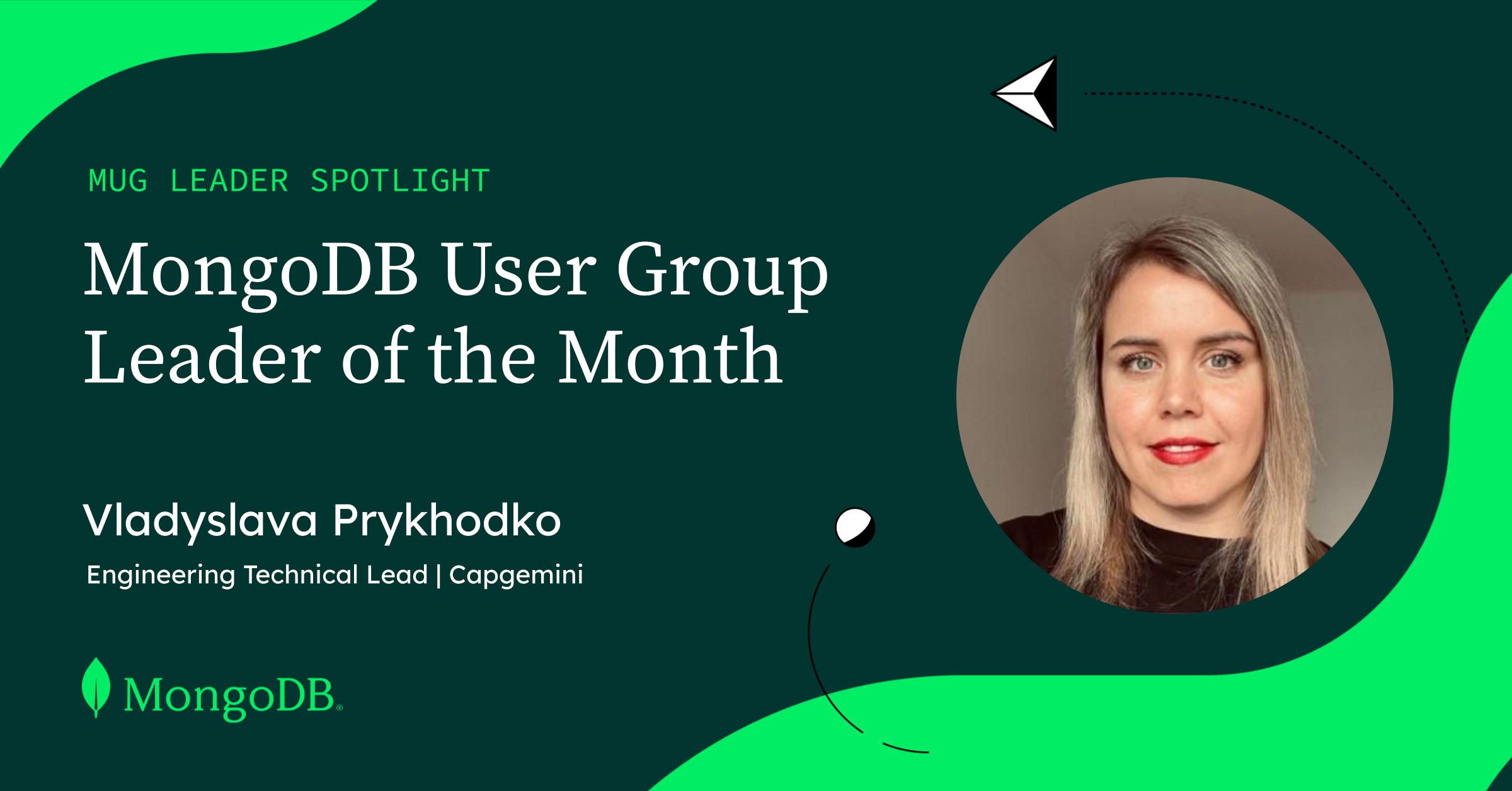
We’re thrilled to recognize @Vladyslava_Prykhodko from Lisbon, Portugal, as our MongoDB User Group Leader of the Month.
Vladyslava is an Engineering Technical Lead at Capgemini with over a decade of experience building and scaling modern platforms and distributed systems. She is also passionate about sharing knowledge and bringing developers together through the MongoDB User Group Lisbon, where she has organized events, supported community collaborations, and spoken on topics such as microservices, MongoDB Change Streams, distributed data, and event-driven architecture. Her technical expertise and dedication to helping others learn make her an incredible part of the MongoDB Community.
As part of this recognition, we asked Vladyslava a few questions about her journey. Keep reading to learn more about her story and the impact she is making 
Tell us about your journey as a MongoDB User Group leader
I didn’t set out to lead a community. I set out to find one. When I moved to Lisbon, I was building distributed systems with MongoDB at scale and wanted to connect with engineers facing similar challenges. I joined MUG Lisbon as an attendee first, and quickly realised I had knowledge worth sharing. The local community was just beginning, so I stepped in to help lead it. In one year, MUG Lisbon grew to five meetups, partnering with AWS and GDG User Groups and hosting events at companies like Sky, Devoteam, Cloudflare, and Banco BPI. Building trust and consistency from scratch, showing up every time, shaped everything.
What has been your most rewarding moment as a MUG leader?
My most rewarding moment came when I stepped outside our own community. As MUG Lisbon leader, I was invited to speak at JUG Lisbon, presenting “Building a Microservices Infrastructure with MongoDB” to a Java-focused audience. Drawing on my experience as a Tech Lead responsible for application architecture across 150+ microservices, I wanted to show what MongoDB enables at scale in ways that matter to architects and engineers. The response exceeded expectations: several developers joined MUG Lisbon and became regular members. One architect told me he would now seriously consider MongoDB as a primary database based on the features demonstrated. That’s the impact I aim for: changing how people think, not just what they know.
Do you have any tips for developers looking to build a community?
Start before you feel ready: waiting for the “right moment” is how communities never start. Find one co-organiser you trust completely; solo leadership burns out fast. Be honest about what you don’t know: engineers respect authenticity more than authority. Don’t optimise for attendance numbers early, optimise for conversation quality. One real technical discussion between five people is worth more than a packed room of passive listeners. Partner with adjacent communities: your audiences overlap more than you think, and collaboration multiplies reach without multiplying effort. And always follow up with speakers after the event. Relationships outlast any single meetup.
What’s your favorite thing about being part of the MongoDB Community?
The depth. MongoDB engineers and community members talk about real production problems, actual trade-offs: when to normalise, when not to, how geo-sharding behaves under pressure, what actually breaks at scale. The community rewards people who go deep, ask hard questions, and share honest lessons from production. As someone who works daily with geo-distributed clusters and complex schema design, finding engineers who want to engage with the same problems at that level makes this community genuinely valuable. It’s not just about the technology, it’s about the quality of thinking that surrounds it. That’s what keeps me coming back.
Where can developers connect with or learn more about you?
They can find me on either LinkedIn, GitHub, or on my blog (archtenet.dev).
Thank you very much, Vladyslava, for sharing your story with us today and for all the incredible work you’ve done for the MongoDB Community. We can’t wait to see what you achieve next.
