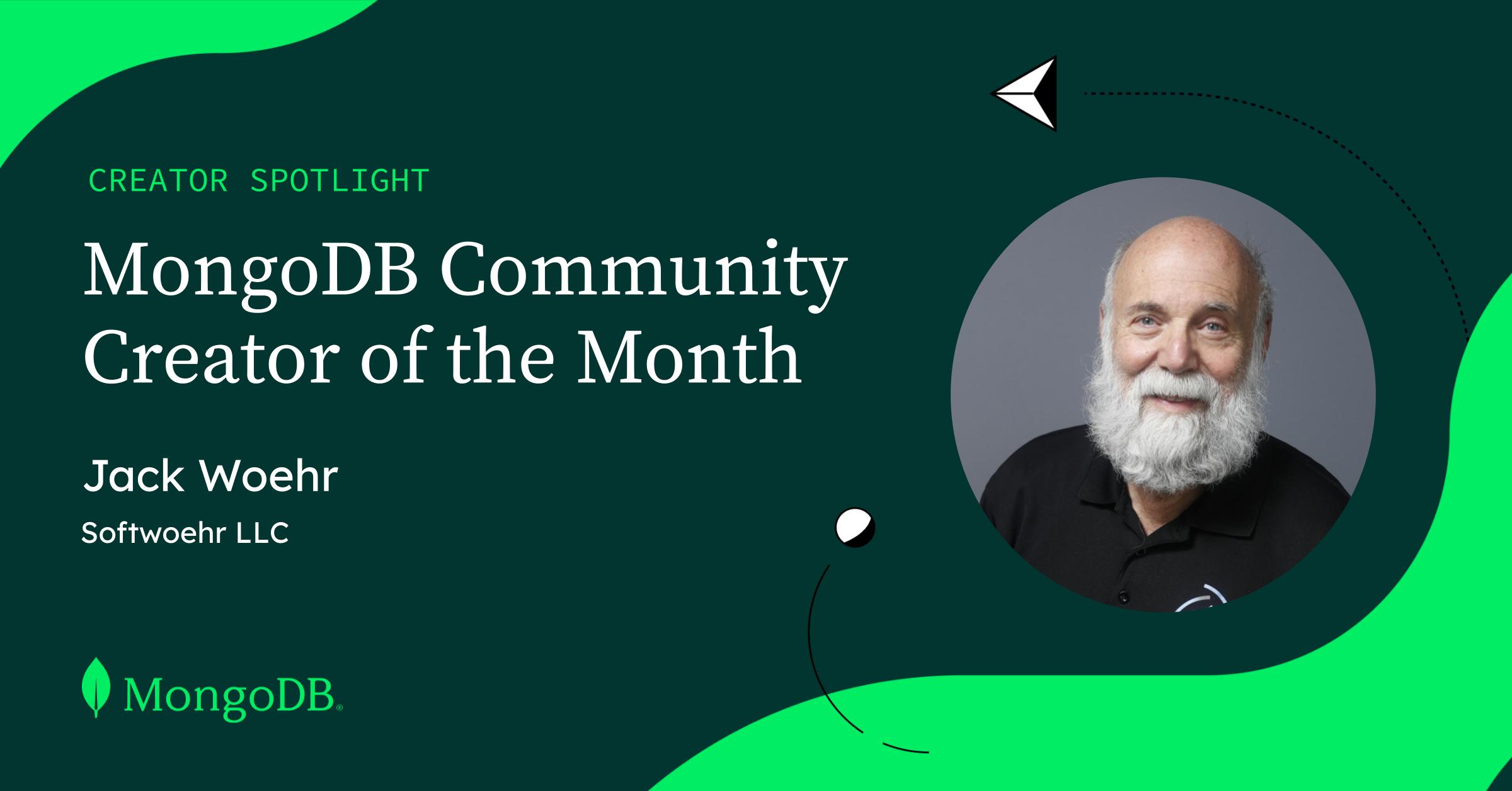
Introducing @Jack_Woehr , our MongoDB Creator of the Month! He currently leads Softwoehr LLC and is an Independent Consultant in enterprise AI Modernization and Quantum Computing. Jack is a passionate educator with over 40+ years of experience in programming, and he has made MongoDB concepts accessible to developers through his content, like MongoDB and PHP: Creating Your Own Framework and Ep. 199 MongoDB Community Creator Spotlight - Jack Woehr.
Inspired by his work, we asked Jack some questions, and he was kind enough to share insights, tips, and recommendations. His answers are very insightful, so keep reading to learn more about him👇
Why did you start creating and sharing technical content?
I’m going to focus first on the code itself before discussing writing about code.
I’ve been an open source author and contributor since the 1980’s. It is primarily due to sharing that the world experienced the rapid cyber technological progress of the past 50 years.
Take us behind the scenes of your creative workflow.
Technical content creation is a guided tour of real code and real ideas, so again, here, I’m going to talk about code first. Here’s what I recommend:
-
Start with an idea, typically a need of your own.
-
Remember that you’re not building a product, you’re satisfying a personal whim, scratching an itch, solving your own problem first.
-
Start at the bottom and work your way up. Create the building blocks first. Play with them. Test them. Make solid, then build upwards.
-
Don’t hide. Share from the start (use a good open source license, of course) for good tips, feedback, and time-saving suggestions.
What tools do you use?
Since 2025, I’ve been developing with agentic tasking code assistance. My favorite is Roo Code, which I use as a VS Code extension with Claude or Gemini.
I still use NetBeans for Java and PHP project maintenance (I’m a heavy professional user of PHP). I typically have both NetBeans and VSCode+Roo open on my PHP projects.
I also use Vim and jEdit for specific editing tasks. Vim is great for quickly editing code directly on a server when tracking down a nasty bug, while jEdit really shines for tricky search-and-replace work thanks to its regex and rectangular selection support, which are still better than VS Code.
What tips can you share with anyone reading this to improve their technical writing workflow?
I’d say try to order the structure of your writing using this format:
-
Tell what we’re going to learn today and why.
-
Tell how we’re going to teach it and what we’re going to show.
-
Teach it and show it.
-
A cut and paste example or a Jupyter notebook is gold.
-
Recap what we taught and how we showed it.
-
Recap what we learned today and why.
You should also follow this order of priority when writing: Ideas → Code → Tools → You. You see how “You” was the last thing on the order list? That’s because in my opinion, the only excuse for writing about yourself is if you can be amusing, and that means the reader thinks you’re amusing, not just you!
What is your favorite content that you’ve created so far?
I wrote a book in 1992 called Forth: The New Model, about American National Standard Forth. I still get asked about that by members of the (tiny) community of Forth language programmers.
For 20 years, I was a Contributing Editor to Dr. Dobb’s Journal, then America’s most popular programming magazine. All the technical material and discussions with individuals at the top of their field (including 2 Nobel laureates and several immortals of our profession) totally shaped my practice.
I enjoy writing about MongoDB. I’ve coded a MongoDB agent based on the MongoDB MCP server and will write about that soon.
If you could share one piece of advice to someone who wanted to start creating technical content, what would that be?
We learn by teaching. We’re forced to re-examine our assumptions and our preferences when we present before others. You generally get at least as much preparing for your reader/listener/viewer as they get from you. This is why I do conferences: it’s not the food, it’s the (sometimes painful) self-audit that repeatedly enriches my professional competence.
You’re an artist, grab hold of your passion and paint it on your audience’s screen!
Where can developers connect with or learn more about you?
Want to catch Jack at an upcoming event or connect with them? Reach him via LinkedIn, Blog, or GitHub.
Thank you very much, Jack, for sharing your story with us today and for all the incredible content you’ve created about MongoDB. We can’t wait to see the next content you publish.
