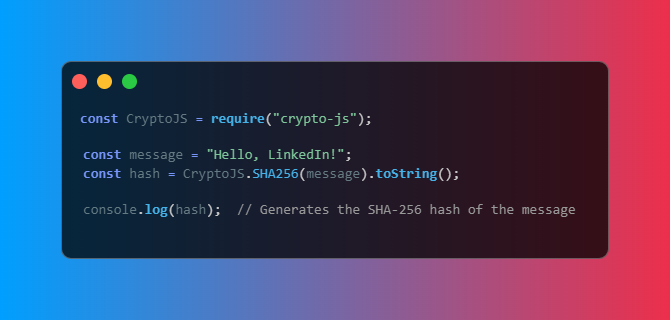
Day 7 of #100DaysOfCode: Deep Dive into CryptoJS and SHA-256 Hashing
Today’s challenge led me to explore the CryptoJS library and its widely-used SHA-256 hashing function, a critical tool in modern web security.
 What is CryptoJS?
CryptoJS is a JavaScript library that provides simple yet powerful cryptographic algorithms, including encryption, decryption, and hashing. It’s widely used to secure web applications by protecting sensitive data like passwords, API tokens, and digital signatures.
Given the growing concerns over data breaches and privacy, understanding and implementing strong cryptographic techniques is essential for every developer.
 Why SHA-256?
SHA-256 is part of the SHA-2 (Secure Hash Algorithm 2) family, developed by the NSA. It’s one of the most commonly used hashing algorithms, trusted for its balance of speed and security. The function takes an input of any length and produces a unique, fixed-size 256-bit hash.
Hashing is a one-way function, meaning once data is hashed, it cannot be converted back to its original form, ensuring its integrity.
 Key Learning:
Even the smallest change in the input creates a completely different hash, making it nearly impossible to reverse-engineer or manipulate the data.
With CryptoJS, you can hash strings, secure data in transit, and ensure that your application’s sensitive information remains protected.
 Why It Matters:
Data security is non-negotiable. Whether it’s securing passwords or verifying data integrity, learning how to properly implement cryptographic techniques like SHA-256 can make your application significantly more robust.
 Use Case in CryptoJS: One of the easiest ways to hash a message in JavaScript is through the CryptoJS library. Here’s a quick example using SHA-256: